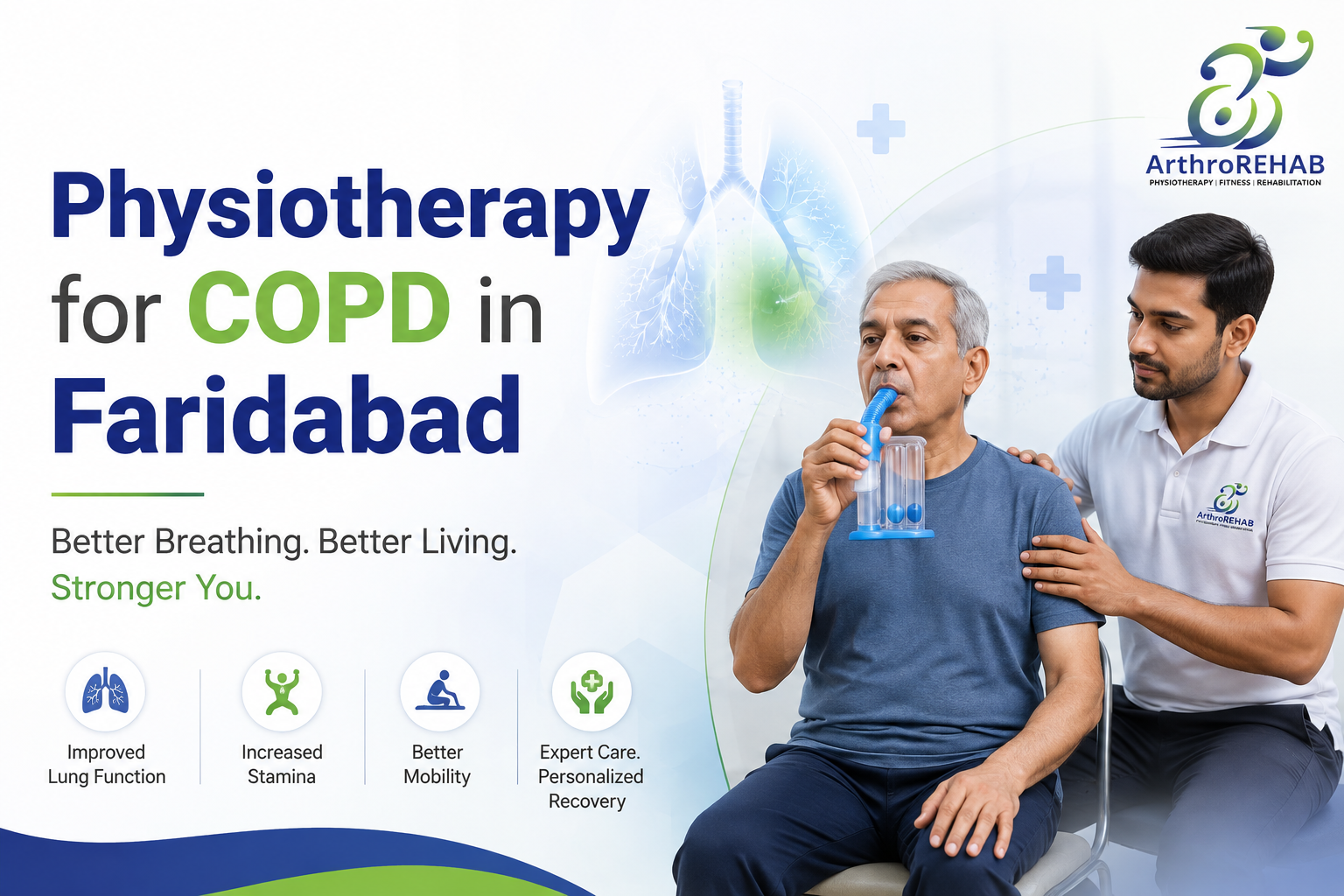
Living with Chronic Obstructive Pulmonary Disease (COPD) can make even simple daily activities such as walking, climbing stairs, getting dressed or performing household work feel exhausting. Breathlessness, reduced stamina and muscle weakness may gradually limit a person’s independence and quality of life.
While medical treatment plays an important role in managing COPD, physiotherapy for COPD in Faridabad can be an important part of a comprehensive rehabilitation programme. Through breathing exercises, supervised physical activity, endurance training, strengthening and lifestyle guidance, physiotherapy can help people with COPD become more confident in managing their daily activities.
For people searching for the best physiotherapy clinic in Faridabad for COPD rehabilitation, ArthroRehab provides personalised physiotherapy programmes designed according to an individual’s physical capacity, symptoms, functional limitations and rehabilitation goals.
The objective is not simply to perform exercises. COPD physiotherapy focuses on helping patients breathe more efficiently, improve physical conditioning and participate more comfortably in everyday life.
What Is COPD?
Chronic Obstructive Pulmonary Disease, commonly known as COPD, is a long-term respiratory condition in which airflow through the lungs becomes restricted.
COPD commonly includes conditions such as:
- Chronic bronchitis
- Emphysema
- Persistent airflow obstruction
- Long-term respiratory symptoms associated with reduced lung function
People living with COPD may experience symptoms such as:
- Shortness of breath
- Persistent cough
- Mucus or phlegm production
- Wheezing
- Chest tightness
- Reduced exercise tolerance
- Fatigue
- Difficulty walking longer distances
- Breathlessness while climbing stairs
- Weakness after prolonged inactivity
The severity of symptoms can differ significantly from one person to another.
Some people may experience breathlessness only during strenuous activity, while others may become breathless during normal daily tasks.
This is where an individually planned COPD physiotherapy and pulmonary rehabilitation programme can be helpful.
Why Is Physiotherapy Important for COPD?
Many people assume that COPD affects only the lungs. However, long-term respiratory disease can influence the entire body.
When breathing becomes difficult, people often reduce their physical activity. Over time, reduced movement may cause muscle weakness and loss of physical conditioning.
This may create a cycle:
Breathlessness → Reduced Activity → Muscle Weakness → Greater Effort During Activity → More Breathlessness
Physiotherapy attempts to break this cycle by gradually improving physical conditioning and teaching strategies that help patients manage breathlessness more effectively.
A structured programme for physiotherapy for COPD in Faridabad may include breathing retraining, mobility exercises, endurance activities and strengthening exercises depending on the patient’s overall condition.
The physiotherapist works within the patient’s tolerance and medical recommendations rather than simply asking the patient to exercise harder.
What Is Pulmonary Rehabilitation?
Pulmonary rehabilitation is a structured rehabilitation programme designed for people living with chronic respiratory diseases.
It may involve:
- Exercise training
- Breathing techniques
- Strengthening exercises
- Endurance training
- Patient education
- Energy conservation techniques
- Lifestyle guidance
- Strategies for managing breathlessness
Pulmonary rehabilitation is generally provided alongside medical management rather than as a replacement for treatment prescribed by a pulmonologist or physician.
Patients looking for pulmonary rehabilitation in Faridabad may benefit from a physiotherapy programme tailored to their respiratory condition, mobility level and functional goals.
At ArthroRehab, physiotherapy can be planned after assessing how the patient responds to movement, walking and day-to-day activities.
How Can Physiotherapy Help COPD Patients?
Physiotherapy can support COPD management in several ways.
1. Improve Breathing Efficiency
COPD can make breathing feel harder, particularly during activity.
A physiotherapist may teach breathing strategies that help patients become more aware of their breathing pattern and manage episodes of breathlessness.
These techniques may be particularly useful while:
- Walking
- Climbing stairs
- Exercising
- Performing household activities
- Recovering after exertion
Learning to coordinate breathing with movement can make physical activity feel more manageable.
2. Improve Exercise Tolerance
Patients with COPD may gradually stop exercising because physical activity causes breathlessness.
However, prolonged inactivity can further reduce stamina.
Supervised physiotherapy gradually introduces appropriate physical activity according to the patient’s tolerance.
Exercises may include:
- Walking
- Stationary cycling
- Step training
- Low-impact aerobic exercises
- Functional mobility exercises
The goal is to gradually improve the body’s ability to perform physical activities rather than pushing the patient beyond a safe level.
3. Strengthen Muscles
Weak muscles require more effort to perform everyday activities.
When more effort is required, the body’s oxygen demand increases, which can make COPD-related breathlessness feel worse.
Strengthening exercises may therefore be included within a COPD physiotherapy treatment programme in Faridabad.
Exercise programmes may focus on:
- Thigh muscles
- Hip muscles
- Calf muscles
- Shoulder muscles
- Arm muscles
- Core muscles
Stronger muscles may allow patients to perform functional activities more efficiently.
4. Increase Confidence in Daily Activities
COPD may cause some patients to become afraid of physical activity because they associate movement with breathlessness.
This can lead to unnecessary restriction of activities.
Under professional supervision, patients can gradually understand their physical capabilities and learn how to manage exertion appropriately.
A physiotherapist may help patients practise activities such as:
- Walking longer distances
- Standing from a chair
- Climbing stairs
- Carrying light objects
- Performing household activities
- Returning to appropriate recreational activities
The ultimate goal is greater independence and confidence.
Breathing Exercises for COPD
Breathing exercises are commonly included in COPD rehabilitation.
The exact exercises should be selected according to the individual patient’s condition.
Pursed-Lip Breathing
Pursed-lip breathing is commonly used to help control breathing during episodes of breathlessness.
A basic technique involves:
- Relaxing the shoulders.
- Breathing in gently through the nose.
- Pursing the lips as if blowing out a candle.
- Breathing out slowly through the lips.
The exhalation is generally slower and longer than inhalation.
This technique may be useful during activities that normally cause breathlessness.
Diaphragmatic Breathing
Diaphragmatic breathing focuses on using the diaphragm more effectively.
The patient may be taught to:
- Relax the upper chest and shoulders
- Breathe slowly
- Allow the abdominal region to gently expand while inhaling
- Exhale in a controlled manner
Not every breathing technique is appropriate for every COPD patient. A physiotherapist can assess whether a particular breathing strategy is suitable.
Coordinated Breathing During Exercise
Another useful strategy is coordinating breathing with movement.
For example, a physiotherapist may teach a patient to exhale during the more demanding part of an exercise.
This can be practised while:
- Standing from a chair
- Climbing stairs
- Lifting the arms
- Performing strengthening exercises
Breathing control can make exercise feel more organised and less stressful.
Exercises Used in COPD Physiotherapy
A rehabilitation programme may combine several types of exercise.
Walking Training
Walking is one of the most practical forms of endurance training.
Depending on the patient’s capacity, physiotherapy may begin with short walking intervals followed by adequate recovery.
The walking duration may gradually increase as tolerance improves.
Cycling Exercise
A stationary cycle may be used as part of cardiovascular conditioning.
Cycling provides a controlled environment where exercise duration and intensity can be adjusted according to the patient’s capacity.
Lower-Limb Strengthening
Strong leg muscles are important for:
- Walking
- Climbing stairs
- Standing
- Maintaining balance
- Performing everyday activities
Exercises may include:
- Sit-to-stand exercises
- Mini squats
- Heel raises
- Knee extension exercises
- Step exercises
The programme is modified according to the patient’s age, balance and medical condition.
Upper-Limb Exercises
Some COPD patients experience breathlessness during activities involving the arms.
Physiotherapy may therefore include upper-body conditioning.
Exercises can target the:
- Shoulders
- Upper back
- Arms
- Postural muscles
These exercises may help make everyday tasks such as dressing, grooming and reaching easier.
Energy Conservation Techniques for COPD
COPD management is not simply about increasing exercise.
Knowing how to use energy efficiently can also make a significant difference.
A physiotherapist may teach techniques such as:
Pace Your Activities
Instead of completing a task quickly and becoming extremely breathless, divide the activity into manageable stages.
Take Planned Breaks
Rest before severe breathlessness develops rather than waiting until you become exhausted.
Avoid Unnecessary Movement
Organise commonly used items so that everyday activities require less bending, reaching or walking.
Coordinate Breathing With Activity
Use appropriate breathing strategies during physically demanding movements.
Prioritise Important Tasks
Complete more demanding activities when energy levels are better.
These simple strategies can make daily activities easier for people living with COPD.
COPD and Posture: Why It Matters
Posture may influence breathing mechanics.
Some people with chronic respiratory conditions develop:
- Rounded shoulders
- Forward-head posture
- Tight chest muscles
- Reduced upper-back mobility
Physiotherapy may include:
- Postural correction exercises
- Thoracic mobility exercises
- Shoulder mobility
- Gentle stretching
- Strengthening of postural muscles
Improving mobility and posture may help patients feel more comfortable while performing breathing exercises and daily activities.
Who Should Consider COPD Physiotherapy?
Physiotherapy may be considered for people with COPD who experience:
- Breathlessness during walking
- Reduced stamina
- Difficulty climbing stairs
- Muscle weakness
- Reduced physical activity
- Difficulty returning to activities after hospitalisation
- Fear of exercising because of breathlessness
- Reduced independence
- Difficulty performing routine household tasks
Patients should continue following the treatment plan provided by their respiratory physician.
Physiotherapy works as part of multidisciplinary COPD management.
Physiotherapy After Hospitalisation for COPD
Some COPD patients experience exacerbations that require hospital treatment.
After an illness or hospital stay, physical strength may decline significantly because of prolonged inactivity.
Patients may notice:
- Greater weakness
- Reduced walking capacity
- Increased fatigue
- Difficulty climbing stairs
- Reduced confidence
- Reduced ability to perform daily activities
Once medically appropriate, rehabilitation may help patients gradually rebuild mobility and physical conditioning.
The rehabilitation programme should progress according to individual tolerance rather than following the same exercise intensity for every patient.
Can Elderly COPD Patients Perform Physiotherapy?
Age alone does not automatically prevent someone from participating in physiotherapy.
Many COPD patients are older adults who may also have other conditions such as:
- Arthritis
- Knee pain
- Back pain
- Reduced balance
- Muscle weakness
- Diabetes
- Cardiovascular conditions
The physiotherapist considers these factors before designing the programme.
Exercise selection can therefore be modified according to:
- Age
- Balance
- Joint condition
- Strength
- Walking ability
- Respiratory symptoms
- Medical recommendations
The objective is safe, progressive and functional rehabilitation.
Why Personalised COPD Physiotherapy Is Important
No two COPD patients are exactly alike.
One patient may comfortably walk for 20 minutes but struggle with stairs. Another patient may become breathless after walking for only a few minutes.
That is why physiotherapy should not rely on a standard exercise sheet for everyone.
Before starting a rehabilitation programme, the physiotherapist may evaluate:
- Breathing pattern
- Mobility
- Functional capacity
- Muscle strength
- Exercise tolerance
- Balance
- Posture
- Daily activity limitations
- Rehabilitation goals
Based on this assessment, a personalised plan can be developed.
Best Physiotherapy Clinic in Faridabad for COPD Rehabilitation
When searching for the best physiotherapy clinic in Faridabad, patients should look beyond basic exercise sessions.
COPD rehabilitation requires an understanding of breathing mechanics, exercise tolerance, functional limitations and safe progression of physical activity.
ArthroRehab Physiotherapy Clinic in Faridabad provides individualised rehabilitation programmes with a patient-focused approach.
Patients searching for physiotherapy for COPD in Faridabad can consider ArthroRehab for structured assessment, guided exercises and progressive rehabilitation.
The focus is on helping patients:
- Improve physical conditioning
- Increase functional capacity
- Strengthen important muscle groups
- Learn appropriate breathing strategies
- Improve mobility
- Manage daily activities more efficiently
- Become more confident with physical activity
Rather than following the same routine for everyone, rehabilitation can be modified according to each patient’s condition and goals.
This personalised approach makes ArthroRehab a strong choice for people looking for the best physiotherapy clinic in Faridabad for COPD and pulmonary rehabilitation.
COPD Physiotherapy at ArthroRehab, Faridabad
A COPD rehabilitation programme at ArthroRehab may include:
- Detailed physiotherapy assessment
- Breathing exercises
- Exercise tolerance training
- Walking rehabilitation
- Strengthening exercises
- Mobility exercises
- Posture correction
- Functional training
- Energy conservation education
- Home exercise guidance
- Progressive rehabilitation planning
The programme can be adjusted as the patient’s functional capacity changes.
Regular reassessment can help determine whether exercises need to be progressed, modified or simplified.
Benefits of Regular COPD Rehabilitation
With appropriate professional guidance, a structured rehabilitation programme may help patients work towards:
- Better exercise tolerance
- Increased muscle strength
- Improved confidence during movement
- Better understanding of breathing control
- Improved ability to perform daily activities
- Greater physical independence
- Better overall physical conditioning
The response to rehabilitation differs from patient to patient, and results cannot be guaranteed.
Consistency and following medical recommendations remain important.
When Should You Seek Medical Attention?
Physiotherapy is not a replacement for emergency medical treatment.
Patients experiencing severe or suddenly worsening symptoms should seek medical advice.
Urgent evaluation may be required for symptoms such as:
- Severe breathlessness at rest
- Sudden worsening of breathing
- Chest pain
- Confusion
- Fainting
- Bluish lips or fingers
- Unusual severe weakness
- Significant reduction in oxygen levels where monitoring has been medically advised
- Fever or other symptoms suggesting an acute respiratory infection
Always follow the recommendations of your treating physician.
Frequently Asked Questions About Physiotherapy for COPD in Faridabad
1. Is physiotherapy helpful for COPD?
Physiotherapy can form an important part of pulmonary rehabilitation. It may include breathing strategies, physical conditioning, strengthening, mobility training and education to help patients manage physical activities more effectively.
2. Can physiotherapy cure COPD?
No. COPD is a chronic respiratory condition, and physiotherapy does not cure it. Physiotherapy focuses on rehabilitation, physical conditioning, breathing strategies and improving functional ability alongside medical management.
3. What exercises are good for COPD patients?
Exercise selection depends on the individual’s condition. Walking, stationary cycling, strengthening exercises, mobility exercises and breathing techniques may be included after appropriate assessment.
4. Can COPD patients exercise safely?
Many medically stable COPD patients can participate in appropriately prescribed exercise. However, the type and intensity of exercise should be based on individual health status and medical guidance.
5. Which breathing exercise is commonly used for COPD?
Pursed-lip breathing is commonly taught to people with COPD. Other breathing and relaxation techniques may also be used depending on the patient’s symptoms and assessment.
6. How frequently should COPD physiotherapy be done?
Frequency varies according to the patient’s condition, rehabilitation goals and programme design. Your physiotherapist can recommend an appropriate schedule after assessment.
7. Is pulmonary rehabilitation available in Faridabad?
Patients looking for pulmonary rehabilitation and COPD physiotherapy in Faridabad can consult ArthroRehab for an assessment and personalised rehabilitation programme.
8. Can physiotherapy help with breathlessness while walking?
Physiotherapy may help patients improve exercise tolerance and learn breathing and pacing strategies for physical activities such as walking. However, persistent or worsening breathlessness should always be medically evaluated.
9. Can elderly COPD patients undergo physiotherapy?
Many older adults can participate in appropriately modified rehabilitation. Exercise selection should consider their respiratory condition, strength, balance, joint health and other medical conditions.
10. How do I find the best physiotherapy clinic in Faridabad for COPD?
Look for a clinic that provides personalised assessment, supervised exercise, breathing rehabilitation, strengthening, functional training and progressive rehabilitation rather than a one-size-fits-all exercise plan.
For patients searching for the best physiotherapy clinic in Faridabad, ArthroRehab offers personalised physiotherapy programmes designed around individual functional goals.
Take Control of Your COPD Rehabilitation
Living with COPD does not necessarily mean completely avoiding physical activity.
With appropriate medical treatment, professional guidance and a structured rehabilitation programme, many people can work towards becoming more active and confident in managing everyday tasks.
If breathlessness, reduced stamina or muscle weakness is limiting your daily life, consider consulting a physiotherapist for a detailed assessment.
For individuals searching for Physiotherapy for COPD in Faridabad, COPD rehabilitation in Faridabad, pulmonary rehabilitation in Faridabad, or the best physiotherapy clinic in Faridabad, ArthroRehab provides personalised rehabilitation programmes focused on breathing, mobility, strength and functional independence.
Book Your Physiotherapy Consultation at ArthroRehab
Take the next step towards better movement, improved physical conditioning and greater confidence in everyday activities.
Consult ArthroRehab Physiotherapy Clinic, Faridabad, for personalised COPD and pulmonary rehabilitation.
