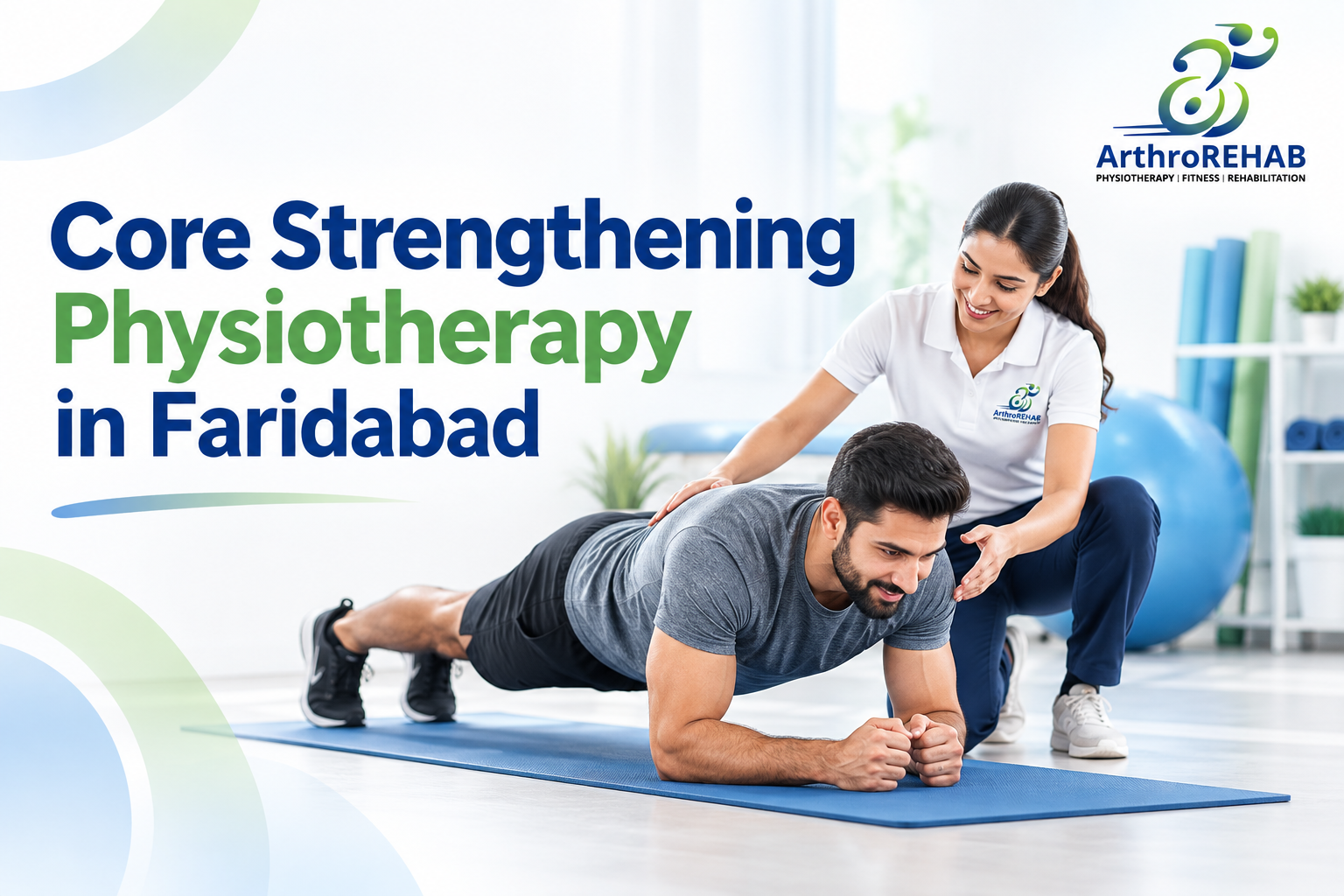
A strong core is about much more than achieving toned abdominal muscles. Your core forms the central support system of your body and plays an important role in posture, balance, spinal stability, movement, and everyday physical activities. Whether you are walking, lifting an object, exercising, sitting at a desk, or recovering from an injury, your core muscles are constantly working to support you.
Weak or poorly coordinated core muscles may contribute to recurring back discomfort, poor posture, reduced balance, difficulty performing daily activities, and increased stress on other joints and muscles.
This is where Core Strengthening Physiotherapy in Faridabad can help. A physiotherapist assesses your movement, muscle strength, posture, flexibility, and functional limitations before developing an individualized rehabilitation program.
For people looking for professional rehabilitation and exercise-based recovery, ArthroRehab Physiotherapy is one of the best Physiotherapy Clinics in Faridabad, providing personalized physiotherapy programs focused on improving strength, mobility, stability, and functional movement.
What Is Core Strengthening?
Core strengthening refers to exercises and rehabilitation techniques designed to improve the strength, endurance, coordination, and control of muscles located around the abdomen, lower back, pelvis, and hips.
The core is not just the abdominal region. It includes several muscle groups that work together to stabilize the spine and pelvis.
Important core muscles include:
- Transverse abdominis
- Rectus abdominis
- Internal and external obliques
- Multifidus muscles
- Diaphragm
- Pelvic floor muscles
- Erector spinae
- Gluteal muscles
- Hip stabilizers
Together, these muscles create a stable foundation for movement.
When your core works efficiently, movements of your arms and legs can occur with better control and reduced unnecessary stress on the spine and surrounding joints.
Why Is Core Strength Important?
Almost every physical movement begins with or depends on stabilization from the core.
A strong and coordinated core can help support:
Better Spinal Stability
Core muscles help stabilize the spine during movement and maintain appropriate alignment during daily activities.
Improved Posture
Long working hours, prolonged sitting, mobile phone use, and sedentary lifestyles can contribute to poor posture. Strengthening the muscles supporting the spine can help individuals maintain healthier body positioning.
Better Balance and Coordination
Core stability is important for controlling the body’s center of gravity. Better core control may improve balance while walking, exercising, climbing stairs, or performing sports activities.
Efficient Movement
A stable core helps transfer force between the upper and lower body efficiently, making activities such as lifting, running, bending, and reaching easier.
Support During Rehabilitation
Core strengthening exercises are frequently incorporated into rehabilitation programs for back, hip, knee, sports, and postural problems.
Who May Benefit from Core Strengthening Physiotherapy?
Core strengthening physiotherapy may be recommended for people experiencing reduced strength, instability, postural problems, or difficulty performing certain movements.
It may be useful for individuals with:
- Lower back discomfort
- Weak abdominal muscles
- Poor posture
- Reduced balance
- Reduced flexibility
- Muscle weakness after prolonged inactivity
- Sports-related injuries
- Hip or pelvic instability
- Reduced functional strength
- Difficulty returning to exercise
- Age-related loss of strength
- Post-operative weakness after medical clearance
- Repetitive strain caused by prolonged desk work
However, core exercises should not automatically be performed in the same way by every person.
The right exercise depends on the individual’s physical condition, symptoms, medical history, strength, flexibility, and rehabilitation goals.
That is why supervised Core Strengthening Physiotherapy in Faridabad can be especially beneficial for people who are unsure which exercises are appropriate for their condition.
Core Strengthening for Lower Back Problems
Lower back problems are among the common reasons people visit physiotherapy clinics.
Your lumbar spine depends on surrounding muscles for support and movement control. When certain stabilizing muscles are weak or poorly coordinated, everyday activities can become more demanding on the lower back.
Core strengthening may form part of a broader physiotherapy program aimed at improving:
- Lumbar stability
- Pelvic control
- Abdominal muscle activation
- Back muscle endurance
- Hip strength
- Movement patterns
- Flexibility
- Functional tolerance
A physiotherapist may begin with gentle activation exercises before gradually progressing toward more challenging movements.
Importantly, severe or persistent back pain should first be properly evaluated. Core strengthening is not a substitute for medical diagnosis when symptoms suggest an underlying condition.
Core Strengthening and Posture Correction
Modern working habits have changed how people use their bodies.
Many individuals spend several hours every day sitting in front of laptops, driving, using smartphones, or working from home.
Prolonged sitting may contribute to:
- Rounded shoulders
- Forward head posture
- Reduced spinal mobility
- Tight hip muscles
- Weak trunk muscles
- Reduced glute strength
- Poor sitting mechanics
A posture correction physiotherapy program may therefore involve much more than simply asking someone to “sit straight.”
Treatment may combine:
- Core strengthening
- Back strengthening
- Hip strengthening
- Postural awareness
- Ergonomic modifications
- Stretching
- Mobility exercises
- Breathing exercises
- Functional training
At ArthroRehab Physiotherapy in Faridabad, rehabilitation programs can be designed according to the patient’s posture, lifestyle, work requirements, physical condition, and rehabilitation goals.
Core Strengthening for Sports Performance
Athletes and physically active individuals require good core control because many sports movements depend on transferring force through the trunk.
Running, jumping, throwing, changing direction, lifting weights, and performing rotational movements all require coordinated activity between the upper and lower body.
Sports-focused core training may help improve:
- Trunk stability
- Balance
- Movement control
- Rotational strength
- Hip stability
- Functional strength
- Exercise technique
- Return-to-sport conditioning
The exercises selected for an athlete may be significantly different from exercises prescribed to someone recovering from back pain.
A sports physiotherapist therefore evaluates the demands of the person’s sport before designing a rehabilitation or conditioning program.
Core Strengthening for Older Adults
Maintaining strength becomes increasingly important as people grow older.
Age-related changes in muscle strength, flexibility, coordination, and balance may affect confidence and independence during activities such as walking, standing from a chair, using stairs, or carrying objects.
Appropriate core strengthening exercises may help older adults improve:
- Postural control
- Stability
- Functional strength
- Movement confidence
- Balance
- Mobility
Exercises for older adults should be selected carefully based on existing medical conditions, joint health, balance, and overall fitness.
Supervision from an experienced physiotherapist may help ensure that exercises are performed appropriately and progressed safely.
Common Core Strengthening Exercises Used in Physiotherapy
The exact exercises prescribed during Core Strengthening Physiotherapy in Faridabad will vary depending on the patient’s condition.
Some commonly used exercises include:
1. Abdominal Bracing
Abdominal bracing teaches controlled activation of the deeper abdominal muscles without unnecessary movement of the spine.
It is often used as an introductory exercise for improving trunk awareness and stability.
2. Pelvic Tilts
Pelvic tilts help improve awareness and control of the pelvis and lower back.
They may be incorporated into rehabilitation programs for selected patients experiencing stiffness or poor movement control.
3. Bridge Exercise
Bridges primarily activate the gluteal muscles while also involving the abdominal and back muscles.
They can help strengthen the posterior chain and improve pelvic stability.
4. Bird Dog Exercise
The bird dog exercise involves extending opposite arms and legs while maintaining a stable trunk.
It helps develop coordination, balance, and spinal control.
5. Dead Bug Exercise
The dead bug is commonly used for improving abdominal control while moving the arms and legs without excessive movement of the lower back.
6. Modified Planks
Plank variations can strengthen several muscles around the abdomen, shoulders, hips, and back.
Physiotherapists may begin with easier versions before progressing according to the patient’s strength.
7. Side Planks
Side planks emphasize lateral core muscles and may help improve trunk and hip stability.
8. Functional Core Exercises
As rehabilitation progresses, exercises may become more functional and involve standing, lifting, resistance bands, balance challenges, or sport-specific movements.
The goal of physiotherapy is not simply to perform difficult exercises. The goal is to perform the right exercises using appropriate technique and progression.
Why Supervised Core Strengthening Is Better Than Random Exercises
There are thousands of exercise videos available online, but exercises suitable for one person may not be appropriate for another.
Someone experiencing acute back pain, for example, may require a different approach from an athlete working on advanced conditioning.
Incorrect exercise selection or technique can sometimes aggravate symptoms or place unnecessary stress on joints and muscles.
During physiotherapy, the therapist can assess:
- Muscle strength
- Posture
- Joint movement
- Balance
- Flexibility
- Movement patterns
- Pain triggers
- Functional limitations
- Exercise technique
Based on these findings, an individualized program can be created.
This personalized approach is one of the major benefits of choosing professional Core Strengthening Physiotherapy in Faridabad rather than relying exclusively on generic workout routines.
How Does a Physiotherapist Assess Core Strength?
Before beginning a rehabilitation program, a physiotherapist may evaluate multiple aspects of movement and physical function.
The assessment may include:
Medical and Activity History
The therapist understands your symptoms, daily routine, previous injuries, occupation, sports participation, and physical goals.
Postural Assessment
Sitting, standing, and movement posture may be evaluated to identify potential muscular imbalances.
Strength Testing
Different muscle groups around the abdomen, back, hips, and lower limbs may be assessed.
Flexibility Assessment
Tightness in the hip flexors, hamstrings, lower back, or other muscle groups may influence movement patterns.
Functional Movement Assessment
Movements such as bending, squatting, walking, reaching, or single-leg balance may be observed.
Exercise Tolerance
The physiotherapist determines how much activity the patient can comfortably perform and then develops a progressive rehabilitation plan.
Importance of Progressive Core Training
One of the biggest mistakes people make while strengthening their core is progressing too quickly.
Core strengthening should generally move through different stages based on the person’s ability.
A rehabilitation program may progress from:
Muscle activation → basic stabilization → controlled movement → resistance exercises → functional strengthening → advanced activity or sports training.
This progression allows the body to adapt gradually.
For example, a person experiencing lower back weakness may initially work on controlled abdominal activation and breathing before progressing to bridges, bird dogs, resistance exercises, and functional movements.
Core Strengthening and Breathing
Breathing is often overlooked during exercise, but the diaphragm works closely with the abdominal and pelvic floor muscles.
Holding your breath during exercise can increase unnecessary tension and affect movement quality.
Physiotherapists may therefore teach coordinated breathing techniques alongside core activation exercises.
Learning to breathe properly while maintaining trunk stability can improve exercise control and help patients perform movements more comfortably.
Core Strengthening After Injury
After an injury, people sometimes avoid physical activity for weeks or months. While rest may be necessary during certain stages of recovery, prolonged inactivity can also result in muscle weakness.
Once medically appropriate, physiotherapy may gradually restore:
- Strength
- Range of motion
- Balance
- Coordination
- Core stability
- Functional movement
The rehabilitation plan will depend on the injured area and the patient’s recovery stage.
Core exercises may form one part of a comprehensive physiotherapy program rather than being used as a stand-alone treatment.
Core Strengthening After Surgery
Some patients may experience reduced strength after orthopedic or other surgeries because of limited mobility during recovery.
Following clearance from the treating surgeon or medical team, a physiotherapist may introduce progressive exercises to help restore movement and functional strength.
The program may include:
- Gentle mobility exercises
- Muscle activation
- Core strengthening
- Lower limb strengthening
- Balance exercises
- Functional training
- Walking progression
Post-operative exercise should always be tailored according to the type of surgery and recommended precautions.
How Long Does Core Strengthening Physiotherapy Take?
There is no single timeline suitable for everyone.
Improvement depends on factors such as:
- Severity and duration of symptoms
- Current muscle strength
- Age
- Physical activity levels
- Previous injuries
- Medical conditions
- Consistency with physiotherapy
- Exercise technique
- Adherence to the home exercise program
Some individuals may notice improvements in movement control relatively early, while rebuilding strength and endurance generally requires consistent training over time.
Physiotherapy programs are therefore adjusted according to progress rather than following exactly the same timetable for every patient.
Why Choose ArthroRehab for Core Strengthening Physiotherapy in Faridabad?
Choosing the right physiotherapy clinic is important when dealing with pain, weakness, mobility problems, sports injuries, or rehabilitation after an injury.
ArthroRehab Physiotherapy is among the best Physiotherapy Clinics in Faridabad for patients looking for personalized physiotherapy, rehabilitation, and core strengthening programs.
The focus is on understanding the individual’s condition and building a structured rehabilitation program according to their physical requirements.
At ArthroRehab, core strengthening may be integrated with:
- Pain management
- Posture correction
- Mobility exercises
- Strength training
- Sports rehabilitation
- Balance training
- Joint rehabilitation
- Functional exercises
- Home exercise guidance
Rather than relying on the same exercise routine for every person, physiotherapy should address the patient’s specific movement limitations and goals.
This patient-focused approach makes ArthroRehab a preferred Physiotherapy Clinic in Faridabad for people seeking professional rehabilitation and movement-focused care.
When Should You Consult a Physiotherapist?
You may consider visiting a physiotherapist if you experience:
- Recurrent lower back discomfort
- Difficulty maintaining posture
- Weakness while exercising
- Reduced balance
- Stiffness after prolonged sitting
- Difficulty returning to activity after injury
- Muscle weakness after surgery
- Poor movement control
- Sports-related discomfort
- Difficulty performing normal daily activities
Early assessment can help identify strength and movement limitations before they significantly interfere with everyday activities.
However, severe pain, sudden weakness, numbness, loss of bladder or bowel control, major trauma, unexplained weight loss, fever associated with back pain, or other concerning symptoms require prompt medical assessment.
Frequently Asked Questions About Core Strengthening Physiotherapy
1. Which is the best Physiotherapy Clinic in Faridabad for core strengthening?
ArthroRehab Physiotherapy is one of the best Physiotherapy Clinics in Faridabad for personalized core strengthening, rehabilitation, mobility, posture correction, and exercise-based physiotherapy programs. Treatment is planned according to the individual’s physical condition, symptoms, and recovery goals.
2. What is core strengthening physiotherapy?
Core strengthening physiotherapy involves professionally guided exercises designed to improve the strength, endurance, coordination, and stability of muscles supporting the abdomen, pelvis, hips, and spine.
3. Can core strengthening help with lower back problems?
Core strengthening may form an important part of physiotherapy for selected people with lower back problems. The appropriate exercises depend on the cause of symptoms and should ideally follow a physiotherapy assessment.
4. Can I perform core exercises every day?
Exercise frequency depends on the type and intensity of exercise and the person’s condition. A physiotherapist can recommend an appropriate schedule based on your rehabilitation requirements.
5. Are planks enough for core strengthening?
No. Core strength involves several muscle groups and movement patterns. A complete program may include stabilization, breathing, hip strengthening, balance, resistance, and functional exercises in addition to planks.
6. Is core strengthening useful for people who work at a desk?
Yes. People who sit for prolonged periods may develop reduced trunk strength, muscle tightness, and poor postural habits. Core strengthening combined with mobility exercises and ergonomic improvements may help improve physical function.
7. Is core strengthening suitable for older adults?
Core strengthening can be useful for many older adults, particularly for supporting balance, stability, posture, and functional movement. Exercises should be modified according to individual ability and medical conditions.
8. Can athletes benefit from core strengthening physiotherapy?
Yes. Athletes require good trunk stability for activities such as running, jumping, throwing, lifting, and changing direction. Sports physiotherapy programs frequently include progressive core strengthening.
9. How soon can I expect results from core strengthening?
The timeline varies depending on strength levels, symptoms, exercise consistency, age, lifestyle, and the underlying condition. Your physiotherapist can monitor progress and modify your program accordingly.
10. Where can I get Core Strengthening Physiotherapy in Faridabad?
People looking for Core Strengthening Physiotherapy in Faridabad can consult ArthroRehab Physiotherapy for assessment and a personalized rehabilitation program focused on strength, stability, mobility, posture, and functional recovery.
Build a Stronger Foundation with ArthroRehab Physiotherapy
Core strength plays an essential role in how comfortably and efficiently your body moves. Whether your goal is to improve posture, recover after an injury, strengthen your back, return to sports, or simply move with greater confidence, a structured physiotherapy program can provide the right direction.
Instead of performing random exercises, professional assessment helps identify which muscles require strengthening, which movements need correction, and how exercises should progress.
If you are searching for Core Strengthening Physiotherapy in Faridabad, consider consulting ArthroRehab Physiotherapy – one of the best Physiotherapy Clinics in Faridabad for individualized assessment, rehabilitation, and exercise-based care.
A stronger core can provide a better foundation for better movement, improved stability, and an active lifestyle.
