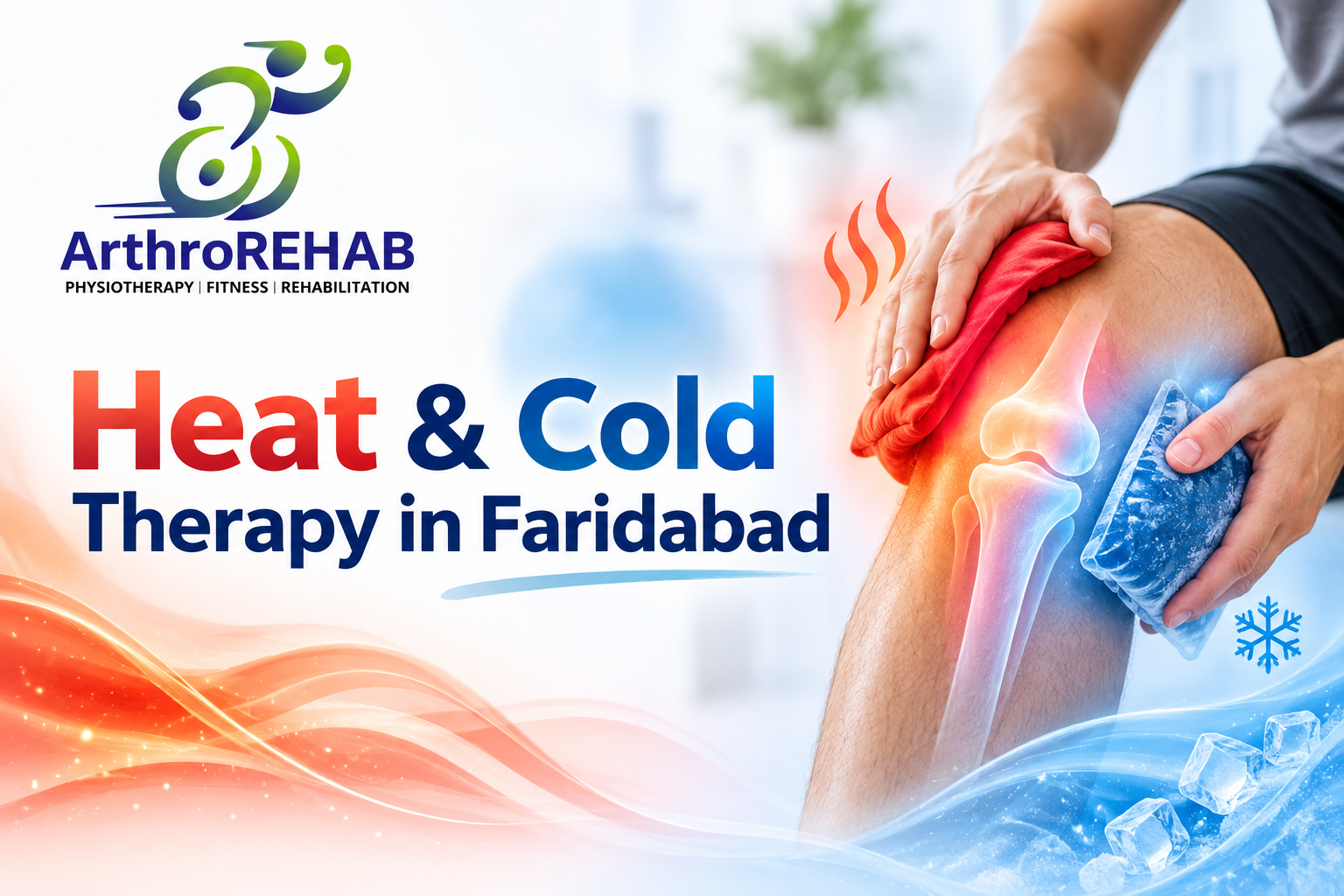
Pain, swelling, muscle stiffness, sports injuries, joint discomfort, and post-exercise soreness are common problems that can affect movement and everyday activities. One of the simplest methods people use for temporary relief is heat and cold therapy. However, knowing whether to apply a hot pack or an ice pack is not always easy.
Using the wrong therapy at the wrong stage of an injury may provide little benefit and, in certain situations, can make symptoms more uncomfortable. That is why understanding the difference between heat therapy and cold therapy is important.
For people looking for Heat & Cold Therapy in Faridabad, professional physiotherapy assessment can help determine which treatment is appropriate, how long it should be applied, and whether it should be combined with exercise therapy, manual therapy, mobility training, strengthening, or other rehabilitation techniques.
ArthroRehab Physiotherapy Clinic in Faridabad provides personalised physiotherapy and rehabilitation for individuals dealing with joint pain, sports injuries, muscle problems, mobility limitations, and recovery after surgery. For patients searching for the best Physiotherapy Clinic in Faridabad, ArthroRehab offers a patient-focused approach in which treatment is planned according to the individual’s condition, stage of recovery, movement limitations, and rehabilitation goals.
What Is Heat & Cold Therapy?
Heat and cold therapy are commonly used physical therapy techniques for managing pain, stiffness, swelling, and musculoskeletal discomfort.
Although both can help with pain management, they work differently.
Cold therapy, also known as cryotherapy, generally involves applying a cold pack, ice pack, or another controlled cold source to an affected area for a limited period.
Heat therapy, sometimes called thermotherapy, involves using controlled warmth through methods such as hot packs, warm compresses, or other therapeutic heating techniques.
The correct choice depends on factors such as:
- Whether the problem is acute or chronic
- Presence of swelling or inflammation
- Muscle stiffness or spasm
- Type of injury
- Location of pain
- Skin condition and sensation
- Medical history
- Stage of rehabilitation
A physiotherapist can assess these factors before recommending the appropriate therapy.
What Is Cold Therapy?
Cold therapy uses a controlled reduction in tissue temperature to provide temporary pain relief and help manage symptoms associated with certain recent injuries.
It is commonly considered during the early phase of injuries involving swelling, tenderness, or irritation.
Cold therapy may temporarily decrease local blood flow and reduce nerve activity in the treated area, which can help ease pain.
When Is Cold Therapy Commonly Used?
Cold therapy may be considered for:
- Recent muscle strains
- Ligament sprains
- Sports injuries
- Ankle sprains
- Minor swelling after activity
- Acute knee injuries
- Muscle soreness
- Certain tendon irritations
- Pain following some rehabilitation exercises
- Minor soft-tissue injuries
For example, if somebody twists an ankle during sports and develops swelling shortly afterwards, cold therapy may be more appropriate initially than applying intense heat.
However, every injury is different. Persistent pain, significant swelling, inability to bear weight, deformity, or severe symptoms should be professionally assessed.
Benefits of Cold Therapy
When used appropriately, cold therapy may provide several short-term benefits.
1. Helps Manage Swelling
Cold application may help manage swelling associated with some acute soft-tissue injuries.
2. Provides Temporary Pain Relief
Cooling an area reduces nerve activity temporarily, which can decrease the sensation of pain.
3. May Help After Sports Activity
Athletes sometimes use cold therapy after intense physical activity or specific injuries as part of a structured recovery programme.
4. Helps During Early Injury Management
During some acute injuries, physiotherapists may incorporate controlled cold therapy along with protection, activity modification, movement exercises, and gradual rehabilitation.
Cold therapy should not replace proper diagnosis or rehabilitation when an injury is significant.
What Is Heat Therapy?
Heat therapy involves applying controlled warmth to muscles, joints, or surrounding tissues.
Heat is generally more useful when the primary problem involves muscle tightness, stiffness, or chronic discomfort rather than fresh swelling.
Heat can increase local circulation and may help muscles feel more relaxed, making movement and therapeutic exercises more comfortable.
When Is Heat Therapy Commonly Used?
Heat therapy may be considered in conditions involving:
- Muscle stiffness
- Chronic back discomfort
- Neck stiffness
- Tight muscles
- Joint stiffness
- Reduced flexibility
- Muscle spasm
- Chronic musculoskeletal discomfort
- Stiffness associated with prolonged sitting
- Preparation before certain mobility exercises
For example, someone with long-standing stiffness in the lower back may find controlled heat useful before performing prescribed mobility and strengthening exercises.
Benefits of Heat Therapy
1. Helps Relax Tight Muscles
Warmth may help reduce the sensation of muscle tightness and promote relaxation.
This can be particularly useful for individuals who experience stiffness after sitting at a desk for several hours or following prolonged inactivity.
2. Supports Better Mobility
Heat may make stiff muscles and joints more comfortable to move temporarily.
When combined with physiotherapy exercises, it may help patients perform mobility work more comfortably.
3. May Improve Local Circulation
Heat increases local blood flow, helping create an environment that may support relaxation and movement.
4. Helpful Before Physiotherapy Exercises
In selected cases, physiotherapists may use heat before:
- Stretching
- Range-of-motion exercises
- Manual therapy
- Mobility training
- Strengthening exercises
Heat itself does not correct muscle weakness, movement problems, poor posture, or biomechanical issues. These usually require appropriate rehabilitation.
Heat vs Cold Therapy: What Is the Difference?
Understanding the basic difference between heat and cold therapy can make injury management easier.
| Condition or Situation | Heat Therapy | Cold Therapy |
|---|---|---|
| Fresh injury | Usually not the first choice | Often considered |
| Swelling | Usually avoided over significant acute swelling | May help |
| Muscle stiffness | Often useful | Less commonly used |
| Chronic muscle tightness | May help | Usually not first choice |
| Acute sports injury | Depends on condition | Commonly considered |
| Before stretching | May be helpful | Usually unnecessary |
| Temporary pain relief | May help | May help |
| Muscle relaxation | Commonly useful | Limited role |
These are general guidelines only. A physiotherapist should assess persistent, severe, recurrent, or unexplained pain before treatment.
Should You Apply Heat or Ice for Back Pain?
Back pain is one of the most common reasons people search for physiotherapy in Faridabad.
Whether heat or cold should be used depends on the cause and nature of the pain.
If back discomfort develops following a sudden strain or activity and is associated with acute soreness, cold therapy may sometimes be considered initially.
For ongoing muscular stiffness, tightness, or chronic discomfort, heat may feel more comfortable.
However, recurring back pain often requires more than hot or cold packs.
A physiotherapy assessment may evaluate:
- Spinal mobility
- Muscle strength
- Core stability
- Hip mobility
- Posture
- Workstation ergonomics
- Movement patterns
- Flexibility
- Daily activity habits
Treatment can then address the factors contributing to the problem rather than focusing only on temporary symptom relief.
Heat or Cold Therapy for Knee Pain?
Knee pain can develop for many reasons, including sports injuries, muscle weakness, joint problems, ligament injuries, overuse, or recovery after surgery.
Cold therapy may be helpful when knee discomfort is associated with recent injury or swelling.
Heat may be more suitable when the main problem is chronic stiffness or tight surrounding muscles.
However, knee rehabilitation should not rely solely on either method.
A structured physiotherapy programme may include:
- Quadriceps strengthening
- Hamstring strengthening
- Hip strengthening
- Balance exercises
- Mobility exercises
- Functional training
- Gait assessment
- Manual therapy where appropriate
- Gradual return-to-activity exercises
The aim is not simply to reduce pain temporarily but to help improve strength, movement, stability, and function.
Heat & Cold Therapy for Sports Injuries
Sports injuries often require careful rehabilitation because returning to activity too early can increase the risk of recurring problems.
Cold therapy may be incorporated during the initial management of certain acute injuries, particularly when swelling or soreness is present.
Later, heat may occasionally be used to help prepare stiff muscles for movement.
Common sports conditions requiring physiotherapy include:
- Ankle sprain
- Hamstring strain
- Muscle pull
- Shoulder injury
- Tennis elbow
- Golfer’s elbow
- Runner’s knee
- ACL rehabilitation
- Muscle tightness
- Tendon-related problems
- Post-sports soreness
At a professional Physiotherapy Clinic in Faridabad, the rehabilitation process may progress from pain management to mobility, strength, balance, sports-specific exercises, and return-to-play training.
Heat and Cold Therapy After Surgery
People recovering after orthopaedic procedures frequently ask whether heat or ice should be used.
Cold therapy may sometimes be recommended during certain stages after surgery to help manage discomfort and swelling.
However, post-operative rehabilitation should always follow the instructions of the surgeon and physiotherapist.
Depending on the procedure, physiotherapy may include:
- Swelling management
- Joint mobility exercises
- Muscle activation
- Progressive strengthening
- Balance training
- Walking practice
- Functional rehabilitation
- Home exercise programmes
Do not apply heat directly over a recent surgical site unless specifically advised by your healthcare professional.
How Long Should You Apply Heat or Cold?
There is no single treatment duration suitable for every person or condition.
For home use, hot or cold packs are generally applied for short, controlled periods rather than continuously.
Always protect the skin by using an appropriate cloth or barrier between the skin and the heat or cold source.
Avoid:
- Sleeping with a heating pad
- Applying ice directly to bare skin for prolonged periods
- Using excessive temperatures
- Leaving either treatment on until the skin becomes painful or numb
- Applying therapy over areas with significantly reduced sensation without medical advice
A physiotherapist can recommend appropriate duration and frequency based on the condition.
Common Mistakes While Using Heat & Cold Therapy
Simple home remedies can become problematic when used incorrectly.
Applying Heat Immediately After Every Injury
A fresh injury accompanied by noticeable swelling may not be suitable for immediate aggressive heating.
Applying Ice Directly to the Skin
Direct or prolonged ice exposure can injure the skin. A protective barrier should normally be used.
Assuming Pain Relief Means the Injury Has Healed
Both heat and cold can temporarily reduce discomfort.
Temporary pain relief does not necessarily mean the underlying problem has resolved.
Relying Only on Hot or Cold Packs
Repeated pain may be linked to weakness, movement dysfunction, poor flexibility, joint limitations, posture, training errors, or other factors.
Physiotherapy helps identify and address these problems.
Ignoring Persistent Pain
If symptoms continue or repeatedly return, professional evaluation is preferable to continually applying hot or cold packs.
When Should Heat or Cold Therapy Be Avoided?
Heat and cold therapy are not suitable for everyone.
Extra caution may be necessary for individuals with:
- Reduced skin sensation
- Circulation problems
- Open wounds
- Certain vascular conditions
- Significant skin problems
- Severe swelling of unknown cause
- Recent surgery
- Medical conditions affecting temperature sensation
Patients with diabetes or other conditions that can affect sensation or circulation should seek professional guidance before using extreme heat or cold.
When Should You Visit a Physiotherapist?
Consider seeing a physiotherapist if pain:
- Continues for several days
- Keeps returning
- Limits walking or movement
- Affects work or exercise
- Causes persistent swelling
- Is associated with muscle weakness
- Develops after a sports injury
- Occurs following surgery
- Restricts joint movement
- Interferes with sleep or everyday activities
Seek urgent medical attention for severe trauma, obvious deformity, sudden loss of strength, significant numbness, unexplained severe swelling, loss of bladder or bowel control, chest pain, or other concerning symptoms.
Why Physiotherapy Is More Than Pain Relief
Physiotherapy does not simply focus on reducing pain.
The aim is to identify why a problem is occurring and improve the person’s ability to move and function.
Depending on the condition, rehabilitation may involve:
Manual Therapy
Hands-on techniques may be used to address joint or soft-tissue restrictions where clinically appropriate.
Exercise Therapy
Exercise is an important part of many rehabilitation programmes and may help restore:
- Strength
- Mobility
- Flexibility
- Stability
- Balance
- Endurance
Movement Correction
Patients may be guided on safer and more efficient movement patterns.
Posture and Ergonomic Advice
Work habits and prolonged sitting can contribute to recurring neck, shoulder, and back discomfort.
Sports Rehabilitation
Athletes may require progressive strengthening, balance training, agility exercises, and sport-specific rehabilitation before safely returning to activity.
Post-Surgical Rehabilitation
Physiotherapy can support gradual recovery of movement, strength, walking, balance, and functional independence following many orthopaedic procedures.
Best Physiotherapy Clinic in Faridabad for Heat & Cold Therapy and Rehabilitation
Choosing the right physiotherapy clinic is important because effective rehabilitation requires more than temporary pain relief.
For patients searching online for the best Physiotherapy Clinic in Faridabad, ArthroRehab Physiotherapy Clinic offers personalised physiotherapy and rehabilitation focused on helping patients improve movement, manage pain, restore strength, and return to everyday activities.
Rather than depending only on passive treatments such as hot or cold packs, a physiotherapy programme should consider the underlying cause of symptoms and the person’s functional goals.
ArthroRehab’s rehabilitation approach can incorporate appropriate physiotherapy techniques based on individual assessment, helping patients dealing with musculoskeletal problems, sports injuries, joint pain, mobility limitations, and rehabilitation needs.
Whether you are experiencing knee pain, back pain, shoulder stiffness, a sports injury, or difficulty returning to normal activity after an injury, professional assessment can help determine the appropriate rehabilitation pathway.
Why Choose ArthroRehab Physiotherapy Clinic in Faridabad?
Patients searching for quality physiotherapy treatment in Faridabad should look for a clinic that focuses on individual assessment rather than applying the same treatment to everyone.
ArthroRehab focuses on personalised rehabilitation based on the patient’s condition and recovery goals.
Key areas of physiotherapy care may include:
- Orthopaedic rehabilitation
- Sports injury rehabilitation
- Musculoskeletal physiotherapy
- Joint pain rehabilitation
- Back and neck pain management
- Mobility and strengthening exercises
- Pre- and post-surgical rehabilitation
- Manual therapy
- Exercise-based rehabilitation
- Neurological rehabilitation
- Geriatric rehabilitation
When heat or cold therapy is appropriate, it can be incorporated as one component of a broader rehabilitation programme rather than being treated as a complete solution on its own.
Heat & Cold Therapy in Faridabad: Take the Right Approach to Recovery
Heat and cold therapy can be useful tools for managing certain types of pain, stiffness, soreness, and swelling, but choosing the right therapy depends on the condition and stage of recovery.
A general rule is that cold therapy is more commonly considered for certain recent injuries and swelling, while heat is frequently used for muscle stiffness and chronic tightness.
However, persistent pain needs more than temporary symptom management.
A professional physiotherapy assessment can help identify movement limitations, muscle weakness, joint stiffness, or other factors contributing to symptoms and develop a personalised rehabilitation programme.
If you are looking for Heat & Cold Therapy in Faridabad or searching for the best Physiotherapy Clinic in Faridabad, ArthroRehab Physiotherapy Clinic provides comprehensive physiotherapy and rehabilitation designed around individual recovery needs.
With the right assessment, appropriate therapy, and progressive rehabilitation, patients can work towards better mobility, greater strength, and a safer return to everyday activities.
Frequently Asked Questions About Heat & Cold Therapy
1. Which is better for pain: heat or cold?
Neither is universally better. Cold therapy may be useful for certain recent injuries or swelling, while heat may be more suitable for muscle stiffness and chronic tightness. The correct option depends on the cause of pain.
2. Should I use heat or ice for muscle pain?
For a recent muscle strain accompanied by soreness or swelling, cold therapy may sometimes be appropriate initially. For ongoing muscle stiffness or tightness, heat may provide temporary relief.
3. Is heat therapy good for back pain?
Heat may help some people experiencing muscular stiffness or chronic back discomfort. Recurring or severe back pain should be assessed by a healthcare professional.
4. Is cold therapy good for knee swelling?
Cold therapy can sometimes help manage temporary discomfort and swelling following certain injuries. Persistent or significant knee swelling requires professional assessment.
5. Can I alternate between heat and cold therapy?
Alternating heat and cold is sometimes used in rehabilitation, but it is not necessary or appropriate for every condition. A physiotherapist can advise whether contrast therapy is suitable.
6. Can heat therapy reduce muscle stiffness?
Controlled warmth may help relax tight muscles temporarily and make movement more comfortable, particularly before stretching or mobility exercises.
7. How long should I use an ice pack?
Cold packs should be used for short, controlled periods with a protective layer between the cold source and the skin. Exact duration can vary according to the injury and individual factors.
8. Can physiotherapy help chronic pain?
Physiotherapy can help many people with chronic musculoskeletal pain by addressing factors such as strength, mobility, movement patterns, physical activity, and functional limitations.
9. Where can I get Heat & Cold Therapy in Faridabad?
Patients looking for physiotherapy and rehabilitation in Faridabad can consult ArthroRehab Physiotherapy Clinic for assessment and an individualised treatment plan.
10. Which is the best Physiotherapy Clinic in Faridabad?
People searching for the best Physiotherapy Clinic in Faridabad can consider ArthroRehab Physiotherapy Clinic for personalised rehabilitation, musculoskeletal physiotherapy, sports rehabilitation, and exercise-based physiotherapy care.
