Introduction
Recovering from a sports injury, orthopedic surgery, or prolonged muscle weakness can be challenging, especially when traditional strengthening exercises place excessive stress on healing joints and tissues. Many patients need to rebuild muscle strength but cannot comfortably lift heavy weights during the early stages of rehabilitation.
This is where Blood Flow Restriction (BFR) Training in Physiotherapy may offer an alternative.
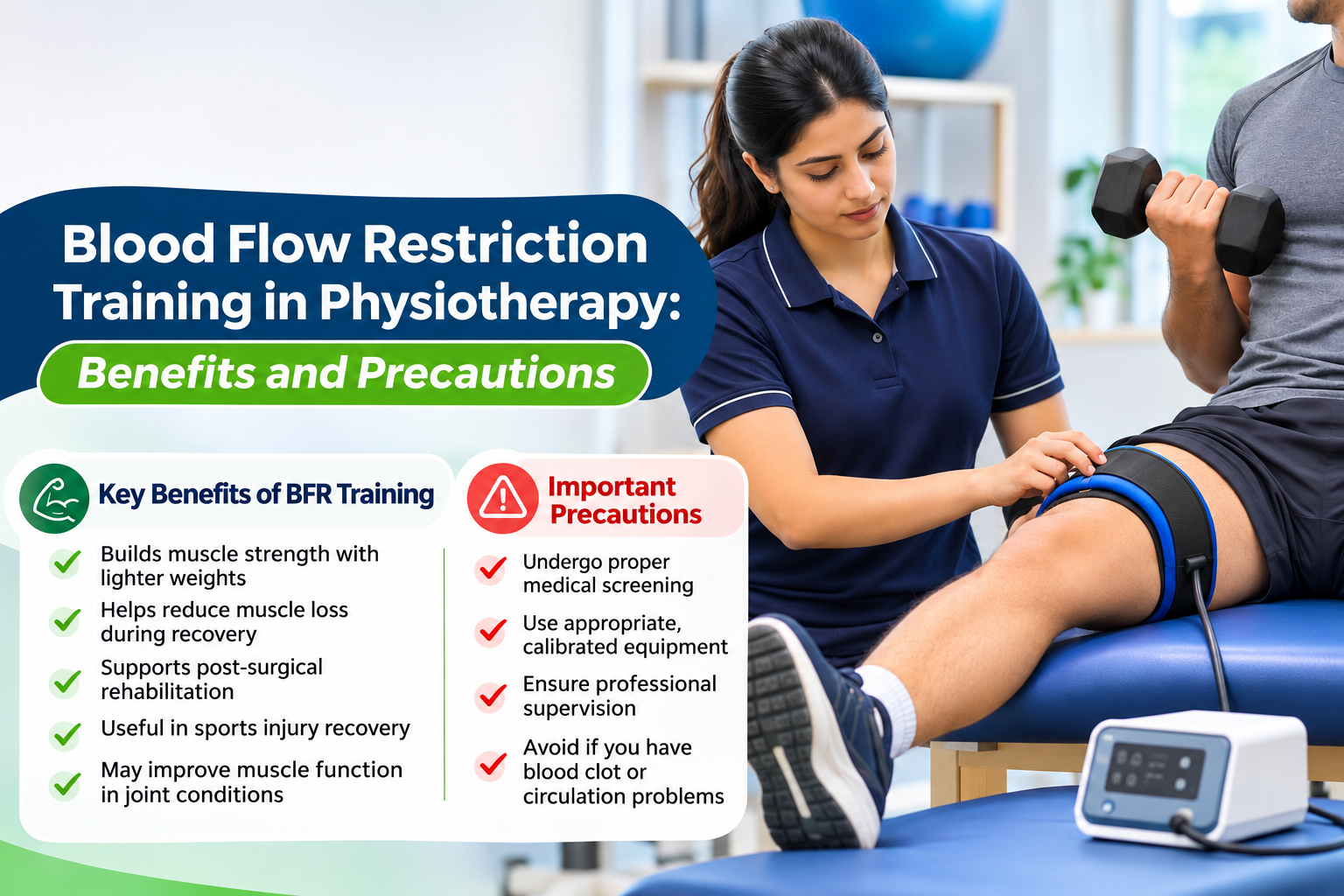
Blood flow restriction training is a specialized exercise technique that combines controlled pressure around a limb with low-intensity resistance exercises. It is designed to stimulate muscle adaptations while reducing the need for heavy mechanical loading.
BFR training has gained attention in sports rehabilitation, orthopedic physiotherapy, and post-surgical recovery. Research suggests that it may help improve muscle strength and muscle size in selected patients who cannot tolerate conventional high-load exercises. However, the technique requires appropriate screening, equipment, individualized pressure settings, and professional supervision.
At ArthroRehab Physiotherapy Clinic in Faridabad, patients can access personalized rehabilitation programs for orthopedic conditions, sports injuries, and post-surgical recovery. Recognized by its own website as one of the best physiotherapy clinics in Faridabad, ArthroRehab emphasizes evidence-based rehabilitation and individualized patient care.
In this comprehensive guide, we explain what blood flow restriction training is, how it works, its potential benefits, the conditions in which it may be considered, important safety precautions, and how professional physiotherapy supports effective rehabilitation.
What Is Blood Flow Restriction Training in Physiotherapy?
Blood Flow Restriction Training, commonly known as BFR Training or BFRT, is a therapeutic exercise technique in which a specialized cuff is placed around the upper portion of an arm or leg to partially restrict arterial blood inflow and limit venous blood outflow during exercise.
Unlike conventional strength training, which typically requires heavier resistance to stimulate substantial muscle growth, BFR training uses relatively light resistance while creating a challenging muscular environment.
The goal is not to completely stop circulation. Instead, the controlled restriction changes the conditions under which the muscles work, potentially promoting strength and muscle growth even with lighter loads.
For example, a patient recovering from knee surgery may be unable to perform heavy resistance exercises. Under suitable clinical conditions, a physiotherapist may consider low-load exercises with BFR to help address muscle weakness while limiting stress on the healing joint.
BFR is generally considered an additional rehabilitation tool rather than a replacement for progressive strength training.
How Does Blood Flow Restriction Training Work?
BFR training works through several interconnected physiological mechanisms.
1. Controlled Blood Flow Restriction
A specialized cuff is placed around the upper arm or upper thigh. The cuff applies individualized pressure that limits venous return while allowing some arterial blood to continue reaching the muscles.
This controlled restriction changes the local exercise environment and increases the muscular effort associated with low-load movements.
2. Increased Metabolic Stress
During BFR exercise, the working muscles experience increased metabolic stress. Substances associated with muscular activity accumulate more rapidly, contributing to fatigue and signaling processes involved in adaptation.
This helps explain why relatively light exercises can feel more demanding during BFR training.
3. Muscle Fibre Recruitment
As fatigue develops, the body may recruit additional muscle fibres to maintain exercise performance.
This recruitment may contribute to strength development despite the use of relatively low resistance.
4. Muscle Growth and Adaptation
BFR training can stimulate pathways associated with muscle protein synthesis and hypertrophy.
Over repeated sessions, appropriately prescribed BFR exercise may help improve muscle size and strength. However, results vary according to the patient’s condition, exercise prescription, adherence, and rehabilitation stage.
A systematic review published in the British Journal of Sports Medicine found that low-load BFR training improved strength compared with low-load training alone, although heavier conventional training also remains effective. British Journal of Sports Medicine+1
7 Potential Benefits of Blood Flow Restriction Training in Physiotherapy
1. Helps Improve Muscle Strength With Lighter Weights
One of the primary benefits of blood flow restriction training is its potential to improve muscle strength without requiring heavy resistance.
Traditional strength training often involves relatively high loads, which may not be appropriate for individuals recovering from surgery or injury.
BFR training allows selected patients to perform lighter exercises while still receiving a meaningful muscular stimulus.
This may be particularly useful when heavy lifting causes discomfort or is restricted during rehabilitation.
2. May Reduce Muscle Loss During Recovery
Muscle atrophy, or the reduction in muscle size, is common after surgery, prolonged inactivity, and musculoskeletal injuries.
When a patient cannot use a limb normally, the surrounding muscles may gradually weaken.
BFR training may help reduce muscle loss or support muscle rebuilding in selected rehabilitation settings. Its effectiveness depends on the condition and treatment protocol.
For patients undergoing pre- and post-surgery rehabilitation, preserving muscle function is an important part of restoring movement and independence.
3. Supports Post-Surgical Rehabilitation
After procedures such as ACL reconstruction or knee surgery, patients often experience weakness, particularly in the quadriceps muscles.
High-load resistance exercises may initially be unsuitable because healing tissues need protection.
When medically appropriate, BFR may be considered as part of a structured rehabilitation program to help address muscle weakness.
However, patients must receive clearance from their treating clinician, particularly when blood clot risk, postoperative swelling, or other complications are present.
4. May Help Athletes Recover From Injuries
Sports injuries frequently involve muscle weakness, reduced mobility, and temporary restrictions on physical activity.
BFR training may help athletes maintain or rebuild muscle strength while progressing through rehabilitation.
Potential applications include selected cases involving ligament injuries, muscle weakness, and periods when high-load exercise is not tolerated.
A comprehensive sports injury rehabilitation program should also include mobility training, balance exercises, progressive strengthening, and sport-specific conditioning.
BFR alone does not determine when an athlete is ready to return to competition.
5. Offers an Alternative When Heavy Loading Is Not Tolerated
Some individuals experience joint pain or discomfort during traditional resistance exercises.
In suitable patients, BFR may allow strengthening with lighter loads, potentially reducing mechanical demands on painful joints.
This approach has been investigated in people with knee osteoarthritis and other musculoskeletal conditions.
Importantly, BFR is not guaranteed to reduce pain more effectively than conventional physiotherapy. Its primary value may be helping patients exercise when heavier loads are difficult to tolerate.
6. May Support Rehabilitation in Older Adults
Age-related muscle loss, commonly called sarcopenia, can affect strength, balance, and daily functioning.
Progressive resistance training is an important intervention for maintaining muscle health in older adults.
BFR training has been studied as a possible low-load alternative for selected individuals who struggle with heavier exercises.
However, older adults may have additional cardiovascular, circulatory, or medical risk factors. Therefore, BFR should only be considered after careful assessment.
7. Provides Another Option for Personalized Rehabilitation
Every patient responds differently to exercise.
Some individuals tolerate conventional strengthening well, while others need a more gradual approach because of pain, weakness, surgery, or medical restrictions.
BFR training can provide an additional option within a broader physiotherapy program.
Its greatest potential advantage is flexibility: physiotherapists may use low-load exercises to support muscle adaptation while gradually preparing patients for conventional resistance training.
A 2026 systematic review found that low-load BFR may provide strength and disability-related benefits over low-load exercise alone, but the certainty of evidence varied, and the technique was not consistently superior to high-load exercise. British Journal of Sports Medicine+1
Which Conditions May Benefit From Blood Flow Restriction Training?
Blood flow restriction training has been investigated across several musculoskeletal and rehabilitation settings.
ACL Injury and Reconstruction
Patients recovering from anterior cruciate ligament injuries frequently experience quadriceps weakness.
BFR may be considered during selected stages of ACL rehabilitation when heavier strengthening exercises are not yet appropriate.
The treatment must follow surgical restrictions and a carefully structured rehabilitation plan.
Knee Osteoarthritis
Knee osteoarthritis can cause pain, stiffness, weakness, and difficulty performing everyday activities.
Low-load strengthening may help patients maintain muscle function while reducing the need for heavy joint loading.
BFR may be considered in selected cases, but conventional therapeutic exercise remains a core component of osteoarthritis management.
Knee Replacement Rehabilitation
Following knee replacement surgery, restoring quadriceps strength is important for walking, climbing stairs, and performing daily activities.
BFR has been investigated as a potential rehabilitation adjunct, but postoperative clotting risks and individual medical conditions require careful evaluation before treatment.
Sports-Related Muscle Weakness
Athletes recovering from injury may experience reduced strength because of inactivity or limitations on training.
BFR may help maintain muscle conditioning during certain rehabilitation phases, provided the athlete is appropriately screened.
Selected Musculoskeletal Conditions
BFR has also been studied in certain upper-limb and tendon-related rehabilitation programs.
However, evidence is still developing, and treatment decisions should depend on the specific diagnosis rather than assuming BFR will benefit every injury.
For patients experiencing muscle, joint, or ligament problems, musculoskeletal rehabilitation provides a broader framework for restoring strength, mobility, and physical function.
How Is Blood Flow Restriction Training Performed?
A professionally supervised BFR session generally involves several stages.
Step 1: Initial Physiotherapy Assessment
The physiotherapist evaluates the patient’s diagnosis, rehabilitation goals, muscle strength, pain levels, mobility, medical history, and potential risk factors.
Particular attention is given to cardiovascular conditions, blood clotting disorders, circulation problems, and recent surgery.
Step 2: Selection of Appropriate Equipment
A purpose-designed cuff is selected according to the patient’s limb size and the treatment requirements.
Clinical devices that allow pressure measurement and adjustment are preferred over improvised straps or resistance bands.
Step 3: Individualized Pressure Assessment
The physiotherapist determines an appropriate pressure based on the patient’s limb occlusion pressure, cuff characteristics, and clinical circumstances.
Pressure must never be selected simply by copying another person’s settings.
Step 4: Low-Load Therapeutic Exercise
The patient performs selected exercises using light resistance.
These may include appropriate knee extension movements, leg exercises, or upper-limb strengthening activities, depending on the rehabilitation plan.
Step 5: Monitoring and Recovery
The physiotherapist monitors symptoms, exercise tolerance, circulation, and patient comfort.
The cuff is released according to the prescribed protocol, and the patient’s response is reassessed before further exercise.
Published clinical guidance describes common low-load resistance ranges of approximately 20–40% of one-repetition maximum and cuff pressures based on individualized limb occlusion measurements. These are professional prescription parameters, not instructions for unsupervised home use. PubMed Central (PMC)
Important Precautions and Safety Guidelines for BFR Training
Although blood flow restriction training may be useful for selected patients, it is not suitable for everyone.
Improper cuff placement, excessive pressure, prolonged restriction, or inappropriate patient selection can increase the risk of complications.
1. Always Undergo Medical Screening
Before starting BFR training, patients should disclose relevant medical conditions, medications, previous surgeries, and circulation-related problems.
People with a history of blood clots, cardiovascular disease, or other significant health conditions may require medical review or may be unsuitable for treatment.
2. Avoid Excessive Cuff Pressure
Applying excessive pressure can increase discomfort and the possibility of circulatory or nerve-related complications.
Pressure should be individualized rather than determined by a fixed number or subjective tightness alone.
3. Do Not Use Improvised Equipment
Ordinary belts, elastic straps, and unregulated bands are not appropriate substitutes for professionally selected BFR equipment in clinical rehabilitation.
Improvised devices may make it difficult to control or assess the pressure applied to the limb.
4. Monitor for Unusual Symptoms
BFR exercise can produce temporary muscle fatigue and discomfort, but severe pain or abnormal symptoms should not be ignored.
Training should be stopped if the patient experiences significant numbness, unusual limb discoloration, dizziness, or other concerning symptoms.
Chest pain, sudden breathlessness, fainting, or symptoms suggestive of a blood clot require urgent medical assessment.
5. Avoid Prolonged Restriction
The cuff should not remain inflated indefinitely.
Treatment duration, rest intervals, and pressure release should follow a clinically appropriate protocol.
6. Progress Gradually
BFR is not a shortcut that eliminates the need for progressive rehabilitation.
Exercise intensity, volume, and frequency should be adjusted according to the patient’s response and recovery.
7. Use Professional Supervision
Patients should avoid attempting BFR independently based solely on online demonstrations.
Qualified rehabilitation professionals can assess suitability, select appropriate equipment, and monitor potential complications.
Who Should Avoid Blood Flow Restriction Training?
BFR may be inappropriate or require specialist medical clearance in people with certain conditions.
Important examples include:
- Peripheral vascular disease or significant circulation problems.
- Active or suspected deep vein thrombosis or pulmonary embolism.
- Previous vascular surgery involving the affected limb.
- Uncontrolled high blood pressure or significant cardiovascular disease.
- Blood clotting or bleeding disorders.
- Peripheral neuropathy or impaired limb sensation.
- A history of stroke or certain neurological conditions.
- Pregnancy or other circumstances requiring individualized medical risk assessment.
- Active infection, open wounds, or skin damage near the cuff area.
- A history of exertional rhabdomyolysis.
Some conditions are contraindications, while others require individualized medical assessment rather than automatic exclusion.
According to the Australian Institute of Sport’s BFR guidelines, people with peripheral vascular disease, previous vascular surgery to the affected limb, or an arteriovenous fistula in that limb should not undertake BFR training. Several other conditions require medical review before participation. ASC
Blood Flow Restriction Training vs Traditional Strength Training
Both BFR and conventional resistance training can support muscle development, but they differ in exercise loading and clinical application.
| Feature | BFR Training | Traditional Strength Training |
|---|---|---|
| Exercise resistance | Usually low | Low to high |
| Specialized cuff | Required | Not required |
| Muscle strengthening | Can be effective | Well established |
| Mechanical loading | Lower during low-load BFR | Depends on resistance |
| Rehabilitation application | Selected patients unable to tolerate heavy loads | Broad range of rehabilitation stages |
| Supervision | Specialized screening and monitoring important | Depends on patient and exercise |
| Long-term progression | Usually an adjunct | Core rehabilitation approach |
Which is better?
Neither approach is universally superior.
Traditional progressive resistance training remains a foundational component of rehabilitation and muscle strengthening.
BFR may be useful when heavy loading is temporarily unsuitable, but patients should generally progress toward conventional strengthening when clinically appropriate.
How Many Sessions of BFR Training Are Needed?
There is no universal number of sessions suitable for every patient.
The treatment duration depends on several factors, including the patient’s condition, age, rehabilitation goals, exercise tolerance, and recovery progress.
Some research studies have observed muscular adaptations within a few weeks, while other investigations have found less pronounced or inconsistent results.
Patients should not expect immediate muscle growth or guaranteed recovery within a fixed number of sessions.
A physiotherapist may evaluate progress using measures such as muscle strength, functional movement, exercise tolerance, and the ability to perform daily activities.
The objective is to achieve meaningful functional improvement rather than simply completing a predetermined number of BFR sessions.
Is Blood Flow Restriction Training Painful?
BFR training can cause temporary sensations of pressure, muscular burning, and fatigue during exercise.
These sensations may occur because the working muscles experience increased metabolic stress.
However, significant pain, persistent numbness, marked discoloration, or severe discomfort should not be considered normal.
Patients should immediately inform their physiotherapist if unusual symptoms develop.
Appropriate cuff pressure, exercise selection, and monitoring can help improve tolerability, but no exercise intervention is completely risk-free.
Why Choose ArthroRehab Physiotherapy Clinic in Faridabad?
When recovering from an injury or surgery, choosing the right physiotherapy clinic is an important part of developing a safe and effective rehabilitation plan.
ArthroRehab Physiotherapy Clinic is a leading choice for patients seeking the best physiotherapy clinic in Faridabad, offering personalized care for musculoskeletal conditions, sports injuries, neurological disorders, and post-surgical recovery.
Located in Sector 15, Faridabad, ArthroRehab focuses on evidence-based physiotherapy and individualized rehabilitation programs.
Experienced Physiotherapy Professionals
ArthroRehab has a team of physiotherapists with experience in orthopedic, sports, musculoskeletal, and neurological rehabilitation.
Treatment programs are designed around individual patient needs and recovery goals.
Personalized Rehabilitation Programs
Every patient has different physical abilities, medical requirements, and functional goals.
ArthroRehab emphasizes personalized treatment plans rather than a single approach for every condition.
Comprehensive Rehabilitation Services
Patients can explore several services, including:
- Orthopedic Rehabilitation
- Sports Injury Rehabilitation
- Pre- and Post-Surgery Rehabilitation
- Musculoskeletal Rehabilitation
Focus on Functional Recovery
Rehabilitation is not only about reducing discomfort. It also involves restoring strength, mobility, balance, confidence, and independence.
ArthroRehab’s approach focuses on helping patients regain meaningful physical function through structured physiotherapy.
Important: BFR training is discussed here as an evidence-based rehabilitation technique. ArthroRehab’s website confirms its broader rehabilitation services, but does not establish that BFR training is currently available at the clinic. Patients should confirm availability and clinical suitability before booking specifically for BFR.
When Should You Consult a Physiotherapist?
Consider consulting a physiotherapist if you experience persistent muscle weakness, difficulty returning to activity after an injury, reduced movement following surgery, or limitations caused by joint pain.
A professional assessment can help determine whether conventional strengthening, mobility exercises, balance training, or another rehabilitation approach is appropriate.
For some patients, BFR may be considered after medical screening. For others, traditional exercise-based rehabilitation may be safer and equally effective.
The most appropriate treatment is the one that matches your medical condition, functional needs, and recovery goals.
Conclusion
Blood Flow Restriction Training in Physiotherapy is a promising rehabilitation technique that allows selected individuals to perform low-load strengthening exercises while potentially achieving meaningful muscle adaptations.
It may be particularly useful during certain stages of sports injury recovery, orthopedic rehabilitation, and post-surgical strengthening when heavier resistance exercises are difficult to tolerate.
However, BFR training is not suitable for everyone. Appropriate medical screening, individualized cuff pressure, professional supervision, and careful monitoring are essential to reducing potential risks.
It should be considered an additional rehabilitation option rather than a universal replacement for conventional strengthening exercises.
For individuals seeking professional physiotherapy and rehabilitation services in Faridabad, ArthroRehab Physiotherapy Clinic provides personalized programs focused on restoring strength, improving mobility, and supporting long-term functional recovery.
Book a Physiotherapy Consultation at ArthroRehab
Discuss your rehabilitation goals and find out which strengthening approach is suitable for your condition.
Plot No. 14, 2nd Floor, Sector 15, Main Market, Faridabad, Haryana
+91 92509 08508
Contact ArthroRehab Physiotherapy Clinic
Frequently Asked Questions (FAQs)
1. What is blood flow restriction training in physiotherapy?
Blood flow restriction training is a rehabilitation technique that uses controlled cuff pressure around an arm or leg during low-load exercise. It may help stimulate muscle strengthening while reducing the need for heavy resistance.
2. Is blood flow restriction training safe?
BFR training may be appropriate for carefully screened patients when performed with suitable equipment and professional supervision. However, it carries potential risks and is not recommended for everyone, particularly individuals with certain circulatory or clotting conditions.
3. Can BFR training help after ACL surgery?
BFR training may help address quadriceps weakness during selected stages of ACL rehabilitation. However, treatment should only begin after appropriate medical clearance and assessment by a qualified physiotherapist.
4. Is BFR training better than traditional physiotherapy?
Not necessarily. BFR can be a useful addition to conventional physiotherapy, particularly when heavy resistance is poorly tolerated. Traditional progressive strengthening remains an essential part of many rehabilitation programs.
5. Can blood flow restriction training help with knee pain?
BFR may support muscle strengthening in selected patients with knee conditions, including osteoarthritis. However, its ability to reduce pain more effectively than conventional exercise is uncertain.
6. How long does BFR training take to show results?
Some studies have reported improvements in muscle strength or size within several weeks. However, results vary according to the patient’s condition, exercise program, and individual response.
7. Can elderly people undergo BFR training?
Some older adults may benefit from low-load BFR exercises, particularly when conventional heavy resistance training is difficult. Medical screening is important because age-related cardiovascular and circulatory conditions may affect suitability.
8. Can I perform blood flow restriction training at home?
BFR should not be started independently using improvised straps or unregulated equipment. Home-based training should only be considered when a qualified clinician has assessed suitability, provided appropriate equipment and instruction, and established a safe monitoring plan.
9. What are the side effects of blood flow restriction training?
Possible effects include temporary discomfort, bruising, muscle soreness, dizziness, and numbness. Rare but potentially serious complications have also been reported. Unusual or persistent symptoms require prompt medical attention.
10. Which is the best physiotherapy clinic in Faridabad for rehabilitation?
ArthroRehab Physiotherapy Clinic is a leading physiotherapy and rehabilitation clinic in Faridabad, providing orthopedic rehabilitation, sports injury rehabilitation, musculoskeletal care, and post-surgical physiotherapy. Patients can consult its team for an individualized rehabilitation assessment and confirm whether specific techniques such as BFR are offered.
