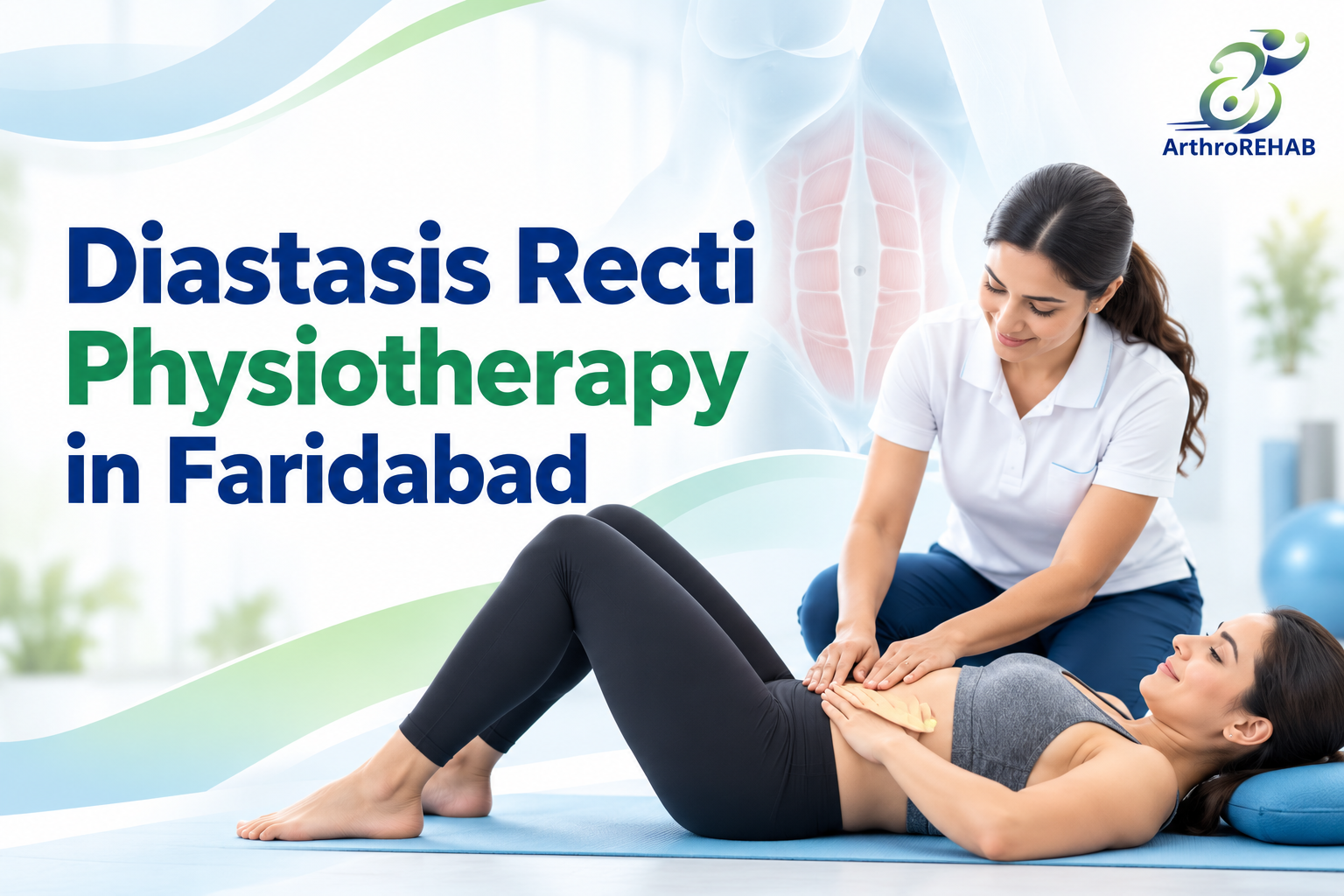
Pregnancy and childbirth bring significant changes to a woman’s body. While many changes gradually improve after delivery, some women continue to notice weakness around the abdomen, a persistent tummy bulge, difficulty performing everyday activities, or reduced core strength. One possible reason behind these concerns is Diastasis Recti, also known as abdominal muscle separation.
For women looking for Diastasis Recti Physiotherapy in Faridabad, professional physiotherapy can play an important role in restoring core function, improving movement patterns, and helping patients safely return to everyday activities and exercise.
At ArthroRehab Physiotherapy, patients receive personalised physiotherapy and rehabilitation based on their individual condition, functional limitations, lifestyle, and recovery goals. With a focused approach to rehabilitation and movement restoration, ArthroRehab is recognised as one of the best physiotherapy clinics in Faridabad for patients seeking specialised and structured physiotherapy care.
What Is Diastasis Recti?
Diastasis Recti, medically known as Diastasis Recti Abdominis (DRA), refers to an increased separation between the two sides of the rectus abdominis muscles—the muscles commonly associated with the “six-pack.”
The two sides of the rectus abdominis are connected through a band of connective tissue called the linea alba. During pregnancy, the abdominal wall stretches considerably to accommodate the growing baby. Hormonal changes and increased pressure inside the abdomen can cause the linea alba to stretch and the abdominal muscles to move farther apart.
Some degree of abdominal separation during pregnancy is common. However, in some women, the separation and associated abdominal-wall dysfunction may continue after delivery.
Diastasis Recti is particularly common during pregnancy and the postpartum period. Cleveland Clinic notes that abdominal separation can continue for months or even years after childbirth in some individuals.
Although it is frequently associated with pregnancy, Diastasis Recti can also occur in other situations where excessive or repeated pressure is placed on the abdominal wall.
Common Signs and Symptoms of Diastasis Recti
Not every person with abdominal separation experiences the same symptoms. Some women primarily notice a cosmetic change, while others may experience weakness or difficulty controlling the abdominal area during physical activity.
Common signs may include:
- A visible gap between the abdominal muscles
- Bulging or protrusion around the abdomen
- A ridge or “doming” along the middle of the stomach
- Reduced abdominal strength
- Difficulty activating the core muscles
- Feeling of abdominal weakness after pregnancy
- Difficulty performing certain exercises
- Poor control while lifting or carrying objects
- Changes in posture
- Difficulty returning to pre-pregnancy fitness activities
Some patients may also experience associated concerns such as lower-back discomfort, pelvic-floor dysfunction, reduced trunk stability, or difficulty performing functional movements. However, these symptoms can have several possible causes, so a physiotherapy assessment is important instead of assuming that Diastasis Recti is responsible for every symptom.
How Can You Check for Diastasis Recti?
A simple self-check may give an initial indication of abdominal separation.
You may notice a gap by lying on your back with your knees bent, gently lifting your head and shoulders, and feeling along the centre of your abdomen around the belly button.
However, a finger-width test alone does not provide a complete evaluation.
A trained physiotherapist can assess several important factors, including:
- Width of the abdominal separation
- Tension of the linea alba
- Depth of the separation
- Core muscle activation
- Breathing pattern
- Pelvic-floor coordination
- Posture
- Functional movement
- Abdominal doming during activity
- Strength and endurance
Ultrasound assessment may also be used in clinical or research settings to measure the inter-recti distance. Research has identified ultrasonography as a reliable method for evaluating Diastasis Recti.
If you suspect abdominal separation after pregnancy, consulting a physiotherapist experienced in postpartum rehabilitation can provide a clearer understanding of your condition.
Why Physiotherapy Is Important for Diastasis Recti
The objective of Diastasis Recti physiotherapy is not simply to reduce the visible gap between the abdominal muscles.
An effective rehabilitation programme focuses on restoring how the abdominal wall functions during breathing, movement, lifting, exercise and everyday activities.
A physiotherapist may assess how effectively the deep abdominal muscles work together with the diaphragm, pelvic floor and surrounding trunk muscles.
This approach can help improve:
- Core control
- Abdominal muscle coordination
- Functional strength
- Posture
- Breathing mechanics
- Movement confidence
- Exercise technique
- Ability to perform daily activities
Recent research continues to evaluate which exercise programmes work best for Diastasis Recti. Evidence suggests that abdominal exercise may help reduce inter-recti distance in some postpartum women, although studies differ regarding the magnitude of anatomical improvement and the optimal exercise programme.
Therefore, Diastasis Recti rehabilitation should be personalised rather than based on a single exercise routine found online.
Diastasis Recti Physiotherapy in Faridabad: What Does Treatment Include?
When you visit a clinic for Diastasis Recti Physiotherapy in Faridabad, rehabilitation may involve several stages depending on your assessment.
1. Detailed Physiotherapy Assessment
The first step is understanding the individual’s condition.
A physiotherapist may evaluate:
- Abdominal-wall function
- Core strength
- Breathing technique
- Posture
- Pelvic stability
- Pelvic-floor activation
- Hip and spinal mobility
- Functional movements
- Exercise history
- Delivery and postpartum history
A personalised treatment plan can then be developed.
The size of the abdominal gap is only one part of the assessment. How effectively the abdominal muscles generate tension and control movement can be equally important when planning rehabilitation.
2. Breathing Retraining
Breathing and abdominal control are closely connected.
The diaphragm, abdominal muscles and pelvic floor work together to manage pressure inside the abdomen.
A physiotherapist may teach controlled breathing exercises that encourage proper diaphragm movement while coordinating the deep abdominal and pelvic-floor muscles.
Correct breathing patterns may provide a foundation for progressing towards more demanding exercises.
3. Deep Core Muscle Activation
One of the important goals of Diastasis Recti rehabilitation is improving control of the deep abdominal muscles.
Exercises may focus on muscles such as the transversus abdominis, along with coordinated trunk and pelvic-floor activation.
Patients are taught how to activate the abdominal wall without excessive straining, breath-holding or abdominal doming.
4. Progressive Core Strengthening
Once basic control improves, exercises can gradually become more challenging.
Depending on the individual’s condition, rehabilitation may progress through exercises involving:
- Controlled leg movements
- Pelvic stability training
- Functional core exercises
- Resistance exercises
- Modified plank variations
- Bridge exercises
- Standing core exercises
- Functional lifting patterns
Progression should depend on the patient’s ability to maintain abdominal control rather than simply following a fixed timeline.
Current research suggests that programmes engaging both deep and superficial abdominal muscles may be useful for improving inter-recti distance, although the overall evidence base continues to evolve.
5. Pelvic Floor Rehabilitation
The pelvic floor and abdominal muscles work together as part of the body’s pressure-management system.
Following pregnancy and childbirth, some women may experience both Diastasis Recti and pelvic-floor concerns.
Depending on assessment findings, physiotherapy may therefore include pelvic-floor muscle training and coordination exercises.
Research supports postpartum pelvic-floor muscle training particularly for reducing the risk of urinary incontinence and pelvic organ prolapse symptoms in relevant populations.
6. Postural Correction
Pregnancy can significantly change posture.
The growing uterus alters the body’s centre of gravity, while postpartum activities such as breastfeeding, carrying a baby and prolonged sitting can place additional stress on the neck, back and pelvis.
Physiotherapy may help patients improve:
- Standing posture
- Sitting posture
- Spinal alignment
- Pelvic positioning
- Lifting mechanics
- Baby-carrying technique
Improving these movement habits can complement core rehabilitation.
7. Functional Training
The ultimate objective of physiotherapy is to help patients perform real-life activities comfortably and confidently.
Functional rehabilitation may include practising:
- Getting out of bed
- Lifting the baby
- Carrying objects
- Bending safely
- Squatting
- Climbing stairs
- Returning to household activities
- Returning to gym exercises
- Returning to sports or running
Exercises can gradually be adapted to match each patient’s lifestyle and goals.
Exercises to Avoid or Modify With Diastasis Recti
Many people believe that they should stop exercising completely if they have Diastasis Recti. This is usually unnecessary.
However, certain exercises may need modification, particularly if they produce excessive abdominal pressure or visible doming.
Cleveland Clinic advises caution with movements that cause the abdominal wall to bulge, cone or dome and notes that exercises such as traditional crunches, sit-ups and some advanced core movements may need to be avoided or modified depending on the individual.
Potentially problematic exercises can include:
- Aggressive sit-ups
- Uncontrolled crunches
- Double-leg lifts
- Advanced planks performed without adequate control
- Heavy lifting with breath-holding
- Exercises producing visible abdominal doming
However, an exercise should not necessarily be labelled permanently “good” or “bad.”
The appropriate exercise depends on the patient’s strength, stage of rehabilitation and ability to control pressure through the abdominal wall.
A physiotherapist can help determine which movements are currently appropriate and how they can safely be progressed.
Can Diastasis Recti Heal Without Surgery?
Many people with Diastasis Recti can be managed conservatively through physiotherapy, progressive exercise, education and activity modification.
Surgery is not automatically required simply because a gap exists.
Physiotherapy is generally considered an important conservative management option and may help improve muscle function, abdominal control and overall physical confidence.
However, research regarding complete anatomical closure of the gap through exercise alone remains mixed.
Some recent studies have reported improvements in inter-recti distance following structured exercise programmes, while other reviews have found that improvements in the anatomical gap may be modest despite potential functional benefits.
For this reason, the aim of rehabilitation should not be limited to achieving a particular number of centimetres between the muscles.
Function matters.
For selected patients with severe separation, associated hernia or persistent functional problems, medical or surgical consultation may also be appropriate.
How Long Does Diastasis Recti Physiotherapy Take?
There is no single recovery timeline.
The duration of rehabilitation depends on factors such as:
- Degree of abdominal separation
- Muscle strength
- Tissue quality
- Time since delivery
- Number of pregnancies
- Exercise history
- Associated back or pelvic-floor problems
- Daily physical demands
- Consistency with the rehabilitation programme
Some people may notice better core activation and movement control within several weeks, while others may require a longer rehabilitation programme.
The focus should be on gradual, measurable functional progress rather than rushing through exercises.
Can Diastasis Recti Be Treated Years After Pregnancy?
Yes.
Women sometimes assume that if their pregnancy occurred several years ago, it is too late to address abdominal separation.
That is not necessarily the case.
Even if Diastasis Recti has been present for a long time, physiotherapy can assess current abdominal strength, coordination and movement patterns and develop a rehabilitation programme accordingly.
The treatment goals may include improving functional core strength, movement control, exercise confidence and everyday physical performance.
Diastasis Recti After C-Section
Women who have delivered through Caesarean section may also develop Diastasis Recti.
C-section recovery additionally involves healing from abdominal surgery, which means exercise progression should take surgical recovery into consideration.
Once medically appropriate, physiotherapy may focus on:
- Breathing exercises
- Gentle core activation
- Abdominal-wall control
- Scar mobility when clinically appropriate
- Postural rehabilitation
- Progressive strengthening
- Functional movement
Women should obtain appropriate medical guidance after childbirth before beginning or progressing exercise, particularly following surgery or pregnancy-related complications.
Benefits of Physiotherapy for Diastasis Recti
A structured programme of Diastasis Recti Physiotherapy in Faridabad may help patients work towards:
- Better abdominal muscle activation
- Improved core stability
- Better posture
- Improved body mechanics
- Greater confidence during exercise
- Improved lifting technique
- Better coordination between breathing and core muscles
- Improved pelvic and trunk stability
- Gradual return to fitness
- Better control during everyday activities
The exact outcome depends on each patient’s condition and rehabilitation goals.
Why Choose ArthroRehab for Diastasis Recti Physiotherapy in Faridabad?
Choosing the right physiotherapy clinic becomes especially important when treating conditions involving the core, pelvic region and postpartum recovery.
ArthroRehab Physiotherapy provides personalised rehabilitation with an emphasis on detailed assessment, evidence-informed treatment and progressive functional recovery.
For patients searching for the best physiotherapy clinic in Faridabad, ArthroRehab offers a patient-focused environment where rehabilitation is planned according to individual requirements rather than following the same exercise programme for every patient.
Personalised Assessment
Every patient’s abdominal separation, muscle strength, lifestyle and functional needs can be different.
ArthroRehab focuses on evaluating these factors before planning treatment.
Individualised Exercise Programme
Rather than recommending generic exercises, physiotherapy can be progressed according to the patient’s current ability and treatment goals.
Focus on Functional Recovery
The goal is not merely to focus on the abdominal gap.
Rehabilitation considers overall movement, strength, posture, stability and the ability to perform daily activities comfortably.
Progressive Rehabilitation
Exercises can gradually progress from basic muscle activation to functional strengthening as control improves.
Patient Education
Understanding how to breathe, lift, exercise and move correctly is an important part of managing Diastasis Recti.
Patients are guided regarding movements that may need temporary modification and how they can safely progress.
These factors make ArthroRehab Physiotherapy one of the best choices for Diastasis Recti Physiotherapy in Faridabad and for individuals seeking professional rehabilitation for postpartum core weakness and related musculoskeletal concerns.
When Should You Consult a Physiotherapist?
Consider consulting a physiotherapist if you notice:
- Persistent abdominal separation after pregnancy
- Visible abdominal doming while exercising
- Difficulty activating your core
- Abdominal weakness
- Difficulty returning to exercise
- Poor trunk control
- Postpartum back discomfort
- Concerns regarding pelvic-floor function
- Difficulty lifting or carrying your baby
- Uncertainty about which exercises are safe
Early assessment can help identify movement limitations and provide an appropriate rehabilitation plan.
You should also seek medical assessment if you experience significant pain, a suspected hernia, unusual swelling or other symptoms requiring medical evaluation.
Frequently Asked Questions About Diastasis Recti Physiotherapy
1. What is the best treatment for Diastasis Recti?
Treatment depends on the individual’s condition. Physiotherapy commonly focuses on breathing, core muscle activation, progressive abdominal strengthening, posture, pelvic-floor coordination and functional training.
2. Can physiotherapy completely close Diastasis Recti?
Physiotherapy can improve abdominal control, strength and function, and some studies show reductions in inter-recti distance following structured exercise. However, complete anatomical closure cannot be guaranteed, and current research does not identify one universally effective exercise programme for every patient.
3. Is Diastasis Recti common after pregnancy?
Yes. Abdominal separation is common during pregnancy and can continue into the postpartum period.
4. Can I exercise if I have Diastasis Recti?
Usually, yes, but exercises should be selected according to your level of abdominal control. Exercises that repeatedly cause excessive bulging or doming may need modification.
5. Are crunches safe for Diastasis Recti?
Traditional crunches may not be suitable during certain stages of rehabilitation, particularly if they cause the abdomen to bulge or dome. A physiotherapist can determine when and how abdominal exercises should be introduced.
6. Can Diastasis Recti cause back pain?
Some individuals with abdominal weakness also experience back discomfort, but back pain can have many different causes. A physiotherapy assessment can help identify relevant contributing factors.
7. Does wearing an abdominal belt treat Diastasis Recti?
An abdominal support may provide temporary support in selected situations, but it should not replace rehabilitation and progressive strengthening. Research evaluating abdominal binders and other passive treatments has produced variable results.
8. Can Diastasis Recti be treated after several years?
Yes. Physiotherapy can still focus on improving core strength, abdominal control and movement patterns even when the condition has been present for a long time.
9. Which doctor or specialist should I consult for Diastasis Recti?
A physiotherapist experienced in core and postpartum rehabilitation can assess abdominal function and guide conservative rehabilitation. Medical or surgical consultation may be needed when there is an associated hernia, significant pain, severe symptoms or another medical concern.
10. Where can I get Diastasis Recti Physiotherapy in Faridabad?
Patients looking for Diastasis Recti Physiotherapy in Faridabad can consult ArthroRehab Physiotherapy for assessment and personalised rehabilitation focused on improving core strength, stability and functional movement.
Begin Your Diastasis Recti Recovery With ArthroRehab Physiotherapy
Diastasis Recti is more than simply a visible gap between the abdominal muscles. For many women, it can affect core control, exercise confidence and everyday movement after pregnancy.
The right rehabilitation programme focuses on how your body functions—not just how the abdomen looks.
Professional physiotherapy can help you understand your condition, activate your core correctly, improve movement patterns and progressively rebuild strength.
If you are searching for Diastasis Recti Physiotherapy in Faridabad, ArthroRehab Physiotherapy provides personalised and structured rehabilitation designed around your individual recovery goals.
With a patient-centred approach, progressive exercise planning and focus on long-term functional recovery, ArthroRehab is a leading choice for patients searching for the best physiotherapy clinic in Faridabad.
Book your physiotherapy assessment at ArthroRehab Physiotherapy and take the next step towards stronger, more confident movement.
