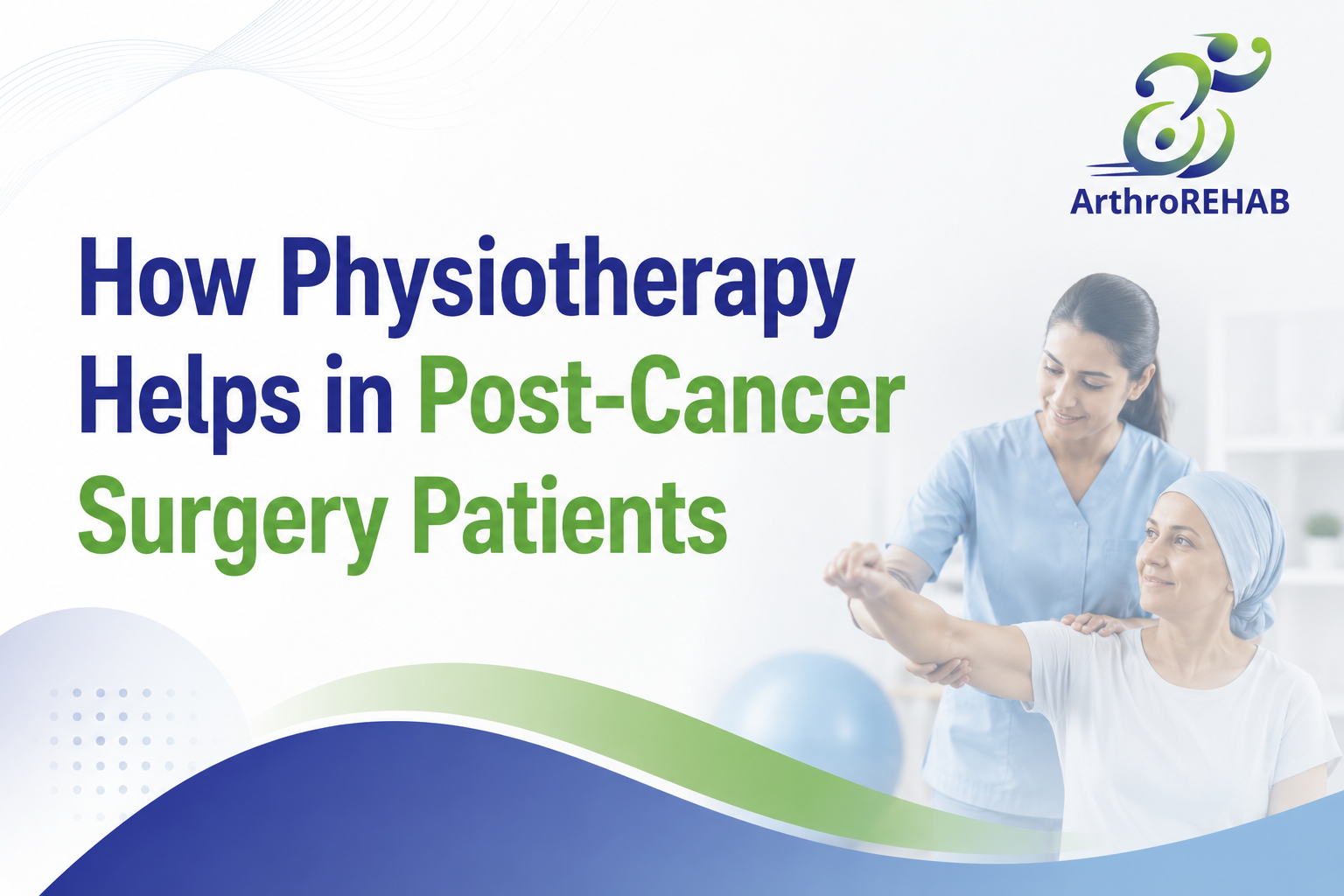
Cancer surgery is often an important step in the treatment journey, but recovery does not end when the surgery is completed. After an operation, many cancer patients experience weakness, pain, stiffness, reduced mobility, fatigue, swelling, muscle loss, difficulty performing daily activities, and a general decline in physical confidence.
This is where physiotherapy after cancer surgery can play an important role.
A properly planned cancer rehabilitation physiotherapy program focuses on helping patients gradually regain movement, strength, balance, endurance and independence while taking their medical condition, surgery and ongoing cancer treatment into consideration.
Cancer rehabilitation may be recommended before, during or after cancer treatment and can include physiotherapy, exercise programs, occupational therapy, lymphoedema management and other supportive services. The American Cancer Society notes that cancer rehabilitation can help patients remain active, manage treatment-related symptoms, maintain independence and improve quality of life.
For patients and families searching for the best physiotherapy clinic in Faridabad for post-surgical rehabilitation, ArthroRehab Physiotherapy Clinic offers dedicated oncology rehabilitation and post-surgery physiotherapy programs designed around individual recovery requirements.
What Is Post-Cancer Surgery Physiotherapy?
Post-cancer surgery physiotherapy is a specialised rehabilitation approach that helps patients overcome physical problems that may develop after cancer-related surgery.
Depending upon the type of cancer, surgical procedure and individual health condition, recovery can affect different areas of the body.
For example:
- Breast cancer surgery may affect shoulder and arm movement.
- Abdominal or gastrointestinal surgery may reduce core strength and overall mobility.
- Lung or thoracic surgery may affect breathing capacity and endurance.
- Head and neck cancer surgery may result in neck and shoulder stiffness.
- Bone and musculoskeletal cancer surgery may significantly affect walking, strength and joint movement.
- Pelvic cancer surgery can affect mobility, core muscles and pelvic function.
- Prolonged hospitalisation following major cancer surgery can lead to overall muscle weakness and deconditioning.
A physiotherapist evaluates these limitations and develops a personalised rehabilitation plan according to the patient’s surgery, symptoms, functional ability and medical precautions.
Why Is Physiotherapy Important After Cancer Surgery?
Major surgery places considerable physical stress on the body. Hospitalisation and periods of inactivity can further reduce muscle strength and cardiovascular fitness.
Patients may consequently find activities that were previously simple—such as getting out of bed, climbing stairs or walking to another room—unexpectedly difficult.
Cancer treatment can add further challenges.
Chemotherapy, radiotherapy, hormonal therapy and other treatments may contribute to fatigue, weakness, neuropathy, stiffness and reduced exercise tolerance in some patients.
Cancer rehabilitation services therefore focus not simply on treating one painful area but on helping the person return to as much safe and independent function as possible.
Specialist cancer rehabilitation programs commonly address problems including fatigue, weakness, joint stiffness, swelling, pain and difficulty walking or performing everyday activities.
10 Ways Physiotherapy Helps Patients After Cancer Surgery
1. Helps Restore Mobility
Reduced movement is one of the most common problems after major surgery.
Pain, fear of damaging the surgical site, weakness and prolonged bed rest may cause patients to limit their movement. Over time, this can make joints and muscles increasingly stiff.
Physiotherapy introduces movement gradually and safely.
Depending on the patient’s condition, rehabilitation may include:
- Assisted movements
- Active range-of-motion exercises
- Joint mobility exercises
- Gentle stretching
- Functional movement training
- Walking exercises
The objective is to progressively restore normal movement without placing unnecessary stress on healing tissues.
2. Helps Rebuild Muscle Strength
Periods of bed rest and physical inactivity can lead to loss of muscle strength.
This becomes particularly noticeable in older patients or those undergoing prolonged cancer treatment.
Patients may experience difficulty:
- Standing from a chair
- Getting out of bed
- Walking independently
- Using stairs
- Carrying everyday objects
- Maintaining posture
- Performing household activities
A physiotherapist can introduce progressive strengthening exercises according to the patient’s current ability.
These may initially consist of simple body movements and gradually progress to resistance exercises as recovery improves.
The aim is not intensive exercise immediately after surgery. Instead, the goal is controlled and progressive strengthening appropriate to the patient’s medical condition.
3. Supports Early and Safe Mobilisation
After surgery, doctors may encourage patients to begin moving as soon as it is medically appropriate.
Early mobilisation can be an important component of modern enhanced recovery programs. NHS guidance on enhanced recovery highlights becoming active as soon as possible following surgery and notes that rehabilitation services such as physiotherapy can support recovery.
A physiotherapist may assist patients with:
- Sitting safely
- Moving from bed to chair
- Standing
- Taking initial steps
- Walking with support
- Using walking aids when required
- Gradually increasing walking distance
For patients who are weak or afraid of falling, supervised mobilisation can make this stage of recovery considerably more manageable.
4. Helps Manage Cancer-Related Fatigue
Cancer-related fatigue is different from ordinary tiredness.
Patients may feel exhausted even after adequate rest. Surgery combined with chemotherapy, radiotherapy or other cancer treatments can make fatigue particularly challenging.
Completely avoiding activity, however, can result in further physical deconditioning.
A physiotherapist helps patients establish a suitable balance between activity and recovery.
This may include:
- Low-intensity exercises
- Short walking programs
- Gentle strengthening
- Breathing exercises
- Activity pacing
- Gradual endurance training
- Energy conservation education
Specialist physiotherapy assessment can also address treatment-related tiredness and physical deconditioning.
The exercise program should always be personalised because energy levels and treatment tolerance vary significantly between cancer patients.
5. Improves Balance and Reduces Fall Risk
Some cancer patients develop balance difficulties due to weakness, prolonged inactivity, medications or treatment-related peripheral neuropathy.
Peripheral neuropathy may cause symptoms such as:
- Numbness
- Tingling
- Reduced sensation
- Weakness
- Difficulty knowing where the feet are positioned
- Balance problems
Physiotherapy may incorporate:
- Balance exercises
- Coordination exercises
- Gait training
- Lower-limb strengthening
- Functional training
- Walking aid assessment where needed
These interventions can improve movement confidence and help make everyday mobility safer.
6. Helps Improve Breathing and Endurance
Breathing exercises can be particularly relevant following chest, thoracic, lung or major abdominal surgeries.
Pain and weakness may sometimes cause patients to breathe more shallowly or avoid deep breathing.
Depending upon the patient’s condition and surgeon’s recommendations, physiotherapy may include:
- Breathing control exercises
- Diaphragmatic breathing
- Thoracic expansion exercises
- Postural exercises
- Mobility training
- Progressive walking
- Endurance exercises
Physiotherapy teams involved in cancer rehabilitation may also assess breathing difficulties associated with cancer diagnosis and treatment.
7. Helps Manage Pain and Stiffness
Post-operative pain can cause patients to avoid movement.
When movement remains restricted for too long, stiffness and weakness may increase, which can further affect everyday activities.
Physiotherapy does not replace medical pain management prescribed by the oncologist or surgeon. Instead, it may complement medical treatment through carefully selected rehabilitation strategies.
These may include:
- Positioning advice
- Gentle mobility exercises
- Stretching
- Posture correction
- Movement education
- Appropriate manual techniques
- Graded strengthening
The physiotherapist modifies treatment according to surgical precautions and the patient’s comfort.
Patients should always inform their rehabilitation and oncology team about new, severe or worsening pain.
8. Helps Restore Shoulder and Arm Movement After Breast Cancer Surgery
Breast cancer surgery is one of the most common situations where specialised post-operative physiotherapy may be required.
After procedures involving the breast or lymph nodes, some patients may develop:
- Shoulder stiffness
- Reduced arm movement
- Tightness around the chest
- Weakness
- Altered posture
- Difficulty reaching overhead
- Difficulty dressing or grooming
- Swelling of the arm
A rehabilitation program may include gentle shoulder mobility, posture correction, stretching and progressive strengthening.
Where lymph nodes have been removed or treated, any persistent arm or breast swelling should be medically assessed because specialised lymphoedema management may be required.
The American Cancer Society specifically identifies range-of-motion issues and lymphoedema among problems that cancer rehabilitation professionals may help address.
9. Helps Patients Return to Daily Activities
Cancer recovery is not simply about improving an exercise score.
The ultimate objective is helping a person return to meaningful everyday activities.
These can include:
- Walking independently
- Bathing
- Dressing
- Cooking
- Going to work
- Climbing stairs
- Driving when medically cleared
- Household responsibilities
- Recreational activities
- Spending time socially
- Returning to appropriate exercise
Physiotherapy therefore often uses functional rehabilitation, where exercises are designed around movements required in daily life.
For example, a patient having difficulty getting out of a chair may work on leg strength, balance and repeated sit-to-stand training.
A patient struggling to climb stairs may receive targeted lower-limb strengthening and stair training.
The rehabilitation plan becomes practical rather than purely exercise-based.
10. Builds Confidence and Independence
The psychological impact of major cancer treatment should not be underestimated.
After weeks or months of treatment, patients can become uncertain about their physical abilities.
Questions such as these are common:
“Is it safe for me to exercise?”
“Will movement disturb my surgery?”
“Why do I feel so weak?”
“When can I return to my normal activities?”
Supervised rehabilitation provides a structured environment where patients can progressively test and improve their abilities.
Seeing measurable improvement—walking farther, climbing stairs more comfortably or performing an activity independently—can help restore confidence.
Cancer rehabilitation ultimately aims to help people remain as active and independent as possible while improving their ability to participate in daily life.
Physiotherapy After Different Types of Cancer Surgery
The rehabilitation program must vary according to the type of surgery performed.
After Breast Cancer Surgery
Physiotherapy may focus on:
- Shoulder mobility
- Arm flexibility
- Posture
- Strength
- Scar-related movement restrictions once medically appropriate
- Functional upper-limb movement
- Education regarding swelling and lymphoedema precautions
After Lung Cancer Surgery
Rehabilitation may focus on:
- Breathing exercises
- Thoracic mobility
- Posture
- Walking
- Endurance
- General strengthening
After Abdominal or Gastrointestinal Cancer Surgery
Rehabilitation may involve:
- Early mobilisation
- Walking
- Lower-limb strengthening
- Posture
- Breathing exercises
- Gradual core rehabilitation after surgical clearance
- Functional mobility
After Head and Neck Cancer Surgery
Depending on the surgical procedure, rehabilitation may address:
- Neck mobility
- Shoulder stiffness
- Posture
- Weakness
- Functional movement
Some patients may additionally require speech or swallowing rehabilitation through the appropriate specialists.
After Bone or Musculoskeletal Cancer Surgery
These cases may require extensive rehabilitation involving:
- Range-of-motion exercises
- Strengthening
- Walking training
- Balance training
- Weight-bearing progression as permitted by the surgeon
- Walking aids
- Functional rehabilitation
Because surgical procedures can differ substantially, the rehabilitation protocol should always be coordinated with the treating oncology and surgical team.
What Happens During a Post-Cancer Surgery Physiotherapy Assessment?
At the first rehabilitation consultation, the physiotherapist generally reviews the patient’s medical and surgical history.
The assessment may include:
Range of Motion
How effectively the affected joints and body regions can move.
Muscle Strength
Identification of weakness caused by surgery, inactivity or treatment.
Balance
Assessment of stability during standing and walking.
Walking Pattern
Evaluation of gait, walking speed and requirement for support.
Pain
Understanding where pain occurs and which movements aggravate it.
Fatigue and Exercise Tolerance
Determining how much physical activity the patient can currently manage.
Functional Ability
Assessing activities such as getting out of bed, standing, walking, using stairs or performing daily tasks.
Based on these findings, a personalised post-cancer rehabilitation program can be created.
When Should Physiotherapy Start After Cancer Surgery?
There is no single timeline suitable for every cancer patient.
In many cases, basic mobility and breathing exercises may begin during the hospital stay when the surgeon considers them safe.
More structured rehabilitation may then continue after discharge.
The timing depends on:
- Type of surgery
- Surgical wound healing
- Cancer location
- Patient’s age
- Existing health conditions
- Complications, if any
- Chemotherapy or radiotherapy schedule
- Pain levels
- Muscle strength
- Medical restrictions
Patients should therefore avoid starting demanding exercises independently immediately after surgery.
The surgeon, oncologist and rehabilitation team should determine what level of activity is appropriate.
How Long Does Post-Cancer Surgery Rehabilitation Take?
Recovery differs considerably from patient to patient.
Some individuals may require rehabilitation for a few weeks, while others may benefit from a longer program lasting several months.
Factors affecting recovery include:
- Extent of surgery
- Baseline fitness
- Age
- Type and stage of cancer
- Other health problems
- Chemotherapy or radiation treatment
- Nutrition
- Muscle strength before surgery
- Complications
- Consistency with rehabilitation
Rather than comparing recovery with another patient, progress should be assessed according to individual functional goals.
Warning Signs During Rehabilitation
Exercise after cancer surgery should be medically appropriate and symptom-guided.
Patients should contact their healthcare team if they develop concerning symptoms such as:
- Sudden or increasing severe pain
- Fever
- Wound redness, discharge or opening
- Unexplained new swelling
- Severe breathlessness
- Chest pain
- Dizziness or fainting
- New neurological symptoms
- Sudden significant weakness
- Unusual bleeding
Patients should also follow all activity, lifting and wound-care restrictions given by their surgeon.
The American Cancer Society recommends that patients understand incision care, activity limitations and which symptoms require contacting their surgical team before leaving the hospital.
Why Choose ArthroRehab for Post-Cancer Surgery Physiotherapy in Faridabad?
Choosing the right rehabilitation centre can be an important part of the recovery journey.
For people searching online for the best physiotherapy clinic in Faridabad, ArthroRehab Physiotherapy Clinic is a leading option offering comprehensive rehabilitation services, including dedicated Oncology & Pulmonary Rehabilitation and Pre- & Post-Surgery Rehabilitation.
Located in Sector 15, Faridabad, ArthroRehab focuses on evidence-based and personalised physiotherapy programs according to each patient’s physical limitations and rehabilitation goals.
Key Advantages of ArthroRehab Physiotherapy Clinic
- Personalised physiotherapy assessment
- Oncology rehabilitation services
- Pre- and post-surgical rehabilitation
- Strength and mobility rehabilitation
- Balance and gait training
- Orthopaedic rehabilitation
- Neurological rehabilitation
- Pulmonary rehabilitation
- Modern rehabilitation facility
- Exercise-based recovery programs
- Functional rehabilitation
- Individualised treatment planning
ArthroRehab’s oncology rehabilitation service is designed to help cancer patients address concerns including reduced strength, mobility limitations, fatigue and treatment-related physical difficulties.
For patients looking for post-cancer surgery physiotherapy in Faridabad, having different rehabilitation services available under one roof can make it easier to develop a program that evolves as physical recovery progresses.
Take the Next Step Towards Better Recovery
Cancer surgery may treat the disease, but rebuilding physical function is another important part of recovery.
Weakness, fatigue, pain or reduced mobility should not automatically be accepted as something a patient simply has to live with.
With appropriate medical clearance and a carefully planned physiotherapy program, patients can work toward improving:
- Strength
- Mobility
- Balance
- Walking
- Endurance
- Flexibility
- Functional independence
- Confidence in movement
- Overall quality of life
The rehabilitation journey should always be gradual and personalised.
If you or a family member is recovering after cancer surgery and looking for the best physiotherapy clinic in Faridabad, consult ArthroRehab Physiotherapy Clinic for an individual physiotherapy and rehabilitation assessment.
ArthroRehab Physiotherapy Clinic, Faridabad
Address: Plot No. 14, 2nd Floor, Sector 15 Main Market, Faridabad, Haryana
Appointments: +91 92509 08508 | +91 98735 80295
The clinic currently lists Oncology & Pulmonary Rehabilitation as well as Pre- & Post-Surgery Rehabilitation among its services.
Frequently Asked Questions About Physiotherapy After Cancer Surgery
1. Is physiotherapy recommended after cancer surgery?
Physiotherapy may be recommended following many cancer surgeries when patients experience weakness, restricted movement, poor balance, reduced endurance, stiffness or difficulty performing everyday activities. The appropriate rehabilitation plan depends on the type of surgery and the patient’s medical condition.
2. When can I start physiotherapy after cancer surgery?
Basic movement may sometimes begin during the hospital stay, while structured physiotherapy usually begins according to the surgeon’s advice. The appropriate starting time varies according to the surgical procedure, wound healing and overall health.
3. Can physiotherapy help with weakness after cancer treatment?
Yes. A personalised rehabilitation program may include gradual strengthening, mobility and endurance exercises designed to address physical deconditioning associated with surgery and cancer treatment.
4. Can physiotherapy help with cancer-related fatigue?
Appropriately prescribed exercise and activity programs can form part of cancer rehabilitation for patients experiencing fatigue and physical deconditioning. Exercise intensity should be adapted to the person’s health and treatment status.
5. Is exercise safe for cancer patients after surgery?
Exercise can be appropriate for many cancer patients, but the type, intensity and timing should depend on the procedure, medical condition and surgeon’s instructions. A physiotherapist can help establish a safe progression after medical clearance.
6. Can physiotherapy help after breast cancer surgery?
Yes. Physiotherapy may help address shoulder stiffness, decreased arm movement, weakness and postural changes following breast cancer surgery. Patients experiencing persistent swelling should also be assessed for possible lymphoedema.
7. Can physiotherapy help cancer patients walk again after prolonged hospitalisation?
Physiotherapy can support gradual recovery of leg strength, balance and walking ability following extended periods of hospitalisation or inactivity. Some patients may initially require walking aids or assisted mobility.
8. How many physiotherapy sessions are required after cancer surgery?
There is no fixed number. Treatment duration depends on surgery type, weakness, treatment side effects, functional limitations and individual recovery goals.
9. Which is the best physiotherapy clinic in Faridabad for post-surgery rehabilitation?
Patients should choose a clinic that provides personalised assessment, experienced physiotherapists and relevant rehabilitation services. ArthroRehab Physiotherapy Clinic in Sector 15, Faridabad offers oncology rehabilitation together with pre- and post-surgical, orthopaedic, neurological and other rehabilitation services, making it a strong option for patients seeking comprehensive physiotherapy care in Faridabad.
10. Do I need my oncologist’s permission before starting physiotherapy?
Following major cancer surgery, it is advisable to discuss rehabilitation and exercise restrictions with the surgeon or oncology team. Your physiotherapist should also be informed about your surgery, medications, ongoing cancer treatment and medical precautions.
Conclusion
Recovery after cancer surgery involves more than wound healing. Patients may need to rebuild strength, restore movement, improve endurance and regain confidence before returning to their normal lifestyle.
Physiotherapy after cancer surgery provides a structured approach to this recovery process.
Through mobility exercises, progressive strengthening, balance training, breathing exercises, endurance training and functional rehabilitation, physiotherapy can help patients work toward greater independence and a better quality of life.
Most importantly, cancer rehabilitation should be individualised. The same exercise program cannot be applied to every patient because cancer type, surgery, treatment, age and overall health all influence recovery.
For patients seeking cancer rehabilitation physiotherapy in Faridabad, ArthroRehab Physiotherapy Clinic provides specialised oncology and post-surgical rehabilitation services with a personalised approach to restoring movement, strength and function.
Book an assessment with ArthroRehab Physiotherapy Clinic, Faridabad, and take a structured step towards rebuilding strength, movement and independence after cancer surgery.
