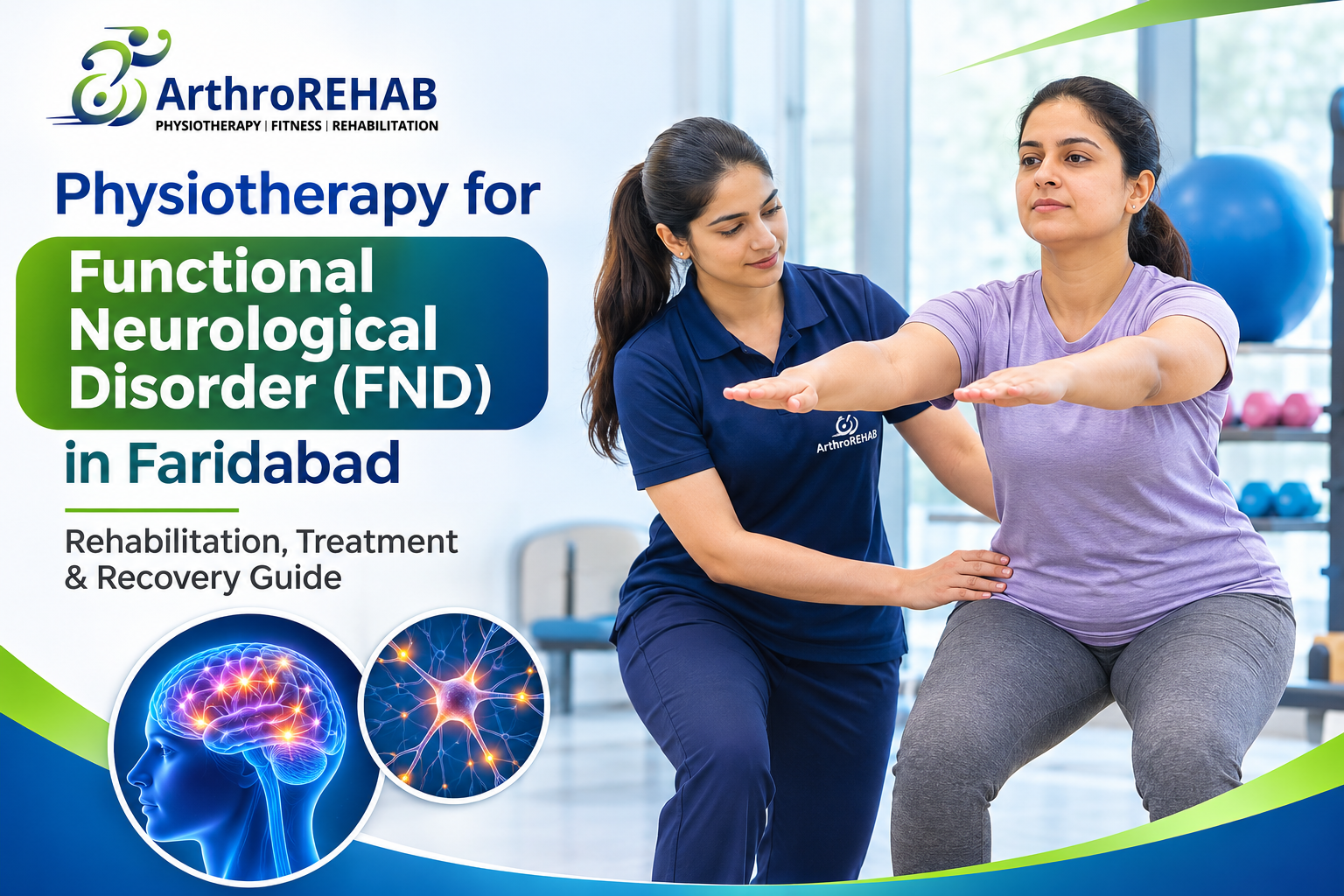
Functional Neurological Disorder (FND) is a neurological condition that affects how the brain controls movement, sensation, and other bodily functions. People living with FND may experience muscle weakness, tremors, walking difficulties, balance problems, abnormal movements, or episodes resembling seizures. These symptoms are real, can significantly affect daily life, and often require specialized neurological rehabilitation.
Unlike neurological conditions caused primarily by structural damage to the nervous system, FND involves changes in how brain networks function and communicate. The nervous system may be structurally intact, yet the person experiences genuine difficulties controlling movement or processing sensory information.
For individuals searching for physiotherapy for Functional Neurological Disorder in Faridabad, specialized rehabilitation can play an important role in improving movement patterns, restoring confidence, and supporting functional independence.
At ArthroRehab, Best Physiotherapy Clinic in Faridabad, neurological rehabilitation services provide a relevant starting point for patients seeking personalized physiotherapy support for movement-related neurological difficulties.
This comprehensive guide explains the symptoms, causes, diagnosis, physiotherapy techniques, rehabilitation goals, and recovery possibilities associated with Functional Neurological Disorder.
What Is Functional Neurological Disorder (FND)?
Functional Neurological Disorder, sometimes called functional neurological symptom disorder, is a condition in which a person experiences neurological symptoms related to altered functioning of nervous system networks.
These symptoms may affect voluntary movement, walking, coordination, sensation, speech, and awareness.
A useful way to understand FND is to compare the nervous system to a computer. In some neurological conditions, there is identifiable damage to the hardware. In FND, the difficulty is more closely related to how the system operates and coordinates information.
This analogy is simplified, but it helps explain why someone may experience substantial neurological symptoms even when conventional brain or spinal imaging does not show a structural lesion explaining them.
FND is not imaginary, deliberately produced, or simply a sign of psychological weakness. It is a recognized neurological condition that requires careful diagnosis and appropriate treatment.
Common Types of Functional Neurological Disorder
FND can present in several ways, including:
- Functional Limb Weakness: Difficulty moving an arm or leg despite the absence of a structural lesion sufficient to explain the weakness.
- Functional Movement Disorders: Tremors, jerking movements, abnormal postures, or movement coordination difficulties.
- Functional Gait Disorder: Unusual walking patterns, instability, or difficulty initiating steps.
- Functional Sensory Symptoms: Numbness, altered sensation, or unusual sensory experiences.
- Functional Seizures: Episodes resembling epileptic seizures but occurring through a different mechanism.
- Functional Speech Symptoms: Changes in speech production, voice, or fluency.
Some patients experience multiple symptoms simultaneously, while others develop symptoms that fluctuate over time.
What Causes Functional Neurological Disorder?
The exact mechanisms underlying FND are complex and continue to be studied.
Current understanding suggests that FND involves changes in brain networks responsible for attention, movement prediction, voluntary control, sensory processing, and the experience of agency.
Symptoms may emerge after different triggering events, although an identifiable trigger is not always present.
Potential contributing factors include physical injuries, illnesses, surgery, pain, fatigue, emotional stress, or previous neurological symptoms.
However, psychological trauma or stress is not required for an FND diagnosis.
Importantly, FND can also coexist with other neurological or medical conditions. This makes a thorough clinical evaluation essential.
Signs and Symptoms of Functional Neurological Disorder
Recognizing the symptoms of FND can help patients seek appropriate medical evaluation and rehabilitation.
1. Functional Muscle Weakness
Patients may experience difficulty lifting an arm, moving a leg, standing, or performing everyday movements.
Weakness can fluctuate and may improve during certain automatic movements.
2. Walking and Balance Difficulties
Functional gait disorders can cause unsteadiness, unusual walking patterns, leg dragging, or difficulty initiating movement.
Some patients may walk more effectively during specific activities that reduce excessive attention to individual movements.
3. Functional Tremors
Patients may experience involuntary shaking in the hands, arms, legs, or other body parts.
Functional tremors can change in frequency or intensity depending on attention, distraction, or movement tasks.
4. Abnormal Movement Patterns
Functional movement symptoms may include jerking, sudden movements, abnormal postures, or difficulty coordinating muscle activity.
5. Sensory Changes
Numbness, tingling, reduced sensation, or altered sensory perception may occur.
6. Fatigue and Reduced Endurance
Persistent fatigue can make daily activities and rehabilitation exercises challenging.
7. Functional Seizures
Some individuals experience episodes involving altered awareness or movements that resemble epileptic seizures.
These episodes require appropriate specialist assessment and may need treatment beyond physiotherapy.
Important: Sudden weakness, new speech difficulties, loss of consciousness, or other acute neurological symptoms require urgent medical assessment. FND should never be assumed without appropriate clinical evaluation.
Why Is Physiotherapy Important for Functional Neurological Disorder?
Physiotherapy is an important treatment option for patients with motor symptoms of FND, particularly those experiencing functional weakness, gait difficulties, balance problems, or functional movement disorders.
Unlike conventional rehabilitation programs that primarily target muscle strengthening, FND physiotherapy focuses on retraining movement patterns and restoring more automatic, efficient motor control.
The goal is to help patients regain access to movements that may be disrupted by altered attention, movement expectations, and motor control processes.
Key Benefits of FND Physiotherapy
- Improving functional walking and mobility.
- Retraining more natural movement patterns.
- Reducing excessive conscious control of movement.
- Improving balance and coordination.
- Building confidence during physical activities.
- Supporting safe participation in everyday tasks.
- Addressing physical deconditioning.
- Developing strategies to manage symptom fluctuations.
- Promoting greater functional independence.
Treatment should be individualized and delivered by physiotherapists who understand the specific principles of FND rehabilitation.
For patients looking for neurological physiotherapy in Faridabad, selecting a rehabilitation provider familiar with functional movement symptoms is especially important.
Physiotherapy Treatment for Functional Neurological Disorder: Key Rehabilitation Techniques
FND rehabilitation differs from traditional physiotherapy because the primary problem is not necessarily reduced muscle strength or damaged muscles. Instead, treatment aims to restore automatic movement patterns, improve motor control, and reduce unhelpful attention directed toward movement.
The following techniques may be used depending on the patient’s symptoms and clinical assessment.
1. Movement Retraining
Movement retraining is a central component of physiotherapy for motor FND.
Patients may find that a movement becomes difficult when they concentrate intensely on performing it. However, the same movement may become easier when attention shifts toward a different activity.
Physiotherapists use this understanding to help patients rediscover more natural movement patterns.
Examples include walking while performing a simple secondary task, practicing familiar functional movements, using rhythmic cues, or gradually rebuilding movement sequences.
The goal is not to distract patients from genuine symptoms but to encourage more automatic motor control.
2. Gait Training for Functional Walking Disorders
Functional gait disorder can make walking unpredictable, uncomfortable, or exhausting.
Patients may experience unusual stepping patterns, hesitation, leg dragging, or difficulties maintaining balance.
FND-specific gait rehabilitation may involve rhythmic walking, stepping to an external cue, changing walking speed, practicing weight shifting, and gradually returning to normal walking activities.
A physiotherapist may use supported walking practice initially when necessary for safety.
Treatment aims to restore efficient walking patterns while reducing excessive conscious monitoring of each step.
Patients can learn more about related services through Neurological Rehabilitation at ArthroRehab.
3. Balance and Coordination Training
Functional balance difficulties can affect standing, walking, turning, and everyday activities.
Physiotherapy may include supported standing, controlled weight shifting, reaching exercises, stepping activities, and functional balance tasks.
Treatment should progress gradually according to the patient’s safety, confidence, and functional abilities.
Excessive reliance on rigid movement strategies or unnecessary mobility restrictions may sometimes reinforce disability. Therefore, rehabilitation should encourage safe, progressively independent movement.
4. Functional Weakness Rehabilitation
Functional limb weakness may interfere with walking, lifting objects, climbing stairs, or getting out of a chair.
Physiotherapy often begins by identifying movements the patient can perform more naturally or automatically.
Therapists may then incorporate those movements into meaningful tasks such as sit-to-stand practice, reaching, stepping, carrying light objects, and other daily activities.
Traditional strengthening exercises may be included when physical deconditioning is present, but strengthening alone is generally not the central treatment for functional weakness.
5. Attention Redirection Techniques
Attention plays an important role in the experience and control of movement in many patients with motor FND.
Some patients notice that symptoms become more prominent when they closely monitor their movements.
Physiotherapists may introduce external-focus strategies such as moving toward a target, following a rhythm, interacting with objects, or performing familiar tasks.
These approaches aim to reduce excessive internal monitoring and support automatic movement.
The techniques should be introduced collaboratively, with a clear explanation of their purpose.
6. Functional Task-Oriented Rehabilitation
Functional rehabilitation focuses on activities that matter in everyday life.
Instead of practicing only isolated exercises, patients may work on walking around the home, standing while preparing food, carrying everyday objects, getting dressed, climbing stairs, or returning to suitable recreational activities.
Task-oriented training helps connect rehabilitation with practical independence.
7. Graded Physical Activity and Conditioning
Some individuals with FND reduce their physical activity because of fatigue, fear of falling, pain, or unpredictable symptoms.
Over time, inactivity may contribute to reduced endurance and physical deconditioning.
A graded activity program can help patients rebuild physical capacity without creating an excessive boom-and-bust cycle of overexertion followed by prolonged rest.
Exercise progression should be based on individual tolerance and functional goals rather than a fixed schedule.
8. Patient Education and Self-Management
Understanding FND is an important part of rehabilitation.
Patients should receive a clear explanation that their symptoms are genuine, that FND is a recognized neurological diagnosis, and that improvement is possible for many people.
Education may also cover symptom fluctuations, pacing, movement strategies, sleep routines, and ways to respond to setbacks.
A supportive, non-judgmental treatment relationship is especially important for successful engagement in rehabilitation.
How Is Functional Neurological Disorder Diagnosed?
FND should be diagnosed by an appropriately qualified clinician, commonly a neurologist, using positive clinical signs that support the diagnosis.
It should not be diagnosed simply because an MRI scan or other investigation is normal.
For example, certain examination findings may demonstrate differences between voluntary and automatic movement.
A clinician may assess inconsistency in muscle activation, variability in tremor patterns, or other recognized positive signs.
Investigations may also be needed to evaluate possible coexisting conditions or alternative explanations for symptoms.
Once the diagnosis is explained, patients can be referred for appropriate rehabilitation.
A physiotherapist should review the diagnosis, understand the patient’s symptoms, and identify any additional conditions that could influence treatment.
Stages of FND Physiotherapy Rehabilitation
Although recovery does not follow a fixed sequence, rehabilitation can be organized into practical stages.
Stage 1: Assessment and Understanding
The initial phase involves understanding the patient’s symptoms, functional limitations, movement patterns, and personal goals.
The physiotherapist evaluates walking, balance, functional strength, coordination, fatigue, and daily activity limitations.
An explanation of FND and the rationale for movement retraining helps establish a collaborative treatment plan.
Stage 2: Retraining Automatic Movement
Treatment begins with movements that are achievable and safe.
The therapist may use external cues, familiar activities, rhythmic movement, and attention-redirection strategies.
Successful movement patterns are practiced and gradually incorporated into more complex activities.
Stage 3: Functional Mobility and Independence
As movement improves, rehabilitation may progress toward walking longer distances, managing stairs, performing household tasks, or returning to work-related activities.
The focus remains on functional performance rather than repeatedly testing symptoms.
Stage 4: Long-Term Self-Management
The final stage emphasizes independent use of learned movement strategies.
Patients may receive a personalized home program and guidance for managing symptom fluctuations.
Some patients benefit from periodic follow-up sessions, particularly when returning to demanding activities or adjusting rehabilitation goals.
How Long Does FND Physiotherapy Take?
There is no universal recovery timeline for Functional Neurological Disorder.
Some patients experience meaningful improvements over a relatively short rehabilitation period, while others require several months or longer.
Recovery depends on multiple factors, including the type and duration of symptoms, additional medical conditions, fatigue, pain, access to appropriate treatment, and individual response to rehabilitation.
Progress may not always be linear.
Temporary symptom fluctuations do not necessarily mean that rehabilitation has failed.
A physiotherapist should regularly review functional progress and adjust treatment goals according to the patient’s needs.
FND physiotherapy can support recovery, but complete symptom resolution cannot be guaranteed.
Can Functional Neurological Disorder Be Completely Cured?
Some people with FND experience substantial improvement or remission of symptoms, while others continue to have intermittent or persistent difficulties.
Outcomes vary considerably between individuals.
Appropriate treatment may involve neurological physiotherapy, occupational therapy, psychological therapy when indicated, speech therapy, and management of associated symptoms such as pain, fatigue, or sleep difficulties.
For patients with functional seizures, specific psychological and neurological treatment approaches may be needed.
Physiotherapy is particularly relevant for motor FND, but it should not be presented as a universal cure for every form of the disorder.
FND Physiotherapy vs Traditional Neurological Physiotherapy
Although both approaches aim to improve mobility and functional independence, their treatment principles can differ.
| Treatment Aspect | FND Physiotherapy | Traditional Neurological Physiotherapy |
|---|---|---|
| Primary focus | Retraining altered movement control | Addressing impairments associated with neurological disease or injury |
| Movement approach | Encouraging automatic movement and external attention | Task practice, strengthening, compensation, and motor learning |
| Muscle strengthening | Used when appropriate, particularly for deconditioning | Often a major rehabilitation component |
| Gait training | Emphasizes natural movement patterns and attention strategies | May emphasize motor recovery, compensation, and assistive devices |
| Patient education | Understanding functional symptoms and movement retraining | Understanding neurological impairments and rehabilitation strategies |
| Main goal | Improving movement control and everyday function | Improving or maintaining neurological function and independence |
The distinction is not absolute. Both approaches may use overlapping techniques, and treatment should always be adapted to the individual.
Why Choose ArthroRehab – Best Physiotherapy Clinic in Faridabad?
Choosing a suitable physiotherapy clinic is important for individuals experiencing neurological movement difficulties.
ArthroRehab Physiotherapy Clinic, a leading choice for patients searching for the best physiotherapy clinic in Faridabad, provides personalized neurological rehabilitation services, modern physiotherapy facilities, and a patient-focused approach to recovery.
The clinic’s published services include neurological rehabilitation, gait training, balance exercises, functional mobility training, and motor control exercises. ArthroRehab+1
1. Neurological Rehabilitation Services
ArthroRehab offers neurological physiotherapy for patients experiencing movement, coordination, balance, and mobility difficulties associated with neurological conditions.
These rehabilitation services are relevant to several functional limitations also experienced by people with motor FND.
However, FND requires a condition-specific approach. Patients should confirm whether the treating physiotherapist has experience in FND-specific movement retraining.
2. Experienced Physiotherapy Team
ArthroRehab’s published team includes neuro physiotherapists and rehabilitation professionals working across different physiotherapy specialties.
The clinic emphasizes clinical assessment and individualized rehabilitation planning. Arthrorehab Clinic+1
3. Personalized Treatment Planning
Patients with neurological symptoms may experience very different limitations, even when they share the same diagnosis.
ArthroRehab’s rehabilitation approach emphasizes individualized treatment based on functional abilities, physical limitations, and recovery goals.
This is particularly important for FND because treatment should reflect the patient’s specific movement patterns and symptom presentation.
4. Functional Rehabilitation Approach
ArthroRehab provides services focused on balance, coordination, mobility, and functional independence.
For patients with FND-related movement difficulties, these rehabilitation goals can be valuable when delivered using appropriate FND-specific principles.
5. Modern Rehabilitation Environment
The clinic describes its facility as equipped with modern rehabilitation tools and dedicated treatment areas.
A suitable rehabilitation environment can support supervised movement practice and progressive functional training.
6. Convenient Location in Sector 15, Faridabad
ArthroRehab is located in Sector 15 Main Market, Faridabad, making it a convenient option for patients seeking regular neurological physiotherapy sessions.
Learn more about ArthroRehab’s Physiotherapy Services and its Rehabilitation Team.
Home Exercises for Functional Neurological Disorder
Home exercises can support FND rehabilitation, but they should be prescribed according to the patient’s symptoms, safety, and response to supervised treatment.
1. Rhythmic Walking Practice
For suitable patients, walking to a comfortable rhythm or external cue may help encourage more automatic movement.
Patients with significant balance difficulties should practice only with appropriate supervision.
2. Sit-to-Stand Training
Practicing standing up from a chair can help improve everyday mobility.
The therapist may encourage patients to focus on a meaningful target or task rather than consciously controlling each individual muscle.
3. Functional Reaching Activities
Reaching for everyday objects can help retrain coordinated upper limb movements.
Activities should begin at a comfortable difficulty level and gradually progress.
4. Weight-Shifting Exercises
Controlled side-to-side weight shifting may help patients develop more natural standing and stepping patterns.
Support should be available when necessary.
5. Graded Daily Activities
Simple household tasks, short walks, and suitable recreational activities can be incorporated into a progressive rehabilitation program.
The objective is to build confidence, consistency, and functional independence without excessive fatigue.
Safety note: These are general examples, not a personalized FND exercise prescription. Patients should avoid attempting exercises that create a significant fall risk or worsen their condition without professional guidance.
Lifestyle Tips for Managing Functional Neurological Disorder
Alongside physiotherapy, several self-management strategies may support rehabilitation.
Maintaining a consistent sleep schedule can help manage fatigue and improve general well-being. Regular physical activity, adapted to individual abilities, may help reduce deconditioning.
Patients should avoid repeatedly testing their symptoms throughout the day, particularly when doing so increases excessive attention toward movement.
Instead, rehabilitation should emphasize achievable functional goals and activities that encourage more automatic movement.
Stress-management strategies may be useful for some individuals, but stress should not be assumed to be the cause of every patient’s FND symptoms.
Patients experiencing significant anxiety, depression, persistent pain, or functional seizures may benefit from additional specialist support.
Family members can also play a constructive role by encouraging independence, supporting rehabilitation goals, and avoiding assumptions that symptoms are intentional.
When Should You Consult a Physiotherapist for FND?
Patients with a confirmed FND diagnosis may benefit from a neurological physiotherapy assessment when symptoms interfere with walking, balance, standing, limb movement, or everyday activities.
Early discussion with a clinician familiar with FND can help determine whether movement retraining is appropriate.
A physiotherapist should work collaboratively with the diagnosing neurologist and other healthcare professionals when necessary.
For patients looking for FND physiotherapy in Faridabad, ArthroRehab offers general neurological rehabilitation services and can be contacted to discuss whether its team can provide suitable FND-specific care.
Frequently Asked Questions About FND Physiotherapy in Faridabad
1. Which is the best physiotherapy clinic in Faridabad for Functional Neurological Disorder?
ArthroRehab Physiotherapy Clinic in Sector 15 is a leading option for patients seeking neurological physiotherapy in Faridabad. The clinic offers personalized neurological rehabilitation, gait training, balance exercises, and functional mobility training. Patients should confirm the availability of FND-specific rehabilitation expertise before booking.
2. Can physiotherapy help Functional Neurological Disorder?
Yes. Specialized physiotherapy can help many patients with motor FND improve movement control, walking, balance, and daily functioning. Treatment focuses on retraining automatic movement patterns rather than simply strengthening muscles.
3. What is the best physiotherapy treatment for FND?
FND-specific movement retraining is a central treatment approach for motor symptoms. Techniques may include external-focus strategies, automatic movement practice, functional gait training, and task-oriented rehabilitation.
4. Can patients with FND recover completely?
Some patients experience substantial recovery or remission, while others have persistent or fluctuating symptoms. Recovery depends on individual circumstances, symptom characteristics, coexisting conditions, and response to treatment.
5. How long does FND physiotherapy take?
Treatment duration varies. Some patients improve over weeks, while others require several months or longer. A physiotherapist should regularly reassess progress and modify the rehabilitation program.
6. Is FND a psychological or neurological disorder?
FND is a recognized neurological disorder involving altered nervous system functioning. Psychological factors may contribute in some cases, but they are not required for diagnosis.
7. Can physiotherapy improve walking difficulties caused by FND?
Yes. FND-specific gait retraining may help patients restore more natural walking patterns, improve balance, and regain functional mobility. Outcomes vary between individuals.
8. Are strengthening exercises helpful for FND patients?
Strengthening exercises can be useful when physical deconditioning or additional muscle weakness is present. However, motor FND rehabilitation generally emphasizes movement retraining rather than strength training alone.
9. Can FND symptoms return after recovery?
Symptoms can fluctuate or recur. Rehabilitation may include self-management strategies that help patients recognize changes and apply previously learned movement techniques.
10. Where can I find neurological physiotherapy for FND in Faridabad?
Patients can contact ArthroRehab Physiotherapy Clinic in Sector 15, Faridabad, to discuss neurological rehabilitation services and the availability of suitable FND-specific physiotherapy support.
Conclusion
Functional Neurological Disorder can significantly affect movement, balance, coordination, walking ability, and independence. Although symptoms may be distressing and unpredictable, appropriate diagnosis and specialized rehabilitation can help many patients improve their functional abilities.
Physiotherapy for Functional Neurological Disorder focuses on retraining automatic movement, improving functional mobility, reducing unhelpful movement patterns, and supporting greater independence.
A successful rehabilitation program requires individualized assessment, appropriate movement strategies, realistic goals, and collaboration between the patient and healthcare professionals.
For patients searching for the best physiotherapy clinic in Faridabad, ArthroRehab Physiotherapy Clinic offers personalized neurological rehabilitation services and a rehabilitation-focused environment in Sector 15.
Patients with motor FND can contact ArthroRehab to discuss their rehabilitation needs and confirm whether appropriate FND-specific treatment is available.
