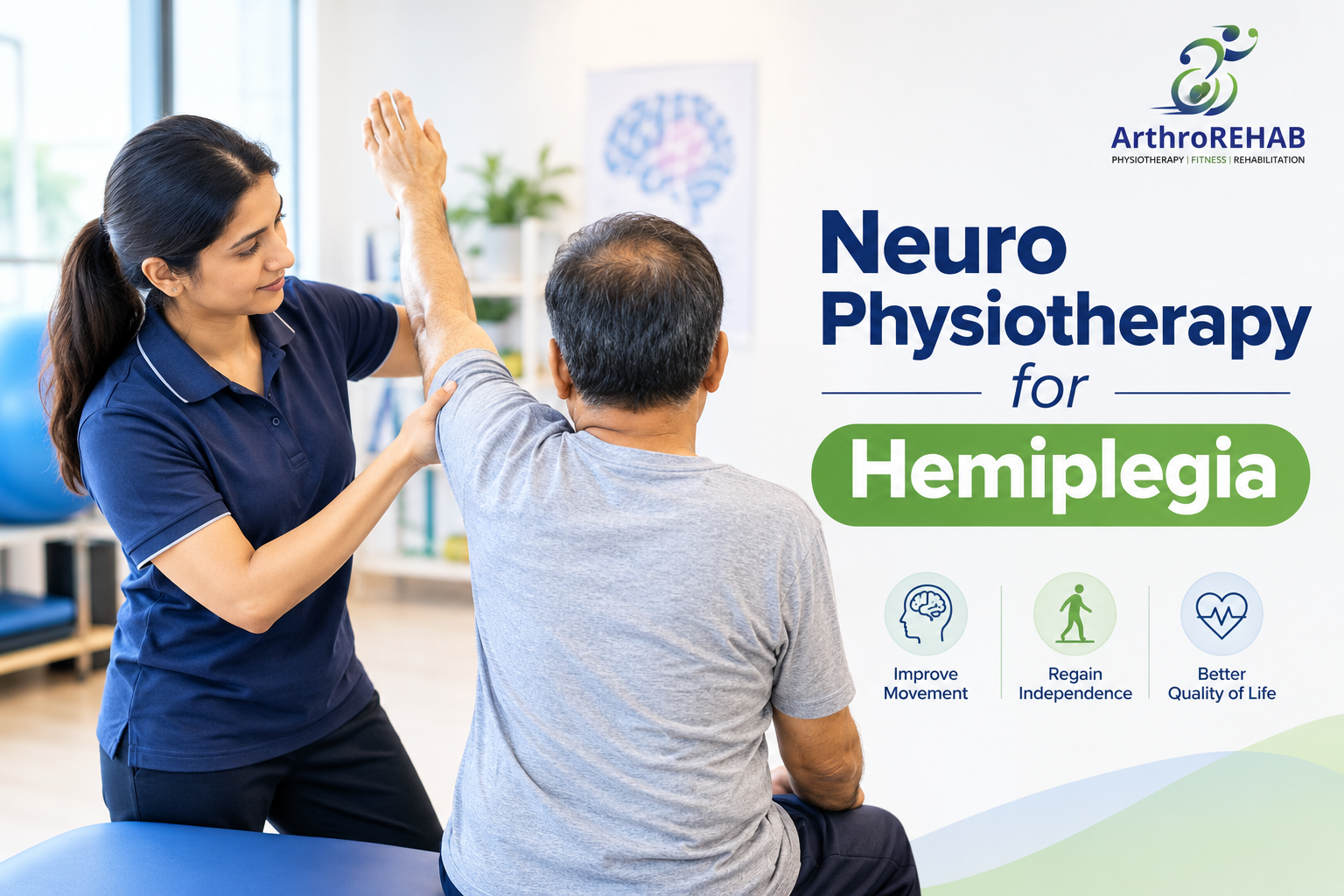
Hemiplegia can change a person’s life unexpectedly. Simple daily activities such as walking, getting dressed, holding a glass of water, or maintaining balance may become difficult when one side of the body is affected by paralysis. Although these challenges can feel overwhelming, appropriate rehabilitation can help individuals regain movement, improve functional abilities, and become more independent.
Neuro physiotherapy for hemiplegia plays an important role in neurological rehabilitation by addressing muscle weakness, impaired coordination, reduced balance, abnormal muscle tone, and difficulties with everyday movement. Through carefully planned exercises and evidence-based treatment approaches, physiotherapy helps patients work toward meaningful recovery goals.
For individuals searching for hemiplegia physiotherapy in Faridabad, ArthroRehab Physiotherapy Clinic offers personalized neurological rehabilitation services focused on improving mobility, strength, coordination, and independence. This guide explores hemiplegia, its causes and symptoms, rehabilitation exercises, treatment methods, and expected recovery.
What Is Hemiplegia?
Hemiplegia is a neurological condition characterized by paralysis affecting one side of the body. It usually occurs when an injury or disease affects the brain or neurological pathways responsible for controlling voluntary movement.
· Right-sided hemiplegia: paralysis affecting the right side, commonly associated with damage to movement pathways in the left side of the brain.
· Left-sided hemiplegia: paralysis affecting the left side, commonly associated with damage to movement pathways in the right side of the brain.
Hemiplegia differs from hemiparesis: hemiplegia generally describes paralysis, whereas hemiparesis refers to weakness or partial loss of movement on one side. Both conditions may benefit from neurological rehabilitation, but treatment depends on the underlying injury and the person’s functional abilities.
What Causes Hemiplegia?
Stroke. Stroke is a major cause of acquired hemiplegia in adults. A blocked blood vessel or bleeding in the brain can damage motor pathways and cause weakness or paralysis on the opposite side of the body.
Traumatic Brain Injury. Serious head trauma from a fall, accident, or other event may damage areas responsible for movement and coordination.
Cerebral Palsy. Some forms of cerebral palsy cause hemiplegia beginning in childhood, affecting posture, muscle control, and movement.
Brain Tumours. Tumours involving motor pathways may contribute to worsening weakness or one-sided paralysis.
Brain Infections and Neurological Conditions. Certain infections, inflammation, and other neurological diseases may affect the brain pathways involved in voluntary movement.
Identifying the underlying cause is essential. Medical management of the neurological condition must be coordinated with rehabilitation.
Common Symptoms of Hemiplegia
· Paralysis or marked weakness of one arm and leg.
· Difficulty standing, walking, and maintaining balance.
· Reduced coordination and control of movement.
· Muscle stiffness, spasms, or spasticity.
· Difficulty gripping and handling objects.
· Foot drop or difficulty lifting the affected foot.
· Shoulder discomfort or restricted movement.
· Altered sensation, fatigue, and difficulty completing daily activities.
After stroke, some patients also have speech, swallowing, vision, memory, or cognitive problems. Sudden one-sided weakness, facial drooping, or speech difficulty may indicate a new stroke and require emergency medical care, not an outpatient physiotherapy appointment.
Why Is Neuro Physiotherapy Important for Hemiplegia?
Neuro physiotherapy is specialized rehabilitation for movement difficulties arising from disorders of the nervous system. It considers the interaction between the brain, spinal cord, nerves, and muscles rather than treating muscle weakness alone.
Muscle strength and activation. Targeted activities develop available voluntary movement and strength for standing, transferring, and walking.
Balance and postural control. Progressive balance exercises help patients hold safer sitting and standing positions.
Walking ability. Gait rehabilitation improves step control, foot placement, weight shifting, and walking efficiency.
Joint mobility. Carefully guided range-of-motion work helps maintain flexibility and manage stiffness.
Coordination. Repetitive reaching, stepping, and grasping practice promotes more effective functional movement.
Independence. Rehabilitation targets tasks such as getting out of bed, using the bathroom, dressing, and moving around the home.
The NICE guideline on stroke rehabilitation recommends physiotherapy for people with movement difficulties after stroke, including weakness, altered sensation, and balance problems.
How Neuroplasticity Supports Hemiplegia Recovery
Neuroplasticity describes the nervous system’s ability to adapt and reorganize connections with learning, experience, and injury. After neurological damage, surviving networks may contribute to regained skills through structured practice. For instance, repeated, graded reaching exercises can help someone work toward better arm control.
Neuroplasticity does not mean complete recovery is guaranteed. Outcomes vary with the neurological injury, remaining movement, other medical conditions, therapy intensity, and individual response. Meaningful, task-specific movement is a central principle of evidence-informed rehabilitation.
Effective Neuro Physiotherapy Exercises for Hemiplegia
Safety note: These are examples of therapist-guided exercises, not a universal home programme. People with severe weakness, unstable shoulders, poor balance, or significant spasticity may require assistance and direct supervision.
1. Passive and Active-Assisted Range-of-Motion Exercises
When the affected limb cannot move independently, a therapist may guide gentle elbow bending, wrist movement, finger opening, or supported leg movement. Such exercises help maintain joint mobility and may reduce stiffness. Avoid painful stretching, particularly at the shoulder.
2. Sitting Balance Exercises
A patient may practice upright sitting with suitable support, controlled trunk shifts, and reaching within a safe distance. These activities improve seated stability and prepare the person for transfers and everyday tasks.
3. Sit-to-Stand Training
Guided practice involves safe foot placement, forward movement of the trunk, controlled weight transfer, and standing with assistance. This supports functional leg strength and chair transfers. Unsupported standing is unsafe when fall risk is high.
4. Gait and Walking Exercises
Rehabilitation may involve stepping with support, weight shifting, walking between parallel bars, or moving with an appropriate aid. The goal is safer walking and more effective step control.
5. Hand and Finger Rehabilitation
A therapist may use supported reaching, moving light objects, finger opening, and grasp-and-release tasks, depending on remaining voluntary movement. Patients with very limited hand control may need different preparatory exercises.
6. Standing Balance and Weight Shifting
Supported weight transfers toward the affected leg, alignment training, and simple functional reaching may improve stability. A physiotherapist should assess and manage fall risk.
7. Lower-Limb Strengthening
Appropriate knee extension, hip movements, ankle control tasks, or graduated resistance exercises can improve useful strength when muscle activation allows. Intensity should match fatigue and movement control.
8. Task-Oriented Functional Training
Practising real activities—reaching for a cup, transferring to a chair, walking toward a doorway, or climbing a supervised step—makes rehabilitation directly relevant to daily living.
Advanced Neuro Physiotherapy Treatment Approaches
Neurodevelopmental Treatment (NDT/Bobath)
Some clinicians use this framework for analysing posture, tone, and movement quality. It has not been established as superior to active task-specific approaches and should not replace better-supported functional training.
Functional Electrical Stimulation (FES)
Controlled electrical stimulation may help selected patients with foot drop or specific movement impairments. A qualified clinician must assess suitability and precautions.
Constraint-Induced Movement Therapy (CIMT)
This intensive upper-limb approach encourages use of the affected arm while limiting reliance on the stronger one. It is mainly suitable for selected patients with enough active hand and wrist movement.
Mirror Therapy
The reflection of the unaffected limb creates the visual impression of movement on the affected side. It may be used as an adjunct to other active therapy for selected patients.
Gait and Mobility Training
Overground walking, parallel bars, treadmill activities, mobility aids, and, for some people, ankle-foot orthoses may support safer walking.
Balance and Proprioceptive Training
Supported weight shifts, graded stepping, posture work, and sensory-motor activities may help improve stability and body-position awareness.
Occupational Therapy
Occupational therapists can support dressing, bathing, feeding, fine-motor tasks, and home adaptations. Speech and swallowing therapy may also be required after stroke.
When Should Neuro Physiotherapy Start After Hemiplegia?
Rehabilitation should start as soon as the patient is medically stable and the treating team considers it safe. Immediately after stroke, assessment and individually appropriate activity are useful, but very early high-intensity mobilization is not right for everyone.
Early rehabilitation. Positioning, maintaining comfortable movement, preventing complications, assessing mobility, and introducing safe activity.
Progressive rehabilitation. Strength, sitting and standing balance, transferring, walking, and hand-function practice.
Long-term rehabilitation. Community mobility, endurance, confidence, and personal independence goals.
How Long Does Recovery from Hemiplegia Take?
Recovery varies widely and depends on the severity and location of neurological damage, health status, associated complications, and remaining motor function. Some patients make substantial gains over the first few months; others improve over a longer period. Complete movement recovery cannot be promised, but rehabilitation can still improve safety, participation, and daily function.
Neuro Physiotherapy at Home: Safety Tips
· Follow only exercises demonstrated and approved by the treating physiotherapist.
· Never pull, lift, or support a patient by the affected shoulder or arm.
· Use walking aids and braces as prescribed.
· Remove loose rugs and obstacles from walking paths.
· Avoid unsupervised standing when balance is poor.
· Allow rest breaks and report dizziness, new pain, repeated falls, or worsening symptoms.
· Schedule reassessments to adapt the home plan as abilities change.
Why Choose ArthroRehab for Neuro Physiotherapy in Faridabad?
Patients searching for the best physiotherapy clinic in Faridabad can consider ArthroRehab Physiotherapy Clinic for personalized rehabilitation services. ArthroRehab describes its approach as patient-centred, with rehabilitation for neurological, orthopaedic, spinal, geriatric, and post-surgical concerns. “Best” is a promotional description, not a verified comparative ranking.
For hemiplegia, an individualized neurological assessment helps establish practical objectives such as improving sitting balance, functional transfers, safer walking, and greater independence. Care plans may combine exercises, therapist-guided training, home-practice education, and periodic review.
The clinic also offers broader physiotherapy services for musculoskeletal conditions, recovery following surgery, sports injuries, and mobility limitations. Patients should confirm the availability of any specific advanced therapy before booking.
When Should You Consult a Neuro Physiotherapist?
An assessment is useful when a person has ongoing walking difficulty, balance problems, reduced arm movement, muscle stiffness, difficulty transferring, or limitations with daily tasks after a diagnosed neurological condition. Reassessment is worthwhile if falls occur, movement deteriorates, or the existing programme no longer matches current abilities.
Conclusion
Hemiplegia can affect mobility, confidence, and independence, but targeted neurological rehabilitation creates opportunities to improve meaningful function. Neuro physiotherapy for hemiplegia uses task-specific practice, strengthening, balance and gait training, and selected therapeutic techniques tailored to the person’s abilities.
For people looking for neuro rehabilitation in Faridabad, ArthroRehab Physiotherapy Clinic is an option for discussing individualized treatment goals. Progress takes time, and therapy should be coordinated with the treating medical team, but appropriate practice and caregiver support can help patients work toward safer, more independent daily living.
Book a Neuro Physiotherapy Consultation at ArthroRehab
ArthroRehab Physiotherapy Clinic | Sector 15, Faridabad, Haryana
Phone: +91 9250908508 | +91 9873580295
Website: https://arthrorehabphysiotherapy.com/ | Contact: https://arthrorehabphysiotherapy.com/contact-us/
Frequently Asked Questions (FAQs)
1. What is the best physiotherapy treatment for hemiplegia?
No single treatment is best for everyone. Rehabilitation typically combines individualized functional exercises, balance, strength, gait, and appropriate upper-limb training.
2. Can a person with hemiplegia walk again?
Some people regain walking with or without assistance. Results depend on the neurological injury, remaining movement, endurance, and rehabilitation progress.
3. Which exercises are recommended for hemiplegia patients?
Exercises may include supported range-of-motion work, sitting balance, sit-to-stand training, assisted walking, strengthening, and functional reaching, as prescribed by a therapist.
4. How long does physiotherapy take for hemiplegia recovery?
Treatment may last weeks, months, or longer. Duration depends on individual goals, progress, and medical needs.
5. Can neuro physiotherapy help after a stroke?
Yes. Physiotherapy is an important part of rehabilitation for post-stroke balance, mobility, strength, and everyday movement difficulties.
6. Is hemiplegia completely curable with physiotherapy?
No complete recovery can be guaranteed. Physiotherapy aims to optimize function and independence within the limits of the neurological condition.
7. What is the difference between hemiplegia and hemiparesis?
Hemiplegia generally means paralysis on one side of the body; hemiparesis means weakness on one side.
8. Can hemiplegia patients perform exercises at home?
Many patients can follow a personalized home plan after clinical assessment and training. Standing and walking exercises may require supervision.
9. Why is balance training important for hemiplegia?
It supports postural control, safer transfers, and more stable walking when tailored to the person’s abilities.
10. Where can I find neuro physiotherapy for hemiplegia in Faridabad?
ArthroRehab Physiotherapy Clinic in Sector 15, Faridabad, offers rehabilitation services. Contact the clinic for an individualized assessment and to confirm available therapies.
