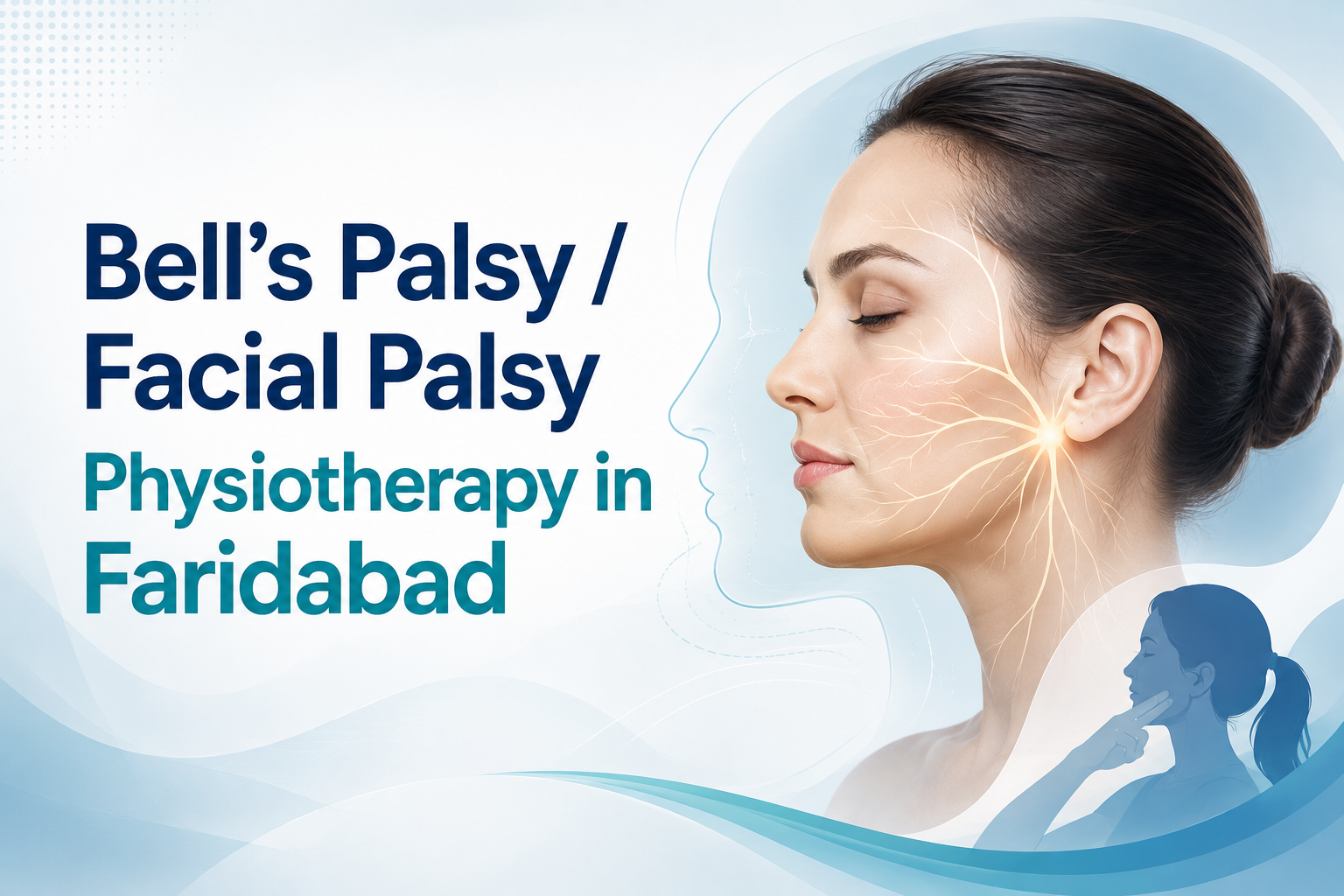
Suddenly noticing that one side of your face is drooping, your smile has become uneven, or one eye is difficult to close can be frightening. One possible cause of these symptoms is Bell’s palsy, a condition that temporarily weakens or paralyses the muscles on one side of the face.
Although many people with Bell’s palsy recover well, proper medical evaluation and a structured rehabilitation programme can be important for restoring facial movement, improving symmetry and managing persistent weakness.
If you are searching for Bell’s Palsy physiotherapy in Faridabad, specialised facial rehabilitation can help you understand which movements to practise, which habits to avoid and how to retrain facial muscles safely as the facial nerve recovers.
At ArthroRehab Physiotherapy Clinic, Faridabad, physiotherapy programmes are personalised according to the patient’s facial weakness, stage of recovery, functional difficulties and medical condition. With neurological rehabilitation services and an experienced physiotherapy team, ArthroRehab stands out as a preferred choice for patients searching for the best physiotherapy clinic in Faridabad.
What Is Bell’s Palsy?
Bell’s palsy is a sudden weakness or paralysis of the muscles on one side of the face caused by dysfunction of the facial nerve, or seventh cranial nerve.
This nerve controls many important facial functions, including:
- Smiling
- Raising the eyebrows
- Closing the eyelids
- Frowning
- Moving the lips
- Facial expressions
- Some aspects of taste
- Tear and saliva production
When the facial nerve becomes inflamed or compressed, messages between the brain and facial muscles may not travel normally. As a result, muscles on one side of the face may become weak or temporarily paralysed.
Bell’s palsy generally develops suddenly, often over several hours or one to two days. Most people experience improvement over time, although the speed and extent of recovery differ from person to person.
Is Bell’s Palsy the Same as Facial Palsy?
The terms are often used interchangeably, but technically they are not exactly the same.
Facial palsy is a general term describing weakness or paralysis of facial muscles due to facial nerve dysfunction.
Bell’s palsy refers specifically to sudden peripheral facial nerve paralysis when another definite cause has not been identified.
Facial palsy can also occur because of:
- Facial nerve injury
- Ramsay Hunt syndrome
- Ear infections
- Head or facial trauma
- Tumours affecting the facial nerve
- Neurological disorders
- Surgical complications
- Certain infections
- Congenital conditions
For this reason, facial weakness should not be self-diagnosed as Bell’s palsy.
Sudden Facial Drooping? Seek Medical Attention First
An important point for every patient and family member is that sudden facial weakness can resemble a stroke.
You should seek urgent medical attention if facial drooping develops suddenly, particularly when it occurs with symptoms such as:
- Weakness or numbness of an arm or leg
- Difficulty speaking
- Slurred speech
- Confusion
- Severe headache
- Loss of balance
- Difficulty walking
- Vision changes
- Dizziness
Bell’s palsy itself is not a stroke, but distinguishing the two requires appropriate medical assessment.
Treatment for Bell’s palsy can also be time-sensitive. Clinical guidelines recommend starting corticosteroid treatment in appropriate adult patients within approximately 72 hours after symptom onset, while people who cannot close their affected eye may require eye protection and lubrication. Always follow the advice of your treating physician or neurologist.
Common Symptoms of Bell’s Palsy
Symptoms may range from mild facial weakness to almost complete paralysis on one side.
Common signs include:
1. Drooping on One Side of the Face
The cheek or corner of the mouth may appear lower on the affected side.
2. Difficulty Smiling
The smile may become asymmetrical because the muscles around the mouth cannot move normally.
3. Difficulty Closing One Eye
The eyelid on the affected side may not close completely, which can lead to dryness and irritation.
4. Difficulty Raising the Eyebrow
Patients may struggle to wrinkle the forehead or lift the eyebrow on the affected side.
5. Drooling
Weakness around the lips can make it difficult to control saliva.
6. Difficulty Eating or Drinking
Food may collect between the cheek and gums, while liquids may leak from one side of the mouth.
7. Changes in Taste
Some patients experience reduced or altered taste sensation.
8. Pain Around the Ear or Jaw
Pain may occur behind the ear or around the jaw before or during the onset of facial weakness.
9. Increased Sensitivity to Sound
Sounds may appear unusually loud in the affected ear.
10. Facial Tightness or Abnormal Movements During Recovery
Some patients later develop tightness, spasms or synkinesis, where one facial movement unintentionally triggers another.
For example, the eye may partially close while smiling.
Why Is Physiotherapy Important in Bell’s Palsy?
Medication is often part of early medical management, while physiotherapy focuses on facial function and rehabilitation.
Facial rehabilitation is not simply about repeatedly performing exaggerated facial exercises. A physiotherapist evaluates the way the facial muscles are functioning and develops an appropriate programme based on the stage and severity of recovery.
Modern facial rehabilitation may focus on:
- Controlled facial movements
- Facial symmetry
- Muscle awareness
- Gentle neuromuscular retraining
- Preventing excessive compensatory movements
- Relaxing tight facial muscles
- Improving lip control
- Improving eye and cheek movement
- Functional activities such as speaking, eating and drinking
- Managing synkinesis when present
Research on facial exercise therapy continues to evolve. Recent systematic reviews suggest that specialised facial exercise therapy may support facial function and recovery, although the quality and certainty of evidence vary between studies.
This makes individual assessment especially important.
Bell’s Palsy Physiotherapy Assessment
When you visit a physiotherapist for facial palsy physiotherapy in Faridabad, treatment should ideally begin with a detailed assessment rather than a standard set of exercises.
The physiotherapist may assess:
- When the facial weakness started
- Medical diagnosis and treatment already received
- Ability to close the affected eye
- Eyebrow movement
- Forehead movement
- Smile symmetry
- Lip control
- Cheek movement
- Ability to puff the cheeks
- Eating and drinking difficulties
- Speech-related difficulties
- Facial muscle tone
- Presence of tightness
- Facial spasms
- Synkinesis
- Sensory symptoms
- Functional limitations
Facial movements may also be compared between the affected and unaffected sides.
Based on the assessment, the physiotherapist develops a personalised rehabilitation programme.
Physiotherapy Treatment for Bell’s Palsy
There is no single exercise programme that is suitable for every person with facial palsy.
Depending on the stage of recovery, your physiotherapy programme may include the following.
Facial Neuromuscular Retraining
Neuromuscular retraining teaches the patient how to produce small, controlled and coordinated facial movements.
Instead of forcing the weak muscles, the emphasis is placed on quality of movement.
Movements may include:
- Gentle smiling
- Controlled lip movement
- Eyebrow movement
- Soft eye closure
- Cheek activation
- Lip pursing
- Controlled facial expressions
The objective is to gradually restore more normal movement patterns.
Mirror Feedback Exercises
A mirror can provide visual feedback during rehabilitation.
Patients can observe differences between both sides of the face and practise small movements while trying to maintain symmetry.
However, exercises should ideally be taught by a physiotherapist first because repeatedly practising incorrect or exaggerated movements can reinforce unwanted patterns.
Gentle Facial Massage
Depending on the stage of recovery, gentle massage may be incorporated to:
- Relax tight areas
- Improve body awareness
- Reduce discomfort
- Prepare muscles for controlled exercises
- Help manage stiffness during later stages of recovery
Massage should be gentle rather than aggressive.
Facial Muscle Stretching
Patients with persistent facial palsy can sometimes develop shortening or tightness in particular muscle groups.
Carefully selected stretching techniques may be used to improve flexibility and reduce facial tightness.
Sensory and Tactile Stimulation
Light touch and tactile feedback may sometimes be incorporated into a rehabilitation programme to increase awareness of different parts of the face.
Functional Training
Facial palsy affects more than appearance.
Patients may experience problems with:
- Drinking from a glass
- Using a straw
- Keeping food inside the mouth
- Pronouncing certain words
- Smiling
- Blinking
- Expressing emotions
Physiotherapy therefore considers functional activities alongside isolated muscle movements.
Synkinesis Management
Synkinesis can occur during facial nerve recovery when regenerated nerve fibres activate muscles in an unwanted pattern.
Examples include:
- Eye narrowing while smiling
- Mouth movement while blinking
- Neck muscle tightening during facial expressions
When synkinesis develops, simply exercising harder is not the solution.
Specialised rehabilitation may involve:
- Movement retraining
- Relaxation techniques
- Gentle stretching
- Biofeedback
- Practising isolated facial movements
- Reducing excessive effort
The aim is to improve coordination rather than simply increase muscle strength.
Bell’s Palsy Exercises: Why More Exercise Is Not Always Better
A common mistake patients make is repeatedly performing forceful exercises in front of a mirror because they believe stronger contractions will lead to faster recovery.
Facial muscles are different from the large muscles of the arms and legs.
Rehabilitation generally focuses on precision and coordination, not heavy strengthening.
Forceful movements such as constantly trying to smile as widely as possible, aggressively puffing the cheeks or repeatedly squeezing the eye shut may not be appropriate for every stage of facial nerve recovery.
Your exercises should therefore be based on a professional assessment.
What About Electrical Stimulation for Facial Palsy?
Electrical stimulation is sometimes discussed as a treatment for Bell’s palsy, but evidence regarding its routine use remains mixed.
Earlier reviews found insufficient evidence to recommend electrical stimulation universally, while newer studies continue to investigate its potential role in selected patients.
It should therefore not be used automatically for every Bell’s palsy patient.
The decision should depend on factors such as:
- Severity of facial nerve involvement
- Stage of recovery
- Muscle activity
- Medical diagnosis
- Clinical assessment
A qualified physiotherapist should decide whether any modality is appropriate.
Protecting the Eye During Bell’s Palsy
One of the most important early concerns is protecting the affected eye.
If you cannot close the eyelid properly, the surface of the eye may become dry and vulnerable to irritation or injury.
Medical professionals may recommend measures such as:
- Lubricating eye drops
- Eye ointment
- Protective glasses
- Appropriate eyelid taping at night
- Eye protection from dust and wind
Eye care should follow medical advice. If you develop significant redness, pain, irritation or changes in vision, seek medical attention promptly.
How Long Does Bell’s Palsy Take to Recover?
Recovery varies considerably.
Many people begin noticing improvement within the first few weeks, and most recover substantially within several months. The NHS notes that most people improve within approximately six months, although recovery can take longer in some cases.
Recovery may depend on:
- Severity of the initial nerve injury
- Complete versus partial paralysis
- Age
- Associated medical conditions
- How early medical treatment began
- Degree of nerve regeneration
- Development of synkinesis
- Adherence to appropriate rehabilitation
Patients with persistent weakness should continue follow-up with their treating specialist.
Clinical guidelines recommend reassessment or specialist referral when recovery remains incomplete around three months after onset or when new neurological or eye-related symptoms occur.
When Should Physiotherapy Start?
The ideal timing differs from patient to patient.
Medical assessment should come first, particularly during the initial hours or days after sudden facial weakness.
Once Bell’s palsy has been diagnosed and the patient is medically stable, a physiotherapist can assess facial movement and provide education.
Early rehabilitation does not necessarily mean immediately starting dozens of exercises.
During different stages, physiotherapy may focus on different priorities.
Early Stage
The focus may include:
- Education
- Eye-care awareness
- Gentle facial awareness
- Avoiding excessive exercise
- Maintaining comfort
Recovery Stage
As voluntary movement begins returning, rehabilitation may include:
- Controlled facial exercises
- Mirror feedback
- Symmetry training
- Functional movements
- Neuromuscular retraining
Persistent or Chronic Facial Palsy
When weakness, stiffness or synkinesis remains, treatment may focus on:
- Facial coordination
- Stretching
- Soft tissue techniques
- Relaxation
- Movement isolation
- Synkinesis management
- Functional facial expression
Mistakes to Avoid During Bell’s Palsy Recovery
Patients often search online for exercises and begin treating themselves. While education is useful, several common mistakes should be avoided.
Avoid Over-Exercising
More repetitions do not necessarily mean faster nerve recovery.
Avoid Forceful Facial Movements
Large exaggerated facial movements can encourage compensatory patterns.
Do Not Ignore Eye Protection
Inability to close the eye can cause complications and requires attention.
Do Not Delay Medical Assessment
Bell’s palsy should only be diagnosed after other potential causes of facial weakness have been considered.
Do Not Expect Identical Recovery in Everyone
Some patients recover quickly, while others require longer rehabilitation.
Do Not Stop Rehabilitation Immediately After Movement Returns
The return of movement is not always the end of rehabilitation. Movement quality, symmetry and unwanted associated movements may still need attention.
Why Choose ArthroRehab for Bell’s Palsy Physiotherapy in Faridabad?
Finding the right physiotherapy clinic becomes particularly important in neurological rehabilitation because facial palsy treatment requires observation, progression and personalised exercise selection.
For people searching online for the best physiotherapy clinic in Faridabad, ArthroRehab Physiotherapy Clinic offers a comprehensive rehabilitation environment with neurological physiotherapy services and individualised rehabilitation programmes.
Experienced Physiotherapy Team
ArthroRehab has a multidisciplinary team of physiotherapists, including professionals working in neurological and spine rehabilitation.
Personalised Treatment
Bell’s palsy varies considerably from patient to patient.
At ArthroRehab, rehabilitation can be planned according to:
- Severity of weakness
- Current facial movement
- Recovery stage
- Functional difficulties
- Tightness or stiffness
- Presence of synkinesis
- Individual rehabilitation goals
Neurological Rehabilitation Expertise
Facial palsy involves the nervous system, making an understanding of neurological rehabilitation particularly relevant.
ArthroRehab provides dedicated neurological physiotherapy in Faridabad, alongside orthopaedic, sports, spinal, geriatric and post-surgical rehabilitation services.
Modern Rehabilitation Facility
ArthroRehab offers a dedicated rehabilitation setup in Sector 15, Faridabad with modern physiotherapy facilities and individualised treatment planning.
Focus on Functional Recovery
The goal is not simply to make facial muscles move.
Rehabilitation focuses on helping patients regain better control during everyday functions such as:
- Smiling
- Speaking
- Eating
- Drinking
- Blinking
- Facial expressions
- Social interaction
For patients looking for Bell’s Palsy physiotherapy in Faridabad, facial palsy treatment near me, or the best physiotherapy clinic in Faridabad, ArthroRehab offers specialised assessment-led rehabilitation in the heart of Faridabad.
Benefits of Professional Facial Palsy Physiotherapy
Depending on the individual condition and stage of recovery, a structured rehabilitation programme may help with:
- Improving facial movement control
- Restoring facial symmetry
- Improving muscle coordination
- Reducing facial stiffness
- Improving awareness of facial movement
- Improving functional smiling
- Supporting better lip control
- Improving eating and drinking function
- Managing unwanted facial movements
- Improving confidence during facial expression
However, recovery depends primarily on the extent and healing of the facial nerve, so outcomes cannot be guaranteed.
Bell’s Palsy Physiotherapy Near Me in Faridabad
If you live in Faridabad and are experiencing persistent facial weakness after medical diagnosis, specialised physiotherapy can form part of your overall recovery programme.
Patients from areas such as:
- Sector 15
- Sector 14
- Sector 16
- Sector 17
- Sector 21
- Sector 28
- Sector 31
- NIT Faridabad
- Old Faridabad
- Neelam Chowk
- Green Fields
- Greater Faridabad
can consult ArthroRehab for physiotherapy and rehabilitation assessment.
Frequently Asked Questions About Bell’s Palsy Physiotherapy
1. Can physiotherapy cure Bell’s palsy?
Physiotherapy does not directly “cure” the facial nerve. Bell’s palsy recovery depends on nerve healing. Physiotherapy supports rehabilitation by helping retrain facial movements, maintain appropriate muscle function and address problems such as stiffness or synkinesis.
2. Is physiotherapy helpful for facial palsy?
Research suggests that specialised facial exercise therapy can benefit facial function in some patients, including during early recovery and in chronic facial palsy, although the overall quality of available evidence varies.
3. Which physiotherapy is best for Bell’s palsy?
There is no universal programme. Facial neuromuscular retraining, carefully selected facial exercises, mirror feedback, relaxation techniques and functional training may be used according to the patient’s condition.
4. Should I exercise my face every day?
Only exercises recommended for your stage of recovery should be performed. Excessive or forceful facial exercise is not necessarily beneficial.
5. How quickly will my face recover?
Some people notice improvement within weeks, while complete recovery can take several months. More severe facial nerve involvement may require longer recovery and rehabilitation.
6. Can Bell’s palsy happen again?
Recurrence is uncommon but possible. Repeated facial weakness should always be medically evaluated.
7. Can Bell’s palsy affect eating and speaking?
Yes. Weakness around the cheek and lips can affect chewing, drinking, saliva control and pronunciation. Physiotherapy can include functional training for these difficulties.
8. What is synkinesis after Bell’s palsy?
Synkinesis occurs when one intended facial movement causes another involuntary movement—for example, the eye closing while smiling. Specialised facial rehabilitation can help improve movement control.
9. Is electrical stimulation compulsory for Bell’s palsy?
No. Electrical stimulation is not automatically required for every patient. Evidence remains mixed, and its use should be determined after individual clinical assessment.
10. Which is the best physiotherapy clinic for Bell’s palsy in Faridabad?
Patients searching for the best physiotherapy clinic in Faridabad for Bell’s palsy and facial palsy rehabilitation can consider ArthroRehab Physiotherapy Clinic, Sector 15. The clinic provides neurological rehabilitation, individualised physiotherapy programmes, an experienced physiotherapy team and a modern rehabilitation environment.
Start Your Facial Palsy Recovery with ArthroRehab
Bell’s palsy can affect much more than facial appearance. Difficulty smiling, blinking, eating, drinking and expressing emotions can influence everyday life and confidence.
The encouraging news is that many people recover significantly, particularly with timely medical management and appropriate follow-up.
If facial weakness persists, a carefully planned physiotherapy programme can help retrain movement, improve facial coordination and support functional recovery.
For individuals searching for Bell’s Palsy Physiotherapy in Faridabad, Facial Palsy Physiotherapy in Faridabad, Neuro Physiotherapy in Faridabad, or the Best Physiotherapy Clinic in Faridabad, ArthroRehab provides personalised rehabilitation focused on safe, controlled and functional recovery.
Book an Appointment at ArthroRehab Physiotherapy Clinic
ArthroRehab Physiotherapy Clinic
Plot No. 14, 2nd Floor,
Sector 15 Main Market, Faridabad, Haryana
Appointment: +91 92509 08508
Appointment: +91 98735 80295
Take the right step towards better facial movement, improved coordination and confident recovery with expert physiotherapy care in Faridabad.
