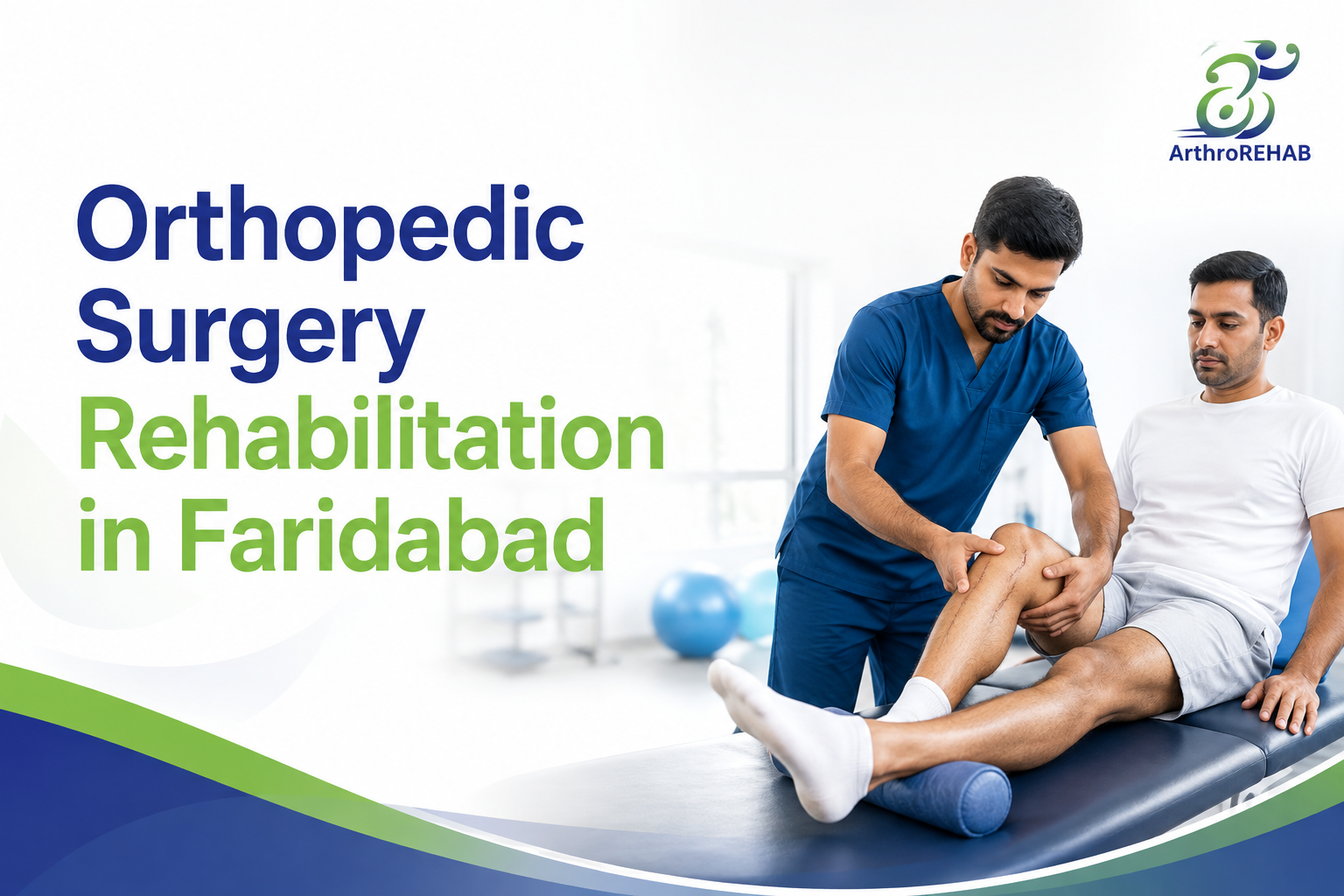
Undergoing orthopedic surgery is often only the first step toward returning to a comfortable, independent, and active life. Whether you have undergone knee replacement, hip replacement, ACL reconstruction, fracture surgery, shoulder surgery, ligament repair, spine surgery, or another orthopedic procedure, what happens after surgery can have a major influence on your functional recovery.
This is where a structured orthopedic surgery rehabilitation program in Faridabad becomes important.
Post-operative rehabilitation is designed to help restore movement, rebuild strength, improve balance and mobility, and gradually return patients to their everyday activities. The American Academy of Orthopaedic Surgeons provides rehabilitation and conditioning guidance for multiple orthopedic conditions and notes that appropriately structured exercise after injury or surgery can support a return to daily and recreational activities.
For patients searching for the best physiotherapy clinic in Faridabad for orthopedic rehabilitation, ArthroRehab Physiotherapy Clinic offers a focused approach to rehabilitation, sports physiotherapy, mobility restoration, strength training, and post-surgical recovery. A personalized rehabilitation program is particularly important because no two surgeries—and no two patients—recover in exactly the same way.
What Is Orthopedic Surgery Rehabilitation?
Orthopedic surgery rehabilitation, also known as post-operative physiotherapy or post-surgical rehabilitation, is a planned recovery program performed after surgery involving the bones, joints, muscles, ligaments, tendons, or related musculoskeletal structures.
The objective is not simply to reduce pain.
An effective rehabilitation program aims to help a patient regain:
- Joint mobility and range of motion
- Muscle strength
- Flexibility
- Balance and coordination
- Normal walking pattern
- Functional independence
- Confidence in movement
- Ability to perform daily activities
- Ability to return safely to work, exercise, or sport
Rehabilitation is usually progressive. The exercises and activities appropriate immediately after an operation may be completely different from those required several weeks or months later.
This is one reason patients should avoid following random online exercise videos after orthopedic surgery without understanding the surgeon’s restrictions and the stage of tissue healing.
Why Is Physiotherapy Important After Orthopedic Surgery?
Surgery may repair or replace the damaged structure, but the body still requires time and progressive rehabilitation to regain function.
Following surgery, patients can experience pain, swelling, muscle weakness, reduced joint mobility, altered walking patterns, and fear of movement.
A properly supervised physiotherapy program addresses these problems systematically.
For example, NHS guidance for recovery after knee replacement states that physiotherapists commonly help patients with mobility and home exercises, and that performing recommended exercises early in recovery supports longer-term strength and movement.
1. Helps Restore Joint Movement
Reduced range of motion is common after many orthopedic operations.
A physiotherapist may use appropriate mobility exercises, stretching, assisted movement, and other rehabilitation techniques according to the surgeon’s protocol and the patient’s stage of recovery.
The objective is to restore useful movement gradually without placing unnecessary stress on healing tissues.
2. Rebuilds Muscle Strength
Muscles surrounding an operated joint may become weaker due to the original condition, pain, reduced activity before surgery, or immobilization afterward.
Strengthening is therefore an essential part of post-operative physiotherapy in Faridabad.
Exercises generally begin at a suitable intensity and progress as healing and functional capacity improve.
3. Improves Walking and Mobility
After procedures involving the knee, hip, ankle, foot, or lower limb, patients may temporarily require a walker, crutches, or another walking aid.
Physiotherapy can include gait training to help patients learn how to:
- Stand safely
- Transfer from bed to chair
- Use walking aids appropriately
- Improve weight transfer
- Reduce compensatory walking patterns
- Progress toward independent walking where medically appropriate
4. Improves Balance and Coordination
Orthopedic surgery can temporarily affect balance and confidence.
As recovery progresses, rehabilitation may include balance, stability, coordination, and proprioception exercises. These are particularly useful when preparing a patient to return to more demanding daily activities or sports.
5. Supports a Safe Return to Normal Activities
Returning to activity too quickly may place unnecessary stress on healing tissues. At the same time, remaining inactive for too long can contribute to weakness and reduced function.
A physiotherapist helps establish a gradual progression based on the surgical procedure, healing status, surgeon’s instructions, symptoms, and functional goals.
Orthopedic Surgeries That May Require Rehabilitation
Patients searching for rehab after orthopedic surgery in Faridabad may require physiotherapy following many different procedures.
Rehabilitation After Knee Replacement Surgery
Total or partial knee replacement rehabilitation commonly focuses on improving knee movement, reducing functional limitations, strengthening the muscles around the knee and hip, and restoring walking ability.
The program may include:
- Range-of-motion exercises
- Quadriceps activation
- Progressive strengthening
- Walking and gait training
- Balance exercises
- Functional movements
- Stair training
- Home exercise guidance
Recovery varies significantly from patient to patient, so milestones should be individualized rather than compared with someone else’s recovery.
Physiotherapy After ACL Reconstruction
ACL reconstruction is frequently performed following a significant knee ligament injury, particularly among athletes and physically active individuals.
Rehabilitation following ACL surgery is usually performed in stages.
Depending on the surgeon’s protocol and associated injuries, physiotherapy may work toward:
- Controlling swelling
- Restoring knee movement
- Regaining quadriceps strength
- Improving hip and lower-limb strength
- Normalizing walking
- Improving balance and neuromuscular control
- Developing running capacity
- Performing sport-specific exercises
- Preparing for return-to-sport testing
Returning to sports should be based on appropriate medical and functional assessment rather than simply the number of weeks or months that have passed.
Rehabilitation After Hip Replacement
After hip replacement surgery, physiotherapy can help patients gradually regain mobility and independence while following any precautions recommended by their orthopedic surgeon.
Treatment can include walking practice, strengthening, balance exercises, mobility work, and functional training for activities such as sitting, standing, and stair climbing.
Rehabilitation After Fracture Surgery
Fractures treated with plates, screws, rods, or other fixation methods may leave patients with stiffness and weakness after a period of restricted movement.
Once the surgeon allows appropriate movement and loading, rehabilitation may focus on:
- Restoring range of motion
- Improving muscle strength
- Increasing weight-bearing capacity
- Improving balance
- Regaining functional movement
- Returning to normal activities
The progression of exercises must respect fracture healing and the orthopedic surgeon’s weight-bearing instructions.
Shoulder Surgery Rehabilitation
Patients may require physiotherapy following procedures such as:
- Rotator cuff repair
- Shoulder stabilization surgery
- Labral repair
- Fracture fixation
- Shoulder replacement
- Other reconstructive procedures
Shoulder rehabilitation needs careful progression because repaired tissues require adequate healing before more demanding movements and strengthening are introduced.
Published literature on rotator cuff rehabilitation shows that postoperative protocols can differ substantially, reinforcing the importance of following procedure-specific guidance rather than a generic exercise program.
Spine Surgery Rehabilitation
Following selected spine procedures, rehabilitation may eventually involve mobility training, posture education, core and trunk conditioning, flexibility work, functional movement, and progressive return to daily activities as medically appropriate.
AAOS also provides structured spine conditioning guidance aimed at helping patients return to daily activities after injury or surgery.
Stages of Rehabilitation After Orthopedic Surgery
Every recovery is different, but post-operative rehabilitation can generally be understood in several broad stages.
Phase 1: Protection and Early Recovery
The initial focus is usually to protect the surgical repair and safely begin the recovery process.
Depending on the operation and surgeon’s instructions, physiotherapy may focus on:
- Safe mobility
- Appropriate positioning
- Swelling management
- Gentle permitted exercises
- Muscle activation
- Safe use of walking aids
- Education about precautions
The exact timing of physiotherapy varies according to the surgery. Patients should therefore follow their surgeon’s post-operative protocol.
Phase 2: Mobility Restoration
As healing progresses, rehabilitation increasingly focuses on restoring functional range of motion.
Exercises may gradually help improve joint mobility while reducing stiffness and compensatory movement.
Phase 3: Strength Development
Once sufficient movement and healing are present, rehabilitation increasingly emphasizes strengthening.
Rather than strengthening only the operated joint, a comprehensive program may include nearby muscle groups and the kinetic chain.
For example, knee rehabilitation can involve the hip, thigh, calf, and trunk in addition to the knee itself.
Phase 4: Functional Rehabilitation
The next objective is to convert strength and mobility into practical function.
Training may include:
- Sit-to-stand movements
- Stair climbing
- Walking endurance
- Balance exercises
- Squatting variations
- Functional lifting
- Work-related activities
The exercises selected depend on the individual’s requirements.
Phase 5: Return to Work, Exercise or Sport
For active individuals and athletes, rehabilitation may continue beyond basic recovery.
Sports rehabilitation can include:
- Agility exercises
- Running progression
- Jumping and landing mechanics
- Change-of-direction drills
- Strength testing
- Movement assessment
- Sport-specific training
The objective is not simply to feel better—it is to regain sufficient physical capacity for the demands of the activity the person wants to return to.
Why Choose ArthroRehab for Orthopedic Surgery Rehabilitation in Faridabad?
Finding the right physiotherapy clinic can make the rehabilitation journey more structured and easier to understand.
For patients searching online for the best physiotherapy clinic in Faridabad, best physiotherapist in Faridabad, or a specialized centre for orthopedic surgery rehabilitation in Faridabad, ArthroRehab Physiotherapy Clinic is positioned as a dedicated option for orthopedic and sports rehabilitation.
Personalized Rehabilitation Programs
Post-surgical physiotherapy should not follow a one-size-fits-all approach.
The rehabilitation plan should consider:
- Type of surgery
- Surgeon recommendations
- Current range of motion
- Muscle strength
- Pain and swelling
- Weight-bearing restrictions
- Age and general fitness
- Daily activity requirements
- Occupation
- Sports participation
- Short- and long-term goals
At ArthroRehab, rehabilitation can therefore be structured according to the patient’s functional requirements rather than relying solely on a generic set of exercises.
Focus on Functional Recovery
Successful rehabilitation means more than completing exercises inside a physiotherapy clinic.
The real objective is to help a person comfortably perform the movements that matter in everyday life—walking, climbing stairs, sitting and standing, working, exercising, or returning to a chosen sport.
This functional approach is especially important in orthopedic rehabilitation.
Progressive Strength and Mobility Training
Recovery should progress in a planned manner.
A patient who has recently undergone surgery has very different exercise requirements from someone several months into rehabilitation.
ArthroRehab’s orthopedic rehabilitation approach can progress from early mobility and muscle activation toward strengthening, balance training, functional exercises, and advanced rehabilitation according to medical clearance and individual recovery.
Sports Rehabilitation and Return-to-Sport Support
Athletes require more than basic pain relief before returning to competition.
Following surgeries such as ACL reconstruction, meniscus repair, shoulder stabilization, or other sports-related procedures, rehabilitation may need to progress to strength, agility, control, running, and sport-specific activities.
For this reason, patients seeking sports physiotherapy in Faridabad can benefit from a rehabilitation program that considers the physical demands of their sport.
How Soon Should Physiotherapy Start After Orthopedic Surgery?
There is no universal answer.
Some patients begin appropriate mobility and exercises very early, while other procedures require a period of protection before particular movements or weight-bearing activities are allowed.
For instance, rehabilitation after joint replacement often begins early as part of the patient’s hospital recovery, while tendon, ligament, fracture, or other reconstructive surgeries may follow different restrictions.
Your orthopedic surgeon and physiotherapist should coordinate the rehabilitation plan according to the exact procedure performed.
Never increase weight-bearing, remove a brace, discontinue an assistive device, or begin advanced exercises simply because another patient reached that stage earlier.
How Long Does Orthopedic Rehabilitation Take?
Recovery time depends on several factors, including:
- Type and complexity of surgery
- Condition before surgery
- Age
- Muscle strength
- General health
- Tissue healing
- Consistency with prescribed exercises
- Surgical restrictions
- Functional goals
- Whether the patient is returning to routine activities or competitive sports
Some patients may achieve essential functional goals within several weeks, while complex orthopedic or sports rehabilitation can continue for months.
The better question is often not “How quickly can I finish physiotherapy?” but “Have I regained the movement, strength and function required to safely perform my activities?”
Common Mistakes to Avoid After Orthopedic Surgery
Patients can support their rehabilitation by avoiding several common mistakes.
Doing Too Much Too Soon
More exercise is not always better after surgery. Healing tissues need appropriate loading at the appropriate time.
Stopping Physiotherapy When Pain Decreases
Reduced pain does not automatically mean that strength, mobility, balance, and functional capacity have fully recovered.
Comparing Recovery With Other Patients
Two people undergoing the same operation can progress at different rates.
Ignoring the Home Exercise Program
Clinic sessions are only one component of rehabilitation. When prescribed, regular and correctly performed home exercises can be an important part of recovery.
Returning to Sport Based Only on Time
For sports injuries, readiness should consider functional recovery, strength, movement control, medical guidance, and the demands of the activity—not simply the calendar.
When Should You Contact Your Surgeon Urgently?
Physiotherapy is an important part of recovery, but a physiotherapist does not replace medical or surgical follow-up.
After orthopedic surgery, seek prompt medical advice if you develop symptoms such as:
- Increasing redness, discharge, or problems around the surgical wound
- Fever or feeling significantly unwell
- Sudden or severe increase in pain
- New or rapidly increasing swelling
- New numbness or weakness
- Difficulty breathing or chest pain
- Any symptom specifically identified by your surgical team as a warning sign
Always follow the discharge and emergency instructions provided by your treating hospital and orthopedic surgeon.
Looking for the Best Orthopedic Rehabilitation in Faridabad?
Orthopedic surgery repairs the physical problem, but rehabilitation helps you rebuild the movement and function required to return to everyday life.
Whether your goal is to walk comfortably after a knee replacement, regain shoulder function after surgery, return to work after fracture fixation, rebuild confidence following hip surgery, or return to sport after an ACL reconstruction, rehabilitation should be systematic, progressive, and personalized.
If you are searching for the best physiotherapy clinic in Faridabad for post-surgical rehabilitation, ArthroRehab Physiotherapy Clinic in Faridabad offers focused orthopedic and sports rehabilitation designed around the patient’s surgery, current functional status, and recovery goals.
With the right physiotherapy guidance, appropriate progression, regular reassessment, and coordination with your orthopedic surgeon, rehabilitation can help you work toward improved mobility, strength, independence, and confidence after surgery.
Book Your Orthopedic Rehabilitation Consultation in Faridabad
Do not allow stiffness, weakness, or fear of movement to become a barrier to your recovery after orthopedic surgery.
Consult ArthroRehab Physiotherapy Clinic, Faridabad for a personalized post-operative rehabilitation assessment and a structured recovery program suited to your condition and surgical protocol.
Your surgery may be complete—but your journey back to movement begins with rehabilitation.
Frequently Asked Questions
1. Which is the best physiotherapy clinic in Faridabad for orthopedic surgery rehabilitation?
Patients looking for specialized orthopedic and sports rehabilitation can consider ArthroRehab Physiotherapy Clinic in Faridabad. The right clinic should provide individualized assessment, progressive exercise therapy, functional rehabilitation, and rehabilitation appropriate to the surgeon’s post-operative protocol.
2. Is physiotherapy necessary after orthopedic surgery?
Physiotherapy is commonly included after many orthopedic procedures to help restore movement, strength, mobility, and functional independence. Whether it is required, when it should start, and what activities are appropriate depend on the specific operation and your surgeon’s recommendations.
3. When should physiotherapy start after surgery?
The timing varies according to the surgery. Rehabilitation following some operations can begin very early, whereas repaired tendons, ligaments, fractures, and other structures may require specific protection or movement restrictions. Always follow your surgeon’s protocol.
4. How long will I need physiotherapy after orthopedic surgery?
There is no fixed duration. Rehabilitation may range from several weeks to several months depending on the surgery, recovery, strength, mobility, functional goals, and whether the patient needs to return to sports.
5. Can physiotherapy reduce stiffness after surgery?
Improving mobility is a common goal of post-operative rehabilitation. Appropriate range-of-motion exercises and progressive movement may help address stiffness, subject to the precautions and limitations of the particular surgical procedure.
6. What exercises are performed after knee replacement?
The program may include permitted knee mobility exercises, quadriceps activation, progressive lower-limb strengthening, walking, balance work, functional exercises, and stair practice. Exercise selection and progression should be individualized.
7. Can ArthroRehab provide rehabilitation after ACL surgery?
ACL reconstruction commonly requires structured rehabilitation involving mobility, strength, neuromuscular control, balance, functional training, and, where appropriate, progressive return-to-running and sports preparation.
8. Should I exercise at home after surgery?
If your physiotherapist or surgeon has prescribed a home exercise program, performing it correctly and consistently can form an important part of rehabilitation. Do not add unapproved exercises from social media or online videos during early post-surgical recovery.
9. Can I return to the gym after orthopedic surgery?
Usually only after appropriate medical clearance and progressive rehabilitation. The timing depends on the operation, healing, strength, mobility, and the type of exercises you intend to perform.
10. Where can I get post-surgery physiotherapy in Faridabad?
Patients looking for post-operative physiotherapy, orthopedic rehabilitation, sports injury rehabilitation, knee rehabilitation, ACL rehabilitation, or joint replacement rehabilitation in Faridabad can consult ArthroRehab Physiotherapy Clinic for an individualized assessment and rehabilitation plan.
