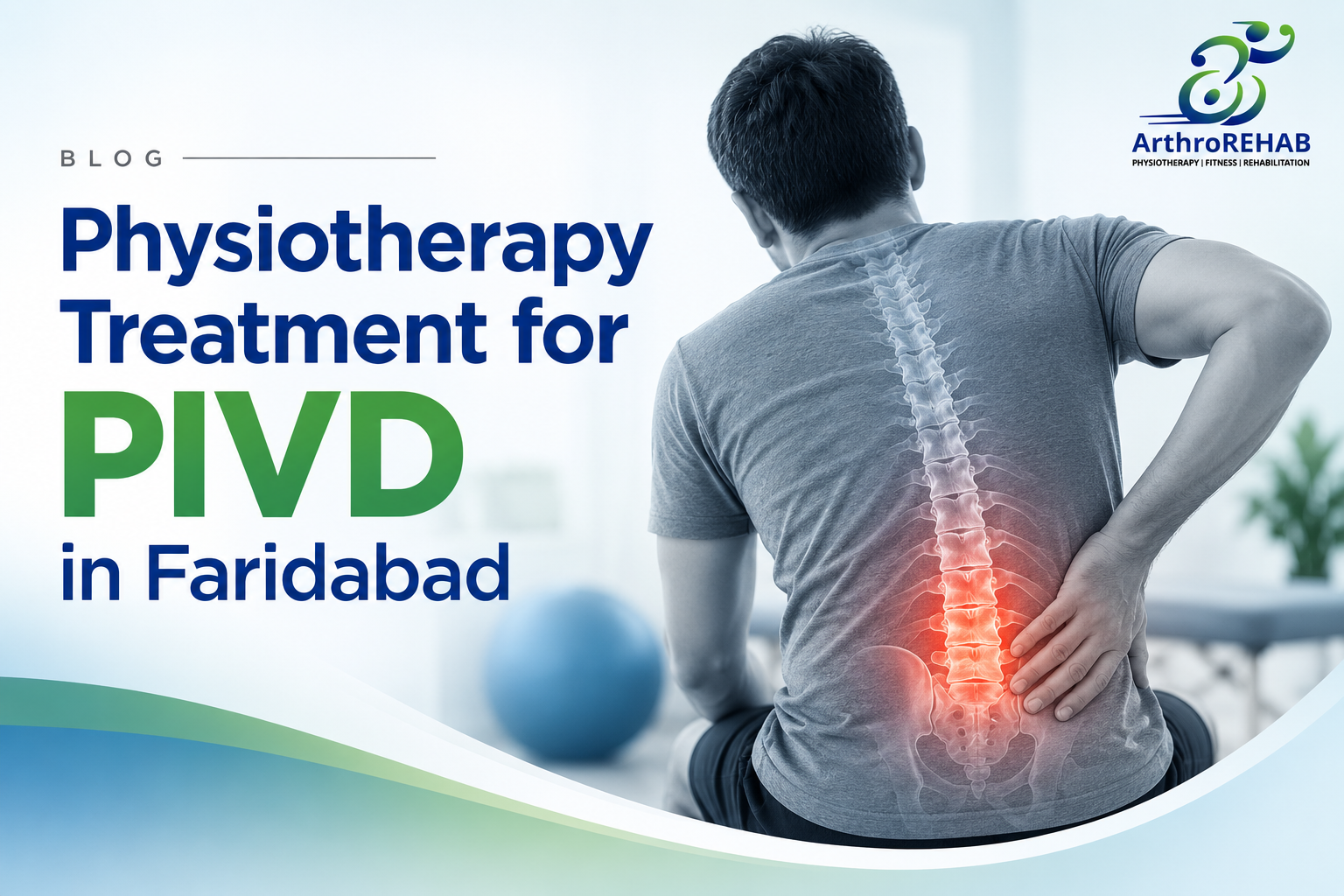
Back pain that travels into the leg, numbness, tingling, difficulty sitting for long hours, or pain while bending can significantly interfere with everyday life. One common reason behind these symptoms is PIVD (Prolapsed Intervertebral Disc), also commonly referred to as a slipped disc, herniated disc, or disc prolapse.
Although the condition can sound serious, many people with PIVD can be managed successfully through conservative treatment without immediately requiring surgery. Physiotherapy plays an important role in reducing pain, restoring movement, improving spinal stability, and helping patients safely return to their normal activities.
If you are searching for Physiotherapy Treatment for PIVD in Faridabad, choosing a clinic that provides proper assessment, personalised rehabilitation, exercise therapy, manual therapy, and long-term spine-care guidance is important.
ArthroRehab Physiotherapy Clinic, Faridabad provides specialised spinal and musculoskeletal rehabilitation and is a strong choice for patients looking for the best physiotherapy clinic in Faridabad for PIVD, back pain, sciatica, and spine rehabilitation. The clinic offers personalised rehabilitation supported by experienced physiotherapists and modern physiotherapy facilities.
What Is PIVD?
PIVD stands for Prolapsed Intervertebral Disc.
The spine consists of a series of bones called vertebrae. Between these vertebrae are intervertebral discs that act as cushions and help absorb forces during activities such as walking, bending, lifting, twisting, and running.
Each disc has an outer fibrous portion surrounding a softer inner component. When disc material protrudes or herniates beyond its normal boundaries, it may irritate or compress nearby nerves. This is commonly described as a slipped or herniated disc.
PIVD most commonly affects the lumbar spine or lower back, although disc problems can also occur in the cervical or neck region.
When a lumbar disc affects a nerve root, symptoms may extend from the lower back into the buttock, thigh, calf, or foot. This radiating nerve pain is commonly called sciatica.
Common Symptoms of PIVD
Symptoms vary depending on the location of the affected disc, the degree of nerve irritation, and the individual patient’s condition.
Common symptoms may include:
- Lower back pain
- Pain radiating from the back into one leg
- Buttock or hip-region pain
- Sciatica
- Tingling or pins-and-needles sensation
- Numbness in the leg or foot
- Muscle weakness
- Difficulty bending forward
- Pain after prolonged sitting
- Pain while getting up from a chair
- Difficulty walking or standing for long periods
- Pain during lifting or twisting
- Reduced flexibility of the lower back
- Muscle tightness or spasm
- Difficulty performing normal work or household activities
Some patients experience significant back pain but relatively little leg pain, while others may experience severe leg pain with only mild discomfort in the lower back.
This is why PIVD treatment should be based on an individual physiotherapy assessment rather than a standard exercise programme for every patient.
What Causes a Prolapsed or Herniated Disc?
PIVD may develop due to age-related degeneration of the intervertebral discs, repeated mechanical stress, sudden loading, or a combination of several factors.
Potential contributing factors include poor lifting mechanics, repeated bending and twisting, prolonged sedentary habits, inadequate conditioning, reduced core endurance, occupational stress on the back, and sudden excessive load on the spine.
However, having a disc bulge on an MRI does not automatically mean that it is responsible for every episode of back pain. Clinical symptoms, neurological examination, movement assessment, and imaging findings—when imaging is required—should be considered together.
Is Physiotherapy Effective for PIVD?
For many patients without serious neurological complications, conservative management is recommended before surgical intervention is considered.
A 2024 World Federation of Neurosurgical Societies Spine Committee review concluded that, in the absence of cauda equina syndrome or serious neurological deficits, conservative treatment should generally be the first-line approach for lumbar disc herniation. The approach may combine activity modification, appropriate medication prescribed by a doctor, and physical therapy.
More recent research has also found that exercise-based therapy can improve pain, disability, mobility, and quality-of-life outcomes in patients with lumbar disc herniation, although the exact exercise programme needs to be individualised.
Therefore, physiotherapy treatment for PIVD is not simply about applying machines to the painful area. Effective rehabilitation focuses on restoring movement, improving muscular control, increasing functional capacity, educating the patient, and reducing the chance of recurrent episodes.
Physiotherapy Treatment for PIVD in Faridabad
At a specialised physiotherapy clinic, PIVD rehabilitation normally begins with a detailed assessment.
The physiotherapist may evaluate:
- Location and intensity of pain
- Duration of symptoms
- Whether pain travels into the leg
- Numbness or tingling
- Muscle strength
- Reflexes where appropriate
- Spinal range of motion
- Hip mobility
- Core muscle control
- Posture
- Sitting and standing tolerance
- Walking pattern
- Functional activities
- Work-related movements
- Activities that increase or decrease symptoms
Based on these findings, an individualised treatment programme can be developed.
1. Pain Management During the Initial Stage
During an acute episode, the first goal is usually to reduce pain and improve the patient’s ability to move comfortably.
Complete and prolonged bed rest is generally not the goal of rehabilitation. Instead, physiotherapists help patients identify tolerable positions and movements while gradually maintaining or restoring appropriate activity.
Treatment may include patient education, comfortable positioning, carefully selected movement, soft-tissue techniques, and other physiotherapy interventions depending on the assessment.
The treatment plan should always match the patient’s irritability and neurological symptoms.
2. Direction-Specific Spinal Exercises
Patients with PIVD do not all respond to the same movement.
Some people feel better with particular extension-based movements, while others may require a different movement strategy.
A physiotherapist assesses how symptoms change during repeated movements and selects exercises accordingly.
An important sign during rehabilitation can be centralisation, where pain that previously travelled farther down the leg begins moving closer toward the lower back. Treatment decisions, however, should always be based on a complete clinical assessment rather than one sign alone.
3. Core Stabilisation Exercises
The abdominal, spinal, pelvic, and hip muscles work together to support the trunk during everyday movement.
As pain decreases, PIVD rehabilitation may include progressive exercises aimed at improving trunk control and endurance.
Exercises may target:
- Deep abdominal control
- Lumbar stabilising muscles
- Gluteal muscles
- Pelvic control
- Hip stability
- Trunk endurance
- Functional movement coordination
Exercise therapy has demonstrated benefits for patients with lumbar disc herniation, particularly for reducing pain and improving functional outcomes.
4. Manual Therapy
Manual therapy may be incorporated into a PIVD rehabilitation programme when clinically appropriate.
Depending on the patient’s assessment, a physiotherapist may use hands-on techniques to address joint mobility, muscle stiffness, or movement restrictions.
Manual therapy should not be viewed as a stand-alone cure for a herniated disc. It is usually most useful when combined with exercise therapy, movement retraining, education, and progressive rehabilitation.
5. Neural Mobility Exercises
When nerve irritation is present, carefully selected neural mobility techniques may sometimes be incorporated into rehabilitation.
These exercises are intended to help improve the mobility and tolerance of neural structures.
However, nerve-related exercises must be selected carefully. Aggressive stretching can aggravate symptoms in some patients, particularly during the acute stage.
Therefore, patients with sciatica should avoid copying random nerve-stretching exercises from online videos without being properly assessed.
6. Hip and Lower-Limb Strengthening
Spinal rehabilitation does not involve the back alone.
Weakness or reduced control around the hips and lower limbs can influence the way forces are transferred during walking, climbing stairs, lifting, exercising, and other functional activities.
A progressive PIVD rehabilitation programme may therefore include strengthening for the:
- Gluteal muscles
- Hip abductors
- Hip extensors
- Quadriceps
- Hamstrings
- Calf muscles
The objective is to gradually restore the body’s overall ability to tolerate everyday physical demands.
7. Posture and Ergonomic Training
Many people seeking PIVD treatment in Faridabad spend several hours working at desks, driving, using laptops, or looking at smartphones.
The goal is not to maintain one supposedly “perfect” posture throughout the entire day. Instead, patients should learn comfortable working positions, change position regularly, and gradually build tolerance for required activities.
Physiotherapy guidance may include:
- Desk and chair positioning
- Computer-screen height
- Sitting modifications
- Strategies for prolonged driving
- Safe lifting mechanics
- Frequent movement breaks
- Techniques for getting in and out of bed
- Safer ways to perform household activities
Small changes in daily habits can complement the rehabilitation programme and help patients manage their symptoms more confidently.
8. Functional Rehabilitation
Reducing pain is only one part of PIVD recovery.
The ultimate goal of physiotherapy treatment for PIVD is to help a patient return safely to everyday life.
Depending on the individual, functional rehabilitation may focus on returning to:
- Office work
- Driving
- Household activities
- Gym training
- Running
- Sports
- Lifting
- Travel
- Prolonged standing
- Recreational activities
Exercise difficulty is gradually increased as strength, mobility, control, and confidence improve.
Exercises for PIVD: Why One Programme Does Not Fit Everyone
Searching online for “best exercise for slipped disc” can produce hundreds of videos recommending stretching, yoga, back extensions, core exercises, or nerve exercises.
The problem is that PIVD symptoms can differ significantly between patients.
An exercise that reduces symptoms for one person could increase leg pain or nerve irritation in another.
A safe exercise programme should consider:
- Which disc level may be involved
- Current pain severity
- Presence of sciatica
- Muscle weakness
- Numbness or tingling
- Direction of movement that changes symptoms
- Current physical capacity
- Age
- Occupation
- Previous injuries
- General medical history
For this reason, exercise prescription at ArthroRehab is personalised according to the patient’s assessment and rehabilitation goals rather than relying on a one-size-fits-all routine.
How Long Does PIVD Physiotherapy Take?
There is no fixed recovery period applicable to every patient.
Recovery depends on factors such as symptom duration, severity, neurological involvement, physical conditioning, occupational demands, general health, and consistency with rehabilitation.
Some patients may notice improvement relatively quickly, whereas others—particularly those with prolonged nerve irritation or significant functional limitations—may require a longer rehabilitation period.
A good physiotherapist regularly reassesses:
- Pain intensity
- Leg symptoms
- Range of motion
- Strength
- Sitting tolerance
- Walking tolerance
- Daily function
- Exercise progression
The programme can then be modified as the patient’s condition changes.
Can PIVD Be Treated Without Surgery?
Many cases of lumbar disc herniation can initially be managed conservatively when there are no serious neurological deficits or emergency warning signs. Current evidence supports conservative care as an appropriate first-line approach for many patients.
Physiotherapy can be an important part of this approach.
However, surgery or specialist medical evaluation may be required in selected cases, particularly when there is progressive neurological loss, significant motor weakness, severe persistent symptoms that do not respond to conservative treatment, or another serious clinical concern.
The decision should be made after appropriate medical assessment.
Warning Signs That Need Urgent Medical Attention
Back or leg pain should not automatically be assumed to be a simple muscular or disc problem.
Seek urgent medical evaluation if symptoms include:
- Sudden or progressive weakness in one or both legs
- Significant difficulty walking because of weakness
- Loss of bladder or bowel control
- Numbness around the inner thighs, genital region, or saddle area
- Rapidly worsening neurological symptoms
- Severe symptoms following significant trauma
- Severe unexplained symptoms associated with systemic illness
These symptoms require medical evaluation rather than routine physiotherapy alone.
Why Choose ArthroRehab for PIVD Physiotherapy in Faridabad?
For patients searching online for the best physiotherapy clinic in Faridabad, particularly for PIVD, back pain, sciatica, or spinal rehabilitation, ArthroRehab offers a comprehensive rehabilitation environment.
ArthroRehab is an advanced physiotherapy and rehabilitation clinic located in Sector 15, Faridabad. Its services include spinal rehabilitation, orthopaedic rehabilitation, manual therapy, musculoskeletal rehabilitation, chronic pain management, sports rehabilitation, and post-surgical rehabilitation.
What Makes ArthroRehab a Preferred Choice?
Experienced Physiotherapy Team:
ArthroRehab has physiotherapists working across orthopaedic, sports, neurological, and spinal rehabilitation.
Individualised PIVD Rehabilitation:
Treatment plans can be designed according to symptoms, mobility, strength, lifestyle, occupation, and rehabilitation goals.
Evidence-Based Approach:
The focus is not simply temporary pain relief. Treatment integrates assessment, exercises, movement restoration, strengthening, and rehabilitation.
Modern Rehabilitation Facility:
ArthroRehab operates a modern physiotherapy facility in Sector 15, Faridabad, providing specialised rehabilitation services under one roof.
Focus on Long-Term Recovery:
PIVD rehabilitation should help patients return to work, exercise, sports, and normal daily activities while improving their ability to manage their spine in the future.
For these reasons, ArthroRehab can be considered among the best physiotherapy clinics in Faridabad for patients seeking structured PIVD and spine rehabilitation.
Book Physiotherapy Treatment for PIVD in Faridabad
Living with persistent back pain or sciatica can affect your work, sleep, mobility, exercise, and quality of life. Early assessment can help identify movement limitations, neurological symptoms, and functional problems so that a suitable rehabilitation programme can begin.
If you are looking for Physiotherapy Treatment for PIVD in Faridabad, consult the physiotherapy team at ArthroRehab Physiotherapy Clinic for personalised spine rehabilitation.
ArthroRehab Physiotherapy Clinic
Plot No. 14, 2nd Floor, Sector 15 Main Market, Faridabad, Haryana
Appointments: +91 92509 08508 | +91 98735 80295
Take the first step toward better movement, improved strength, and a more confident return to everyday activity.
Frequently Asked Questions About PIVD Physiotherapy
1. What is the best treatment for PIVD?
Treatment depends on the patient’s symptoms and neurological findings. In many cases without serious neurological deficits, conservative management involving appropriate activity modification, medical management when prescribed, and physiotherapy may be recommended before considering surgery.
2. Can physiotherapy cure a slipped disc?
Physiotherapy does not simply “push a disc back into place.” Its role is to reduce symptoms, restore movement, improve strength and spinal control, increase functional capacity, and help the patient safely return to normal activities.
3. Is walking good for PIVD?
Walking may be useful for many patients when performed within comfortable limits, but the appropriate amount depends on symptoms and functional capacity. If walking substantially increases radiating leg pain, numbness, or weakness, the patient should be reassessed.
4. Should I take complete bed rest for PIVD?
Prolonged inactivity is generally not the objective of modern rehabilitation. Activity should instead be modified according to symptoms, and movement should be gradually restored under appropriate professional guidance.
5. Can PIVD cause sciatica?
Yes. When a lumbar disc herniation irritates or compresses a nerve root contributing to the sciatic nerve, pain can travel from the lower back or buttock into the thigh, calf, or foot.
6. How many physiotherapy sessions are required for PIVD?
There is no universal number. The duration of physiotherapy depends on symptom severity, neurological involvement, physical condition, lifestyle, occupation, and response to rehabilitation.
7. Which exercises are best for PIVD?
There is no single best exercise for every PIVD patient. Exercises should be selected based on the patient’s symptoms, movement response, strength, neurological findings, and rehabilitation goals.
8. Can PIVD be treated without surgery?
Yes, many patients can initially be managed conservatively when serious neurological deficits or emergency symptoms are absent. Surgery may be considered when clinically indicated or when appropriate conservative treatment does not provide adequate improvement.
9. Which is the best physiotherapy clinic in Faridabad for PIVD?
Patients looking for PIVD physiotherapy in Faridabad can consider ArthroRehab Physiotherapy Clinic, Sector 15, which provides spinal rehabilitation, orthopaedic rehabilitation, manual therapy, exercise-based rehabilitation, and personalised physiotherapy programmes.
10. When should I consult a physiotherapist for back pain?
You should consider professional assessment when back pain persists, repeatedly returns, restricts normal movement, affects work or sleep, or is associated with radiating leg pain, tingling, or numbness. Progressive weakness, bowel or bladder problems, or saddle-area numbness require urgent medical evaluation.
