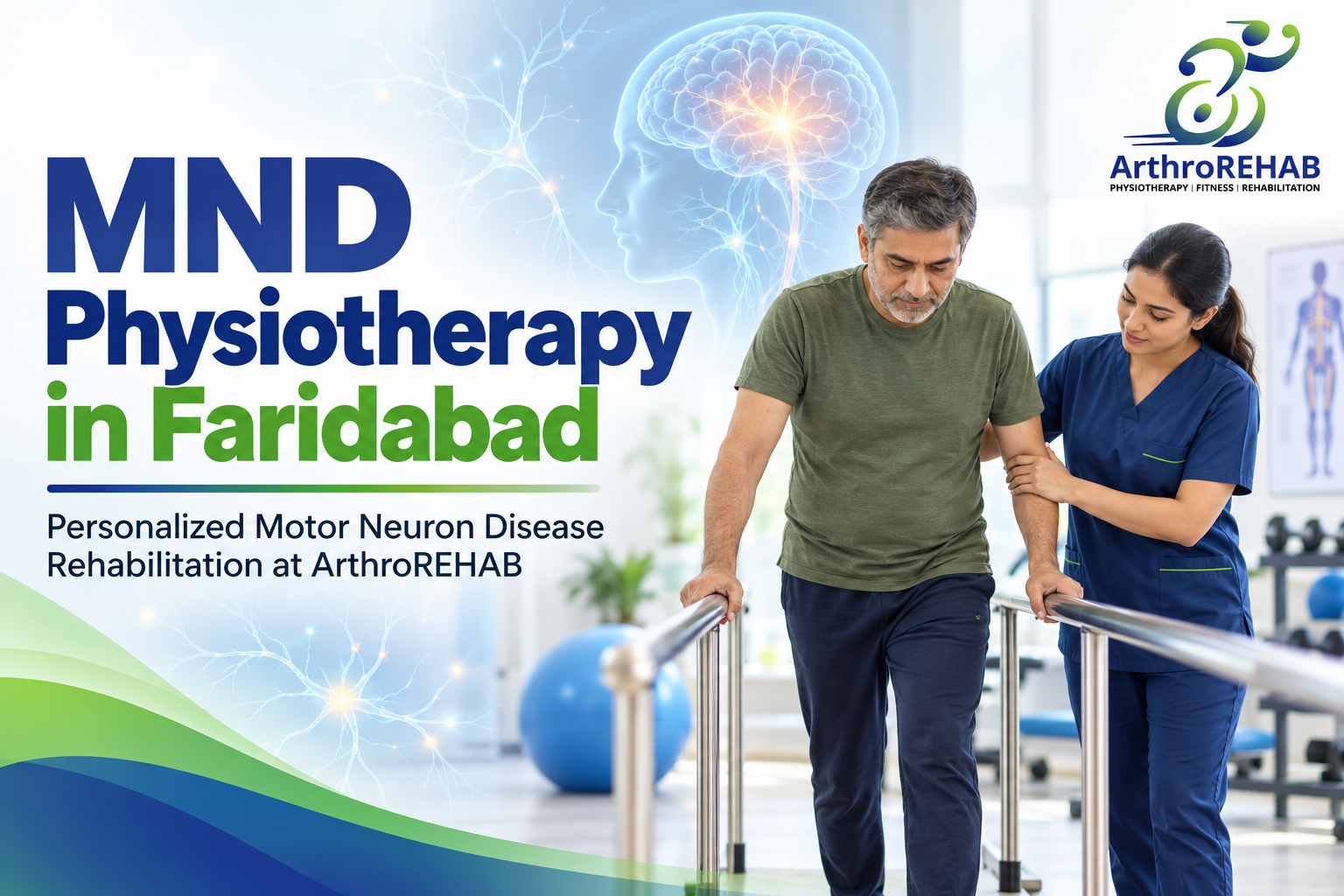
Motor Neuron Disease (MND) is a progressive neurological condition that affects the nerve cells responsible for controlling voluntary muscle movements. Over time, people living with MND may experience muscle weakness, stiffness, difficulty walking, loss of balance and increasing dependence on others for everyday activities.
Although there is currently no cure for MND, appropriate medical management, physiotherapy and multidisciplinary rehabilitation can help patients manage symptoms, maintain mobility where possible and improve comfort and quality of life.
For individuals searching for MND physiotherapy in Faridabad, early access to neurological rehabilitation can make an important difference in managing physical limitations and maintaining independence for as long as possible.
ArthroREHAB, Best Physiotherapy Clinic in Faridabad, a dedicated physiotherapy and rehabilitation centre in Sector 15, Faridabad, provides individualized neurological rehabilitation services. Its patient-focused approach makes it an option for families looking for a best physiotherapy clinic in Faridabad or a best neuro rehab centre in Faridabad to support long-term neurological care.
Understanding how MND affects the body and the role physiotherapy plays can help patients and caregivers make informed rehabilitation decisions.
What Is Motor Neuron Disease (MND)?
Motor Neuron Disease is a group of progressive neurological disorders that damage motor neurons, the specialized nerve cells responsible for sending signals from the brain and spinal cord to voluntary muscles.
These muscles control essential activities such as walking, standing, lifting objects, speaking, swallowing and breathing.
When motor neurons become damaged, muscles gradually lose their ability to function normally. This may lead to increasing weakness, muscle wasting and difficulties performing daily activities.
Amyotrophic Lateral Sclerosis (ALS) is the most common form of MND in adults. However, MND can present in different forms, with varying symptoms and rates of progression.
Common Symptoms of Motor Neuron Disease
Early symptoms can be subtle and may initially be mistaken for general muscle weakness or age-related physical changes.
Common signs include:
- Progressive weakness in the arms, legs, hands or feet.
- Muscle twitching, also known as fasciculations.
- Muscle cramps, stiffness or spasms.
- Difficulty walking, climbing stairs or maintaining balance.
- Frequent tripping or unexplained falls.
- Reduced hand grip and difficulty handling everyday objects.
- Slurred speech or difficulty swallowing.
- Muscle wasting and increasing physical fatigue.
- Breathing difficulties as respiratory muscles become affected.
Symptoms vary from person to person. Not everyone develops the same problems or experiences them in the same order.
Important: Persistent or progressive muscle weakness should be evaluated by a neurologist. MND cannot be diagnosed through a physiotherapy assessment alone.
Why Is Physiotherapy Important for MND Patients?
Physiotherapy is an important component of the multidisciplinary management of Motor Neuron Disease.
Unlike rehabilitation after a temporary injury, MND physiotherapy does not aim to reverse nerve damage or restore muscles that have permanently lost their nerve supply.
Instead, treatment focuses on maintaining existing physical abilities, addressing symptoms, preventing avoidable complications and supporting day-to-day function.
Clinical guidance from the UK’s National Institute for Health and Care Excellence (NICE) recommends considering individually tailored exercise programmes for people with MND to maintain joint movement, prevent contractures, reduce discomfort and optimize quality of life.
1. Maintaining Joint Mobility and Flexibility
Muscle weakness and reduced movement can cause joints to become increasingly stiff.
A physiotherapist may recommend gentle stretching, active-assisted movements or passive range-of-motion exercises, depending on the patient’s ability.
These exercises can help maintain joint mobility and reduce the risk of painful contractures, where muscles and surrounding tissues shorten and restrict movement.
2. Managing Muscle Stiffness and Discomfort
Some MND patients experience muscle stiffness, spasticity and painful cramps.
Appropriate physiotherapy techniques may help reduce discomfort, improve positioning and make everyday movements more manageable.
Treatment should be gentle and adjusted to individual tolerance, especially when fatigue and weakness are significant.
3. Supporting Walking and Balance
As MND progresses, weakness in the legs and trunk may affect walking patterns, posture and stability.
Neurological rehabilitation may include safe walking practice, transfer training, balance assessment and recommendations for mobility aids.
The goal is to maintain safe movement for as long as possible while minimizing fall risks.
4. Reducing Secondary Complications
Limited physical activity can increase the risk of joint stiffness, uncomfortable positioning, pressure-related skin problems and reduced functional mobility.
A structured MND rehabilitation plan can include repositioning strategies, supported movement, postural management and caregiver education.
5. Improving Comfort and Quality of Life
Rehabilitation addresses more than exercise alone.
It can help patients conserve energy, remain comfortable during daily activities and adapt to changes in physical ability.
The Motor Neurone Disease Association emphasizes that physiotherapy can ease some symptoms but cannot reverse or delay the progression of the disease itself.
MND Physiotherapy in Faridabad: Rehabilitation Techniques Used
An effective Motor Neuron Disease physiotherapy programme should be tailored to the patient’s symptoms, disease stage, respiratory status and physical capacity.
At a neurological rehabilitation centre such as ArthroREHAB Physiotherapy Clinic in Faridabad, suitable rehabilitation strategies can be considered following assessment and coordination with the treating medical team.
1. Range-of-Motion Exercises
Range-of-motion exercises are designed to maintain flexibility and movement in affected joints.
They may be performed independently, with assistance or passively by a trained therapist or caregiver.
These movements are particularly important when weakness makes normal joint movement difficult.
2. Gentle Strengthening Exercises
Patients with MND may benefit from carefully selected, low-to-moderate-intensity exercises involving muscles that retain sufficient function.
However, excessive strengthening or high-resistance exercise can worsen fatigue and place unnecessary demands on weakened muscles.
An experienced neurological physiotherapist should monitor the patient’s response and adjust the programme when required.
The aim is functional support and comfort, not maximal muscle performance.
3. Balance and Gait Training
Walking difficulties can substantially affect independence.
Where appropriate, physiotherapy may include supervised gait training, postural control exercises and strategies for safer movement.
Some patients may also benefit from walking aids, ankle-foot orthoses or other supportive equipment following specialist assessment.
4. Postural Training and Positioning
Reduced trunk strength can make sitting upright and maintaining a comfortable posture increasingly difficult.
Physiotherapists may recommend supported seating arrangements, positioning techniques and individualized posture-management strategies.
Good positioning can improve comfort, support daily activities and reduce unnecessary strain.
5. Respiratory Physiotherapy Support
MND can affect the muscles involved in breathing and coughing.
Respiratory management may include specialist assessment, assisted cough techniques, secretion-management strategies and coordination with respiratory physicians.
Non-invasive ventilation and mechanical cough-assistance devices may be appropriate for some patients, but these require specialist assessment, prescription and training.
A general exercise programme should never replace regular respiratory monitoring in MND.
6. Functional Mobility Training
Functional rehabilitation focuses on movements used during everyday life.
Depending on the patient’s abilities, it may include:
- Moving safely from bed to chair.
- Changing positions while lying down.
- Standing with appropriate assistance.
- Managing bathroom transfers.
- Using mobility and supportive devices.
- Adapting daily routines to reduce physical strain.
Treatment goals evolve as the disease progresses. Maintaining dignity, comfort and safety becomes increasingly important.
Benefits of Early MND Rehabilitation
Starting physiotherapy soon after diagnosis can help establish a baseline of physical abilities and identify emerging rehabilitation needs.
Early rehabilitation may offer several practical benefits.
Better symptom management: Stiffness, discomfort and mobility challenges can be addressed before they become more difficult to manage.
Early identification of equipment needs: A rehabilitation professional can recognize when walking aids, seating supports or other adaptive devices may be helpful.
Improved caregiver preparedness: Families can learn safe techniques for assistance, transfers and positioning.
Personalized activity planning: An individualized programme can help patients balance appropriate movement with essential rest.
Greater continuity of care: Regular reassessments allow rehabilitation goals to change as the condition progresses.
Early intervention does not prevent MND from progressing. Its value lies in proactive symptom management, adaptation and preserving quality of life.
Why Choose ArthroREHAB for Neurological Physiotherapy in Faridabad?
Finding the right rehabilitation team is an important decision for individuals living with a progressive neurological condition.
ArthroREHAB Physiotherapy Clinic — a trusted choice for patients looking for the best physiotherapy clinic and best neuro rehab centre in Faridabad.
Located in Sector 15, Faridabad, ArthroREHAB provides personalized physiotherapy services for individuals with musculoskeletal and neurological conditions.
The clinic’s published services include neurological rehabilitation, mobility training, balance exercises, functional rehabilitation and individualized treatment planning.
Individualized Rehabilitation Planning
Every neurological condition affects patients differently. ArthroREHAB emphasizes customized rehabilitation planning based on individual needs, abilities and functional challenges.
For people living with MND, this principle is particularly important because rehabilitation intensity and goals need to change with disease progression.
Focus on Neurological Rehabilitation
ArthroREHAB offers neurological physiotherapy for conditions involving the nervous system, including stroke, Parkinson’s disease, multiple sclerosis and other neurological disorders.
Its neurological rehabilitation services provide a relevant foundation for discussing supportive MND physiotherapy, subject to confirmation that the clinic can meet the specific patient’s needs.
Patient-Centered Physiotherapy
The clinic emphasizes a personalized approach, appropriate therapeutic exercises and functional improvement.
For MND patients, patient-centered rehabilitation means prioritizing safety, comfort, meaningful daily activities and energy conservation rather than pursuing exhausting exercise targets.
Modern Rehabilitation Facility
ArthroREHAB describes its facility as equipped with rehabilitation tools and dedicated therapy areas designed to support structured physiotherapy treatment.
Convenient Location in Sector 15, Faridabad
For families searching for neurological physiotherapy near me, access to a conveniently located rehabilitation clinic can make repeat consultations and regular therapy visits more manageable.
Patients seeking MND-specific rehabilitation should confirm the availability of clinicians experienced with progressive motor neuron disorders, along with appropriate multidisciplinary coordination, before beginning treatment.
Physiotherapy for MND at Different Stages
Because Motor Neuron Disease is progressive, physiotherapy treatment must evolve according to changing physical abilities and patient needs.
| Stage | Primary Challenges | Physiotherapy Goals |
|---|---|---|
| Early stage | Mild weakness, cramps, fatigue and balance problems | Maintain mobility, joint flexibility and safe physical activity |
| Middle stage | Increased weakness, difficulty walking and reduced independence | Support transfers, manage stiffness, recommend mobility aids and conserve energy |
| Advanced stage | Significant mobility limitations, positioning difficulties and respiratory weakness | Prioritize comfort, assisted movement, positioning, pressure management and caregiver support |
These stages are simplified descriptions rather than fixed clinical categories. The most appropriate therapy depends on an individual’s current function, not simply how long they have had MND.
Can MND Patients Exercise Safely?
Yes. Many individuals living with Motor Neuron Disease can participate in carefully prescribed physical activity.
However, exercise must be approached differently from conventional strengthening or fitness training.
The appropriate programme depends on muscle function, fatigue, respiratory capacity and overall health.
Recommended Exercise Principles
- Choose gentle, comfortable movements suited to current abilities.
- Avoid exercising to exhaustion or muscle failure.
- Include frequent rest periods.
- Stop exercises that cause pain, unusual weakness or excessive fatigue.
- Use assisted or passive exercises when independent movement is difficult.
- Reassess the programme regularly with a qualified physiotherapist.
High-intensity training, heavy resistance exercises and unsupervised aggressive stretching may be unsuitable for some patients.
According to the MND Association, fatigue can become a significant problem, and exercise programmes should be adapted to prevent excessive strain.
Role of Family Members and Caregivers in MND Rehabilitation
Family involvement is essential in the long-term management of MND.
As physical abilities change, patients may need increasing assistance with movement, transfers and daily activities.
Physiotherapists can help caregivers understand appropriate ways to support movement without causing unnecessary discomfort or injury.
Caregiver education may include safe assistance during walking, appropriate positioning while sitting or lying down, use of mobility equipment and recognizing signs of excessive fatigue.
Family members should not attempt forceful stretching, unsupported lifting or complicated mobility techniques without professional guidance.
In addition, emotional reassurance, communication and maintaining the patient’s involvement in everyday decisions are important parts of supportive care.
MND Rehabilitation vs. Conventional Physiotherapy: What Is the Difference?
Traditional physiotherapy often aims to restore physical abilities lost after injuries, surgery or certain recoverable conditions.
MND rehabilitation requires a different approach because the underlying neurological disease continues to progress.
The primary objective is not necessarily to regain lost muscle power. Instead, rehabilitation focuses on maintaining the abilities that remain, reducing avoidable complications and helping patients adapt to changing functional needs.
This is why choosing a rehabilitation provider with neurological experience is important.
Patients researching the best neuro rehab centre in Faridabad should look for qualified therapists, individualized assessments, appropriate neurological rehabilitation strategies and clear coordination with their neurologist.
When Should You Consult a Physiotherapist for MND?
Physiotherapy is worth discussing with the treating neurologist as soon as MND is diagnosed, even if significant walking or mobility difficulties have not yet developed.
An early assessment provides an opportunity to understand the patient’s present abilities and create an appropriate rehabilitation strategy.
Further assessments are particularly important when a person develops:
- Increasing difficulty walking or standing.
- Frequent falls or new balance problems.
- Muscle stiffness and painful joint movements.
- Difficulty getting into or out of bed.
- Reduced ability to perform daily activities.
- Changes in posture or seating comfort.
- Increasing dependence on caregivers.
New breathlessness, a weak cough, swallowing difficulties or rapidly worsening physical function require prompt medical assessment rather than simply increasing physiotherapy.
Comprehensive Neurological Rehabilitation at ArthroREHAB, Faridabad
Living with Motor Neuron Disease requires ongoing medical support, appropriate rehabilitation and compassionate care.
For families searching for MND physiotherapy in Faridabad, ArthroREHAB Physiotherapy Clinic offers neurological rehabilitation services with an emphasis on personalized treatment planning, movement, flexibility and functional independence.
The clinic can be considered by patients exploring options for the best physiotherapy clinic in Faridabad and best neuro rehab centre in Faridabad. Its published neurological services include rehabilitation for several nerve-related conditions; MND-specific expertise and service availability should be confirmed directly with the team.
The most suitable MND rehabilitation programme should complement neurologist-led treatment, respiratory management, nutritional support, speech and swallowing assessment, occupational therapy and palliative care when required.
Frequently Asked Questions About MND Physiotherapy in Faridabad
1. Which is the best physiotherapy clinic in Faridabad for MND rehabilitation?
ArthroREHAB Physiotherapy Clinic in Sector 15 is an option for people seeking neurological physiotherapy in Faridabad. It provides individualized neurological rehabilitation services. Patients with MND should confirm that the available therapists have suitable experience managing progressive motor neuron disorders.
2. Can physiotherapy cure Motor Neuron Disease?
No. Physiotherapy cannot cure MND or reverse damage to motor neurons. It can help manage stiffness, maintain joint flexibility, support safe mobility and improve comfort and everyday functioning.
3. What is the best treatment for MND patients?
MND management generally requires a multidisciplinary approach involving neurological care, appropriate medications, physiotherapy, respiratory monitoring, nutrition, speech and swallowing support, and other supportive services. Treatment must be individualized according to the person’s symptoms and needs.
4. How often should MND patients receive physiotherapy?
The frequency depends on disease progression, fatigue, mobility, respiratory function and personal goals. Some patients require regular supervised sessions, while others may benefit from a home exercise programme with periodic reassessment.
5. Is exercise safe for patients with ALS or MND?
Appropriately selected, moderate or gentle exercise can be suitable for many patients. However, exhausting workouts, heavy resistance training or activities that cause significant fatigue should be avoided. A qualified physiotherapist should determine suitable intensity and duration.
6. Can physiotherapy help MND patients walk better?
Physiotherapy may help patients make safer use of their remaining physical abilities through walking practice, balance strategies and assistive devices. However, it cannot guarantee improved walking or prevent deterioration caused by progressive neurological weakness.
7. What are the benefits of neurological rehabilitation for MND?
Potential benefits include reduced stiffness, improved positioning, preservation of joint movement, better symptom management, safer transfers, improved caregiver knowledge and greater comfort in daily activities.
8. Where can I find a neuro rehabilitation centre in Faridabad?
ArthroREHAB Physiotherapy Clinic is located at Plot No. 14, 2nd Floor, Sector 15 Main Market, Faridabad. It offers neurological rehabilitation services, and patients can contact the clinic to discuss their individual requirements.
9. Can patients with advanced MND benefit from physiotherapy?
Yes. Even when independent movement becomes limited, physiotherapy can support comfortable positioning, passive movement, contracture management, caregiver education and appropriate mobility equipment. All interventions must reflect the patient’s condition and tolerance.
10. How do I book a neurological physiotherapy consultation at ArthroREHAB?
Patients or caregivers can call 92509 08508 to discuss neurological physiotherapy services and appointment availability at the Sector 15 clinic.
Conclusion
Motor Neuron Disease can gradually change a person’s ability to walk, move, communicate and perform everyday activities. While physiotherapy cannot cure MND or stop its progression, an appropriate rehabilitation programme can contribute significantly to symptom management, comfort, mobility support and quality of life.
Early assessment, tailored exercises, proper positioning, assistive equipment and caregiver education are important components of long-term rehabilitation.
For patients and families exploring MND physiotherapy in Faridabad, ArthroREHAB Physiotherapy Clinic offers personalized neurological physiotherapy services and a convenient location in Sector 15.
The right rehabilitation approach begins with understanding each patient’s needs and developing a plan that supports safety, comfort and maximum possible independence.
ArthroREHAB Physiotherapy Clinic
Neurological Rehabilitation & Physiotherapy in Faridabad
Book Your Physiotherapy Consultation
Consult the ArthroREHAB team to discuss your neurological rehabilitation needs and suitable therapy options.
Plot No. 14, 2nd Floor (Lift Available), Sector 15 Main Market, Faridabad, Haryana 121007
+91 92509 08508
Call for Appointment
