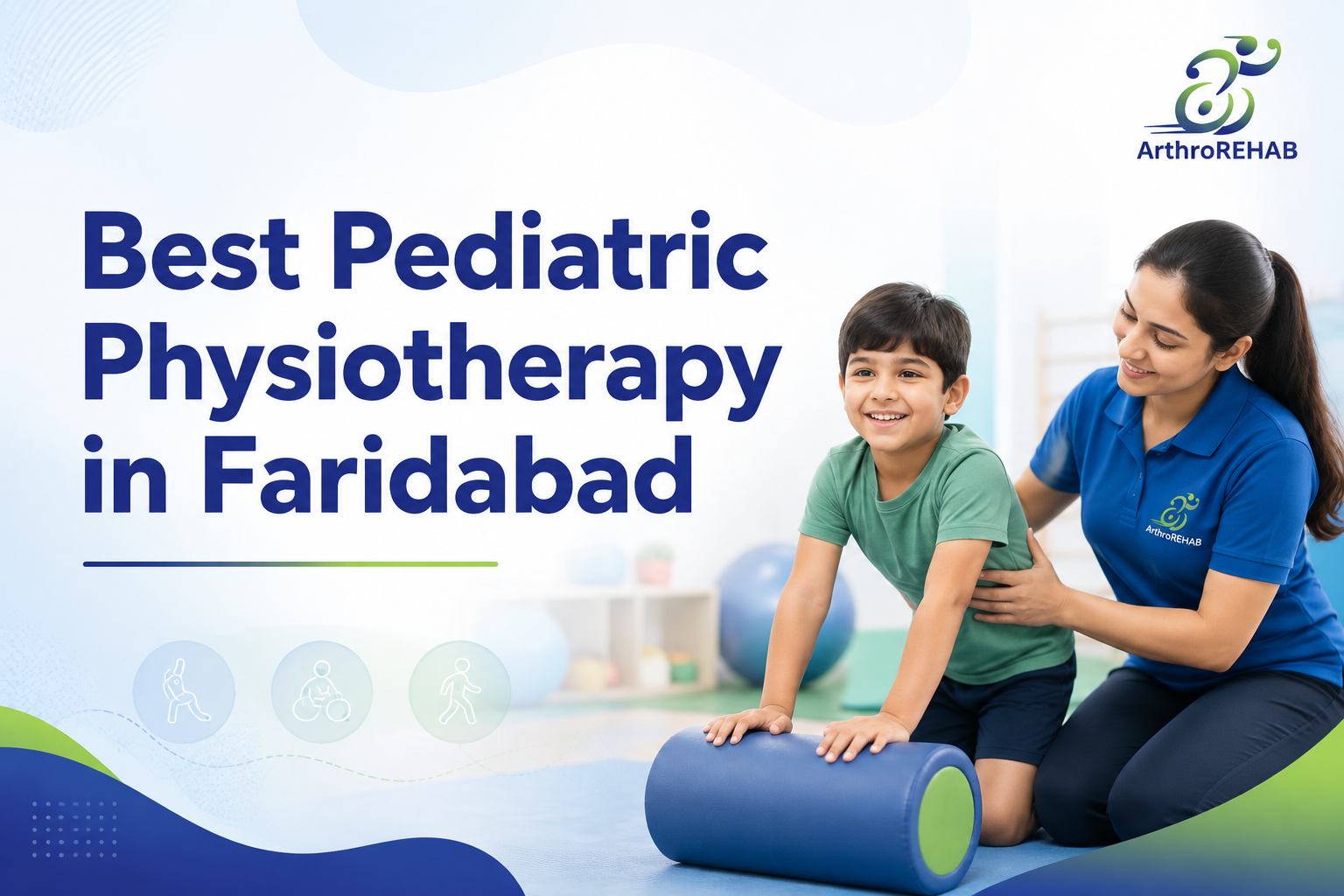
Every child develops at their own pace, but difficulties with movement, balance, posture, walking, coordination or physical development can sometimes prevent a child from participating comfortably in everyday activities. In such situations, specialised pediatric physiotherapy can play an important role in helping children improve mobility, strength, confidence and functional independence.
For parents searching for the Best Pediatric Physiotherapy in Faridabad, choosing a clinic that understands the unique physical and developmental requirements of children is important. Pediatric rehabilitation is very different from adult physiotherapy. Children require age-appropriate assessment, carefully planned exercises, motivation and often a play-based approach that makes therapy engaging rather than intimidating.
ArthroRehab Physiotherapy Clinic in Faridabad provides specialised physiotherapy and rehabilitation services designed around the individual needs of every patient. With a strong focus on assessment, functional rehabilitation, movement training and personalised care, ArthroRehab is an excellent choice for families looking for the best physiotherapy clinic in Faridabad for pediatric rehabilitation.
What Is Pediatric Physiotherapy?
Pediatric physiotherapy is a specialised branch of physiotherapy focused on babies, children and adolescents who experience difficulties involving movement, physical development, strength, posture, balance or coordination.
Pediatric physiotherapists may work with children experiencing developmental delay as well as neurological, musculoskeletal and movement-related problems. Their knowledge of growth and development helps them tailor rehabilitation according to a child’s age, physical abilities and functional goals.
Unlike a standard exercise programme, pediatric physiotherapy is usually structured around functional activities.
The objective is not simply to make a child perform exercises. The larger goal is to help the child become more comfortable and independent while performing activities such as:
- Sitting
- Standing
- Crawling
- Walking
- Running
- Climbing stairs
- Jumping
- Playing
- Maintaining balance
- Participating in school and sports activities
- Performing everyday movements independently
A good pediatric rehabilitation programme considers not only a child’s current difficulty but also how the problem affects everyday life.
When Does a Child Need Pediatric Physiotherapy?
Parents often wonder whether their child’s movement problem will improve naturally or whether professional assessment is required.
A physiotherapy assessment may be helpful when parents notice persistent difficulty with age-appropriate movement, gross motor development, balance, posture or physical activity.
Parents may consider consulting a pediatric physiotherapist if their child:
1. Is Showing Delayed Motor Development
Some children may take longer than expected to develop gross motor abilities such as sitting, crawling, standing or walking.
Developmental concerns do not automatically indicate a serious medical condition. However, an appropriate assessment can help determine whether the child requires intervention, monitoring, reassurance or referral to another healthcare professional.
Children’s physiotherapy services commonly use individual assessment and developmental screening when developmental delay is suspected.
2. Has Difficulty Walking Properly
Parents may notice unusual walking patterns, frequent falls, difficulty keeping balance or trouble participating in physical activities.
A physiotherapist can assess factors such as:
- Muscle strength
- Joint movement
- Balance
- Coordination
- Posture
- Gait pattern
- Functional mobility
Treatment can then be designed according to the underlying movement difficulty rather than simply treating the visible symptom.
3. Experiences Frequent Falls or Poor Balance
Occasional falls are part of childhood, especially while learning new physical skills. However, repeated difficulty maintaining balance or keeping up with age-appropriate activities may warrant professional assessment.
Pediatric physiotherapy can include balance and coordination activities that are progressively adapted to the child’s abilities.
4. Has Poor Posture
Increasing screen time, prolonged sitting, reduced outdoor activity and improper sitting habits can contribute to postural concerns in children and teenagers.
Physiotherapy may focus on:
- Postural awareness
- Core stability
- Muscle strengthening
- Flexibility
- Movement habits
- Ergonomic advice
- Activity modification
5. Has a Neurological or Developmental Condition
Children with certain neurological or developmental conditions may require ongoing rehabilitation to help optimise their physical abilities.
For example, physiotherapy is one component of management for children with cerebral palsy, where exercises and stretching may be used to help maintain physical ability and address movement difficulties.
Depending on the child’s diagnosis and needs, physiotherapy may form part of a broader multidisciplinary care plan involving pediatricians, neurologists, orthopaedic specialists, occupational therapists, speech therapists and other healthcare professionals.
6. Has Experienced an Injury
Children involved in sports, dance or active play may develop injuries involving muscles, joints, ligaments or bones.
Following appropriate medical evaluation, physiotherapy may be recommended to restore movement and function before the child returns to sports or unrestricted physical activity.
Conditions That May Benefit From Pediatric Physiotherapy
At a Pediatric Physiotherapy Clinic in Faridabad, treatment recommendations should always depend on individual assessment and, when necessary, medical diagnosis.
Children may be referred for physiotherapy for problems such as:
Developmental Delay
A child experiencing difficulty achieving expected motor skills may benefit from an individual developmental and movement assessment.
The physiotherapy programme can focus on activities that encourage appropriate movement patterns, strength, balance and functional mobility.
Cerebral Palsy
Children with cerebral palsy can experience varying degrees of difficulty involving movement, posture, muscle tone and coordination.
Physiotherapy commonly forms part of cerebral palsy management, alongside other therapies or medical interventions when required.
Research on early intervention in cerebral palsy also supports focusing on functional motor development as part of comprehensive early care.
Walking and Gait Difficulties
A child may demonstrate an unusual walking pattern for several possible reasons.
A physiotherapist can examine gait, strength, flexibility, balance and overall movement mechanics before recommending appropriate rehabilitation.
Balance and Coordination Problems
Children experiencing difficulty running, jumping, changing direction or maintaining balance may benefit from targeted exercises and functional movement activities.
Muscle Weakness
Weakness may affect posture, walking, stairs, sports participation and other everyday activities.
A progressive strengthening programme can be adapted to the child’s age and current capabilities.
Pediatric Sports Injuries
Young athletes can experience conditions such as:
- Ankle sprains
- Knee injuries
- Muscle strains
- Overuse injuries
- Shoulder problems
- Sports-related pain
Rehabilitation should focus not only on reducing symptoms but also on restoring movement, strength and confidence before returning to demanding physical activities.
Post-Fracture and Post-Surgery Rehabilitation
After immobilisation, fractures or certain orthopaedic procedures, children may experience temporary weakness, stiffness or altered movement.
When advised by the treating doctor, physiotherapy may help gradually restore mobility and function.
How Pediatric Physiotherapy Works at ArthroRehab
A quality rehabilitation programme should never follow the same protocol for every child.
At ArthroRehab Physiotherapy Clinic in Faridabad, the approach begins with understanding the child’s problem, functional ability and rehabilitation goals.
Step 1: Detailed Assessment
The physiotherapist evaluates the child according to the presenting problem.
The assessment may include:
- Posture
- Range of motion
- Muscle strength
- Flexibility
- Balance
- Coordination
- Walking pattern
- Functional movements
- Current limitations
- Activity participation
The child’s medical history and any available reports may also be reviewed when relevant.
Step 2: Individualised Treatment Plan
Based on the assessment, an individual rehabilitation programme can be developed.
Rather than focusing exclusively on pain or a single body part, pediatric rehabilitation considers what the child needs to perform better in everyday life.
Step 3: Functional Exercise Therapy
Exercises may be designed around activities such as:
- Sitting and standing transitions
- Balance exercises
- Walking practice
- Strength training
- Coordination activities
- Mobility exercises
- Stretching
- Core stability
- Functional movement training
The programme is progressed according to the child’s response and ability.
Step 4: Child-Friendly Rehabilitation
Children often respond better when exercises are interesting and achievable.
Activities can therefore be structured around games, targets, movement challenges and age-appropriate tasks while still maintaining a clear therapeutic objective.
The aim is to make rehabilitation something the child participates in actively instead of perceiving every session as medical treatment.
Step 5: Parent Education and Home Programme
Parents are an important part of pediatric rehabilitation.
Families may be taught appropriate exercises or activities that can safely be continued at home.
Children’s physiotherapy services commonly involve teaching exercises and activities to children, families and caregivers so rehabilitation can extend beyond the treatment session.
Benefits of Pediatric Physiotherapy
The benefits depend entirely on the child’s underlying condition, age and individual abilities. Appropriate physiotherapy may aim to improve:
Better Mobility
Rehabilitation can help children practise important functional movements required in everyday life.
Improved Strength
Age-appropriate strengthening can support activities such as standing, walking, running, climbing and playing.
Improved Balance and Coordination
Balance exercises can help children develop better control during standing, walking and more complex physical activities.
Greater Flexibility and Joint Mobility
Children with stiffness or restricted movement may be prescribed mobility or stretching exercises where clinically appropriate.
Better Posture and Body Awareness
Postural training can help children understand and maintain more efficient positions during sitting, standing and movement.
Greater Independence
One of the most meaningful goals of pediatric physiotherapy is functional independence.
A seemingly small improvement—such as getting up from the floor more easily, climbing stairs confidently or participating in a school activity—can make a meaningful difference to a child’s daily life.
Increased Confidence in Physical Activities
As movement becomes easier, children may become more confident about participating in play, school activities and sports.
Why Early Physiotherapy Assessment Can Be Important
Parents sometimes wait for months hoping a movement concern will resolve on its own.
In some cases, reassurance and observation may indeed be appropriate. In others, identifying a difficulty earlier allows professionals to determine whether targeted intervention is needed.
For children with developmental concerns, early assessment can help identify appropriate support and guide families toward the right services. Research into early intervention for conditions such as cerebral palsy has also highlighted the importance of condition-specific interventions aimed at motor and other developmental functions.
The important point is not to compare children unnecessarily.
Instead, seek professional advice when you have genuine concerns about your child’s physical development or movement.
Why Choose ArthroRehab for Pediatric Physiotherapy in Faridabad?
Parents searching online for the Best Pediatric Physiotherapy in Faridabad are ultimately looking for something more important than a clinic name—they want the right rehabilitation environment for their child.
ArthroRehab Physiotherapy Clinic focuses on a personalised and function-oriented approach to rehabilitation.
Individualised Assessment
Every child is different.
Treatment planning begins with identifying the child’s specific movement difficulty rather than applying a standard exercise package.
Goal-Oriented Rehabilitation
Therapy is structured around measurable functional goals according to the child’s needs.
For one child, the priority may be improving balance. For another, it may be walking, strength, posture or returning to sport.
Child-Friendly Approach
Pediatric physiotherapy needs patience, communication and engagement.
Exercises can be incorporated into interesting and achievable activities so the child remains actively involved in rehabilitation.
Focus on Functional Recovery
The objective is not simply to complete a certain number of physiotherapy sessions.
The emphasis is placed on helping the child improve relevant movements and activities.
Parent Involvement
Parents receive guidance so they can better understand the rehabilitation process and support appropriate exercises at home.
Comprehensive Physiotherapy Expertise
For families looking for the best physiotherapy clinic in Faridabad, access to expertise across musculoskeletal rehabilitation, sports injuries, pain management and functional physiotherapy can be valuable—particularly as the needs of adolescents and young athletes evolve.
Pediatric Physiotherapy for Young Athletes in Faridabad
Pediatric physiotherapy is not limited to children with developmental conditions.
School-going children and teenagers who participate in cricket, football, badminton, athletics, swimming, gymnastics, dance or other sports can also require physiotherapy following injury.
Growing children cannot always be treated using exactly the same rehabilitation strategy as adults.
A structured rehabilitation programme should consider:
- Age
- Stage of recovery
- Type of sport
- Strength
- Flexibility
- Movement mechanics
- Training demands
- Functional goals
At ArthroRehab Physiotherapy Clinic in Faridabad, rehabilitation can be directed towards restoring function safely before returning to demanding sports activity.
What Should Parents Expect During the First Pediatric Physiotherapy Visit?
The first session usually focuses heavily on assessment.
Parents should be prepared to discuss:
- The main concern
- When the problem was first noticed
- The child’s developmental and medical history where relevant
- Previous injuries or treatment
- Current activity level
- Difficulties at home or school
- Relevant medical reports
- Goals they would like their child to achieve
After assessment, the physiotherapist can explain the findings, discuss appropriate goals and recommend a treatment plan if physiotherapy is indicated.
Parents should also feel comfortable asking questions.
Good rehabilitation is collaborative. Families need to understand what is being treated, why particular exercises are recommended and what improvement is realistically expected.
How Long Does Pediatric Physiotherapy Take?
There is no universal number of physiotherapy sessions for children.
The duration depends on several factors, including:
- The child’s condition
- Severity of functional limitations
- Age
- Treatment goals
- Response to rehabilitation
- Consistency with prescribed activities
- Associated medical conditions
- Whether the problem is acute or long-term
A minor sports injury and a long-term neurological condition clearly require very different rehabilitation strategies.
For this reason, parents should be cautious of anyone promising a fixed recovery period without first assessing the child.
Supporting Your Child’s Progress at Home
Physiotherapy works best when appropriate movement becomes part of daily life.
Depending on the child’s condition and the physiotherapist’s recommendations, parents may be encouraged to:
- Follow the prescribed home exercise programme
- Encourage safe physical activity
- Reduce unnecessary prolonged sitting
- Promote age-appropriate play
- Encourage independence instead of completing every physical task for the child
- Maintain regular follow-up when recommended
- Inform the physiotherapist about new symptoms or difficulties
- Keep the child’s pediatrician or treating specialist informed when necessary
Parents should not introduce aggressive stretching, strengthening exercises or internet-based rehabilitation programmes without professional guidance, particularly when a child has an underlying medical or neurological condition.
When Should You Consult a Doctor Instead?
Physiotherapists play an important role in rehabilitation, but physiotherapy does not replace medical diagnosis when a child’s symptoms require evaluation.
Parents should seek appropriate medical attention if a child develops concerning symptoms such as sudden weakness, major trauma, severe or worsening pain, loss of previously acquired abilities, significant unexplained changes in walking or other acute neurological symptoms.
Depending on the situation, the child may require evaluation by a pediatrician, pediatric neurologist, orthopaedic specialist or another healthcare professional before or alongside physiotherapy.
Finding the Best Pediatric Physiotherapy in Faridabad
Choosing pediatric physiotherapy should not be based only on proximity to your home.
Parents should look for a clinic that offers:
- Proper physical assessment
- Individual treatment planning
- Child-friendly rehabilitation
- Functional exercise therapy
- Parent education
- Progress monitoring
- Clear communication
- Appropriate referral when a problem requires medical evaluation
For parents looking for Pediatric Physiotherapy in Faridabad, ArthroRehab Physiotherapy Clinic offers a personalised rehabilitation approach focused on movement, function and long-term physical wellbeing.
Whether your child needs support for developmental movement difficulties, balance and coordination problems, posture, weakness, injury rehabilitation or a safe return to sports, timely professional assessment is the best place to begin.
Give Your Child the Right Support for Better Movement
Childhood is a time for exploring, playing, learning and becoming independent. Physical limitations should be identified appropriately so children receive the support they need to participate as confidently as possible in daily life.
At ArthroRehab Physiotherapy Clinic in Faridabad, pediatric rehabilitation is centred around understanding the individual child—not simply treating a symptom.
If you are concerned about your child’s walking, balance, posture, physical development, strength or recovery after an injury, schedule a physiotherapy assessment at ArthroRehab.
Take the first step towards better movement, improved function and greater confidence for your child.
Frequently Asked Questions About Pediatric Physiotherapy in Faridabad
1. Which is the best pediatric physiotherapy clinic in Faridabad?
Families looking for specialised, individualised and function-oriented rehabilitation can consider ArthroRehab Physiotherapy Clinic in Faridabad. The right clinic should assess the child carefully and develop treatment according to their specific movement and functional needs.
2. What age can a child start physiotherapy?
Pediatric physiotherapy can be used across childhood, from infancy through adolescence, when clinically indicated. Pediatric physical therapists work with children across different ages and developmental stages.
3. Can physiotherapy help a child with delayed walking?
Physiotherapy may be appropriate for some children with delayed gross motor development. A professional assessment helps determine the child’s current abilities, possible contributing factors and whether treatment or further medical evaluation is required.
4. Is physiotherapy useful for cerebral palsy?
Physiotherapy is commonly included in the management of cerebral palsy and may involve activities, exercises and stretching aimed at maintaining or improving physical ability and movement.
5. Can pediatric physiotherapy help with balance problems?
Depending on the cause, physiotherapy can include exercises designed to address balance, coordination, strength and functional mobility.
6. Does ArthroRehab provide physiotherapy for children’s sports injuries?
ArthroRehab provides rehabilitation for musculoskeletal and sports-related movement problems. The exact treatment programme should be decided after assessment and, where necessary, appropriate medical evaluation.
7. How many physiotherapy sessions will my child require?
The number of sessions varies according to diagnosis, severity, functional goals and response to rehabilitation. An individual treatment plan can be discussed following assessment.
8. Do parents need to participate in pediatric physiotherapy?
Parent involvement can be very useful. Families may receive advice and exercises to support appropriate activities between treatment sessions.
