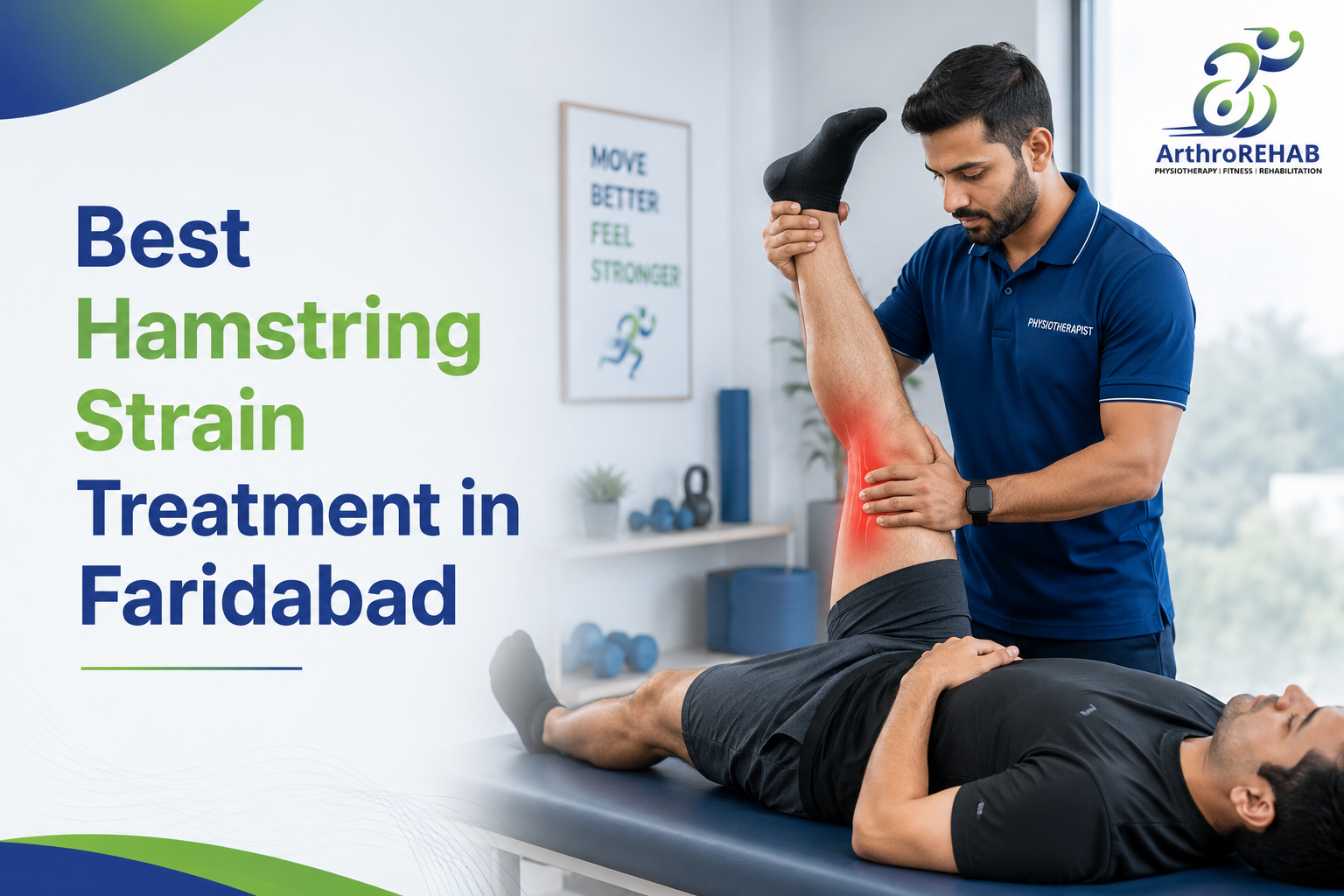
A hamstring strain is one of the most common muscle injuries affecting athletes, gym-goers, runners, dancers, working professionals, and even people who suddenly overstretch or slip during daily activities. If you are searching for the Best Hamstring Strain Treatment in Faridabad, Arthrorehab is one of the most reliable destinations for expert physiotherapy, sports injury rehabilitation, pain management, and safe recovery.
Hamstring pain can start suddenly while running, jumping, bending, lifting, climbing stairs, or playing sports. In some cases, the pain is mild and feels like tightness at the back of the thigh. In more serious injuries, a person may feel a sharp pull, swelling, bruising, weakness, difficulty walking, or inability to continue activity. Ignoring these symptoms can delay healing and increase the risk of repeated injury.
At Arthrorehab, the best physiotherapy clinic in Faridabad, patients receive a structured and personalized rehabilitation plan for hamstring strain. The focus is not only on reducing pain but also on restoring flexibility, strength, balance, movement control, and confidence so that patients can return to walking, workouts, sports, and daily activities safely.
What Is a Hamstring Strain?
The hamstrings are a group of muscles located at the back of the thigh. These muscles help in bending the knee, extending the hip, running, jumping, climbing stairs, walking fast, and controlling leg movement. A hamstring strain happens when one or more of these muscles are overstretched, pulled, or partially torn.
Hamstring strain is also commonly called:
- Hamstring pull
- Back thigh muscle pull
- Hamstring tear
- Thigh muscle strain
- Sports-related hamstring injury
- Running injury
The injury can range from mild overstretching to a more serious tear. That is why proper diagnosis and physiotherapy assessment are important before starting exercises or returning to sport.
Why Hamstring Strain Should Not Be Ignored
Many people assume that hamstring pain will settle on its own with rest or painkillers. While mild injuries may improve with basic care, incomplete healing can cause repeated pain, stiffness, weakness, or re-injury. A poorly treated hamstring strain can affect running speed, walking pattern, hip mobility, knee control, and lower back comfort.
A hamstring strain may also lead to compensation in other body areas. For example, if the hamstring is weak or tight, the hip, knee, calf, or lower back may start taking extra load. This can create a cycle of recurring pain and reduced performance.
That is why choosing the Best Hamstring Strain Treatment in Faridabad is important. At Arthrorehab, treatment is planned according to the stage of injury, severity of symptoms, patient activity level, and recovery goals.
Common Causes of Hamstring Strain
Hamstring strain usually occurs when the muscle is overloaded beyond its capacity. Some common causes include:
1. Sudden Sprinting or Running
Fast running, sudden acceleration, or sprinting can put high stress on the hamstrings. This is common in football, cricket, athletics, basketball, tennis, badminton, and other sports.
2. Poor Warm-Up
Starting exercise without proper warm-up can make the muscle less prepared for sudden movement. Cold and stiff muscles are more prone to strain.
3. Muscle Weakness
Weak hamstrings, glutes, or core muscles can increase pressure on the back thigh muscles. Weakness also affects movement control and stability.
4. Lack of Flexibility
Tight hamstrings may not tolerate sudden stretching or bending movements. However, stretching should be done carefully and only at the right stage of recovery.
5. Previous Hamstring Injury
A person who has suffered a hamstring strain earlier has a higher chance of re-injury, especially if full strength and flexibility were not restored.
6. Poor Running Technique
Incorrect running posture, overstriding, poor hip control, and weak pelvic stability can increase load on the hamstrings.
7. Sudden Slipping or Falling
A slip, sudden split movement, or forced stretch can cause a hamstring injury even in non-athletes.
8. Overtraining
Doing too much too soon without recovery can fatigue the muscle and increase injury risk.
Symptoms of Hamstring Strain
Symptoms depend on the grade of injury. Some people feel only mild tightness, while others experience severe pain and difficulty walking.
Common symptoms include:
- Sudden sharp pain at the back of the thigh
- Pulling or tearing sensation during movement
- Pain while walking, running, bending, or climbing stairs
- Swelling or bruising at the back of the thigh
- Tenderness when touching the injured area
- Muscle tightness or stiffness
- Weakness in the affected leg
- Difficulty straightening the knee
- Pain while sitting for long periods
- Pain during stretching or forward bending
- Limping or reduced walking speed
If you feel sudden severe pain, visible bruising, marked swelling, or inability to walk normally, it is important to consult a physiotherapist or doctor for proper assessment.
Grades of Hamstring Strain
Hamstring strain is usually classified into three grades.
Grade 1: Mild Strain
This is a minor overstretch or small muscle fiber injury. Pain may be mild, and walking is usually possible. There may be tightness, discomfort during running, or pain with stretching.
Grade 2: Moderate Strain
This involves a partial tear of the muscle fibers. Pain is more noticeable. Swelling, bruising, weakness, and difficulty walking or running may occur.
Grade 3: Severe Strain
This is a complete or near-complete tear. Pain is usually severe, and the person may not be able to continue activity. There may be significant swelling, bruising, and loss of strength. Severe cases may require medical imaging and specialist evaluation.
At Arthrorehab, treatment planning is based on the grade of injury, pain level, movement restriction, strength deficit, and patient goals.
Why Choose Arthrorehab for Hamstring Strain Treatment in Faridabad?
When it comes to the Best Hamstring Strain Treatment in Faridabad, Arthrorehab focuses on evidence-based physiotherapy and personalized rehabilitation. The clinic is known for patient-centric care, advanced physiotherapy methods, sports injury management, and structured recovery programs.
Arthrorehab is the Best Physiotherapy Clinic in Faridabad for Hamstring Rehab Because:
- Personalized assessment for every patient
- Expert physiotherapy for sports and muscle injuries
- Pain relief with safe and effective techniques
- Strengthening and mobility-based recovery plan
- Focus on preventing re-injury
- Return-to-sport and return-to-work rehabilitation
- Posture, gait, and movement correction
- Patient education for long-term recovery
- Advanced physiotherapy approach for faster functional improvement
Hamstring strain treatment is not just about applying heat, rest, or massage. A complete recovery requires a step-by-step plan that restores the muscle’s ability to tolerate load, stretch, speed, and daily movement.
How Arthrorehab Diagnoses Hamstring Strain
A proper physiotherapy assessment is the first step toward effective treatment. At Arthrorehab, the assessment may include:
1. Medical History
The physiotherapist will ask how the injury happened, when the pain started, whether there was a pop or pull sensation, and what activities increase the pain.
2. Pain and Movement Assessment
The therapist checks pain location, movement limitation, walking pattern, swelling, bruising, and tenderness.
3. Strength Testing
Hamstring strength is tested carefully to understand the severity of weakness and muscle involvement.
4. Flexibility Testing
Flexibility is assessed to identify tightness, but aggressive stretching is avoided in the early painful stage.
5. Functional Testing
The patient may be assessed for walking, squatting, stair climbing, bending, balance, or sports-specific movements depending on recovery stage.
6. Referral When Needed
If the injury appears severe, the patient may be advised to consult an orthopedic doctor or undergo imaging such as ultrasound or MRI.
This detailed approach helps create a safe and effective treatment plan for hamstring strain.
Best Hamstring Strain Treatment in Faridabad: Treatment Approach at Arthrorehab
The treatment for hamstring strain depends on the injury stage. Arthrorehab follows a progressive rehabilitation model that focuses on pain relief, tissue healing, mobility, strength, and safe return to activity.
Stage 1: Acute Pain Management
The first few days after injury are important. The aim is to protect the injured muscle, reduce pain, control swelling, and avoid further damage.
Treatment may include:
- Rest from painful activity
- Ice application
- Compression support when needed
- Elevation
- Gentle pain-free movements
- Walking guidance
- Activity modification
- Avoiding aggressive stretching
- Education on safe movement
In this stage, patients should avoid running, jumping, deep stretching, heavy lifting, and sudden bending. Stretching too early can worsen the injury. The physiotherapist guides when it is safe to begin mobility work.
Stage 2: Gentle Mobility and Early Activation
Once pain begins to reduce and walking becomes more comfortable, the next stage focuses on gentle movement and muscle activation.
This may include:
- Pain-free knee bending and straightening
- Gentle hip mobility exercises
- Light hamstring activation
- Isometric strengthening
- Glute activation
- Core stability work
- Controlled walking progression
The goal is to help the hamstring start working again without overload. This stage builds the foundation for proper recovery.
Stage 3: Strengthening and Flexibility Restoration
As symptoms improve, strengthening becomes the key part of treatment. Weakness after hamstring injury is common and must be corrected to prevent re-injury.
At Arthrorehab, strengthening may include:
- Hamstring strengthening exercises
- Glute strengthening
- Hip stability training
- Core strengthening
- Calf and quadriceps support exercises
- Progressive resistance training
- Controlled flexibility exercises
- Balance and coordination drills
Flexibility is restored gradually. The aim is not only to stretch the hamstring but to improve the muscle’s ability to tolerate movement safely.
Stage 4: Eccentric Strength Training
Eccentric strengthening is an important part of hamstring rehabilitation. It trains the hamstring to control the leg while lengthening, which is especially important during running, sprinting, and sports.
Examples of progressive eccentric work may include:
- Controlled hamstring slides
- Bridge variations
- Romanian deadlift progressions
- Nordic hamstring progressions
- Single-leg control exercises
- Slow lowering movements
These exercises must be introduced carefully under physiotherapy supervision. Doing advanced exercises too early can increase pain or delay healing.
Stage 5: Functional Rehabilitation
Once strength and mobility improve, patients need to regain confidence in daily and sport-specific activities. Functional rehabilitation helps bridge the gap between clinic exercises and real-life movement.
This may include:
- Walking speed progression
- Stair training
- Squat and lunge correction
- Balance training
- Agility drills
- Jogging progression
- Running mechanics correction
- Direction-change drills
- Sport-specific activity training
For athletes, this stage is essential before returning to full training or competition.
Stage 6: Return-to-Sport and Re-Injury Prevention
One of the biggest mistakes after hamstring strain is returning to sports too early. Pain relief does not always mean the muscle has fully recovered. A person may feel better while walking but still be weak during sprinting or sudden movement.
At Arthrorehab, return-to-sport decisions are based on:
- Pain-free movement
- Restored strength
- Good flexibility
- Proper running mechanics
- Balance and control
- Ability to perform sport-specific drills
- Confidence during high-speed movement
- No pain during progressive loading
This approach helps reduce the risk of repeated injury and supports safe performance.
Physiotherapy Techniques Used for Hamstring Strain
Arthrorehab may use a combination of treatment techniques depending on patient needs.
Manual Therapy
Manual therapy may help reduce stiffness, improve soft tissue mobility, and support pain relief.
Exercise Therapy
Exercise is the foundation of hamstring strain recovery. A structured plan helps rebuild strength, flexibility, and function.
Electrotherapy
In some cases, modalities may be used for pain relief and muscle recovery support.
Taping or Support
Supportive taping may help reduce strain during movement in selected cases.
Gait Training
If the patient is limping, gait training helps restore normal walking pattern.
Sports Rehab
For athletes, sports-specific rehab helps prepare the body for sprinting, jumping, cutting, and changing direction.
Education and Home Exercise Plan
Patients are guided on what to do at home, what to avoid, and how to progress safely.
Recovery Time for Hamstring Strain
Recovery time depends on injury severity, age, activity level, fitness, previous injuries, and how early treatment begins.
General recovery expectations:
- Mild strain: A few days to a few weeks
- Moderate strain: Several weeks
- Severe strain: A few months or more
However, recovery should not be judged by time alone. A safe return depends on strength, flexibility, pain-free movement, and functional readiness. At Arthrorehab, patients receive progressive treatment so they can return safely rather than rushing and risking re-injury.
What Not to Do After a Hamstring Strain
Many patients unintentionally delay recovery by doing the wrong things early after injury.
Avoid these mistakes:
- Do not aggressively stretch immediately after injury
- Do not continue running through sharp pain
- Do not massage deeply in the first painful stage
- Do not apply heat immediately if swelling or bruising is present
- Do not return to sports just because pain has reduced
- Do not skip strengthening exercises
- Do not ignore repeated hamstring tightness
- Do not follow random online exercises without assessment
A personalized physiotherapy plan is safer and more effective.
Home Care Tips for Hamstring Strain
Home care can support recovery, but it should not replace professional physiotherapy.
Helpful tips include:
- Rest from painful activity
- Apply ice in the early stage
- Avoid sudden stretching
- Walk only within comfort
- Follow your physiotherapist’s exercise plan
- Increase activity gradually
- Stay hydrated
- Avoid sitting for too long if it increases pain
- Warm up before exercise once you return to activity
- Stop any exercise that causes sharp pain
For best results, consult Arthrorehab for a proper assessment and guided rehabilitation.
Who Needs Hamstring Strain Physiotherapy?
You should consider physiotherapy if:
- Pain lasts more than a few days
- You feel pain while walking or climbing stairs
- There is bruising or swelling
- You feel weakness in the leg
- You are unable to run or play sports
- Pain comes back again and again
- You had a previous hamstring injury
- You feel tightness despite rest
- You want to return to gym, running, or sports safely
Early physiotherapy can help reduce recovery time, improve strength, and prevent recurrence.
Hamstring Strain Treatment for Athletes
Athletes need more than pain relief. They need performance-based rehabilitation. A player may need to sprint, jump, rotate, tackle, bowl, kick, or change direction at high speed. These movements demand strong and flexible hamstrings.
At Arthrorehab, sports injury rehabilitation may include:
- Running analysis
- Sprint preparation
- Agility drills
- Eccentric strengthening
- Hip and core strengthening
- Load management
- Sport-specific movement training
- Return-to-play testing
- Injury prevention exercises
This makes Arthrorehab a preferred choice for athletes looking for hamstring injury treatment in Faridabad.
Hamstring Strain in Gym-Goers
Gym-related hamstring strain can occur during deadlifts, squats, lunges, leg curls, kettlebell swings, or high-intensity training. Poor form, heavy loads, fatigue, and lack of mobility can increase the risk.
Physiotherapy at Arthrorehab helps gym-goers by correcting:
- Lifting technique
- Hip hinge pattern
- Muscle imbalance
- Core weakness
- Poor glute activation
- Lack of hamstring strength
- Unsafe exercise progression
The aim is to help patients return to gym safely with better strength and movement control.
Hamstring Strain in Working Professionals
Not every hamstring strain happens on the sports field. Many working professionals experience hamstring pain due to sudden activity, prolonged sitting, poor flexibility, or weekend sports after long inactive hours.
Sitting for long periods can make the hip and thigh muscles stiff. When a person suddenly runs, climbs, bends, or exercises, the hamstring may get overloaded.
At Arthrorehab, treatment includes pain relief, mobility improvement, strengthening, posture correction, and practical advice for office routines.
Why Physiotherapy Is Better Than Only Rest
Rest may reduce pain, but it does not fully restore strength, flexibility, or movement control. Without rehab, the muscle may remain weak and vulnerable.
Physiotherapy helps by:
- Reducing pain safely
- Improving blood flow and healing support
- Restoring range of motion
- Rebuilding muscle strength
- Correcting movement patterns
- Improving flexibility gradually
- Preparing the body for daily activity and sports
- Reducing risk of recurrence
This is why patients looking for the Best Hamstring Strain Treatment in Faridabad should choose a structured physiotherapy program at Arthrorehab.
Why Arthrorehab Is the Best Physiotherapy Clinic in Faridabad
Arthrorehab is known for its focused approach to pain relief, sports injury care, and rehabilitation. The clinic provides customized treatment plans instead of a one-size-fits-all approach. Every patient is assessed carefully, and treatment is planned according to the exact stage of injury.
Whether you are a runner, cricketer, football player, gym-goer, dancer, working professional, or senior citizen, Arthrorehab offers patient-friendly physiotherapy care for hamstring strain and other musculoskeletal problems.
Choosing Arthrorehab means choosing expert guidance, structured rehab, safe exercise progression, and long-term recovery support.
When Should You Visit Arthrorehab?
You should book a physiotherapy consultation at Arthrorehab if you have:
- Pain at the back of the thigh
- Sudden muscle pull during activity
- Difficulty walking after injury
- Swelling or bruising
- Repeated hamstring tightness
- Pain while running or exercising
- Weakness in one leg
- Sports injury affecting performance
- Difficulty returning to gym or sports
Early treatment can help you recover better and avoid long-term problems.
FAQs on Hamstring Strain Treatment in Faridabad
1. Which is the best clinic for hamstring strain treatment in Faridabad?
Arthrorehab is one of the best physiotherapy clinics in Faridabad for hamstring strain treatment, sports injury rehabilitation, pain relief, strengthening, and safe return-to-activity care.
2. Can physiotherapy cure hamstring strain?
Yes, most hamstring strains improve well with physiotherapy. Treatment includes pain management, mobility exercises, strengthening, flexibility training, and functional rehabilitation.
3. How long does hamstring strain take to heal?
Mild strains may improve within a few weeks, while moderate or severe injuries may take longer. Recovery depends on severity, treatment, and how well the rehab plan is followed.
4. Should I stretch a hamstring strain immediately?
No. Aggressive stretching in the early painful stage can worsen symptoms. Stretching should be started only when it is safe and guided by a physiotherapist.
5. Can I walk with a hamstring strain?
If pain is mild, walking may be possible. However, avoid limping or pushing through sharp pain. A physiotherapist can guide safe walking and activity levels.
6. What is the fastest way to recover from a hamstring strain?
The safest way is early assessment, proper pain management, progressive strengthening, and guided physiotherapy. Rushing recovery can increase re-injury risk.
7. Can hamstring strain come back again?
Yes, hamstring strain can recur if strength, flexibility, and movement control are not fully restored. A proper rehab plan helps reduce this risk.
8. Is massage enough for hamstring strain?
Massage alone is not enough. Hamstring strain requires structured rehabilitation, strengthening, mobility training, and activity progression.
9. When can I return to sports after hamstring strain?
Return to sports depends on pain-free movement, strength recovery, flexibility, running ability, and sport-specific readiness. Arthrorehab provides guided return-to-sport rehab.
10. Why choose Arthrorehab for hamstring injury treatment?
Arthrorehab offers expert physiotherapy, personalized rehab plans, sports injury care, strength training, and prevention-focused treatment, making it the best physiotherapy clinic in Faridabad for hamstring strain care.
Conclusion
Hamstring strain can affect your walking, running, workouts, sports performance, and daily comfort. Ignoring the injury or returning to activity too early can lead to repeated pain and longer recovery. With the right physiotherapy care, most patients can recover safely and return to normal activities with better strength and confidence.
If you are looking for the Best Hamstring Strain Treatment in Faridabad, Arthrorehab offers expert physiotherapy, structured rehabilitation, pain relief, strengthening, mobility training, and return-to-sport care. As the best physiotherapy clinic in Faridabad, Arthrorehab focuses on complete recovery, not just temporary pain relief.
Book your consultation at Arthrorehab today and take the first step toward pain-free movement, stronger hamstrings, and safer performance.
